Detecting Gravitational Waves: A Journey into Spacetime

Introduction: Unveiling the Invisible Universe with Gravitational Waves
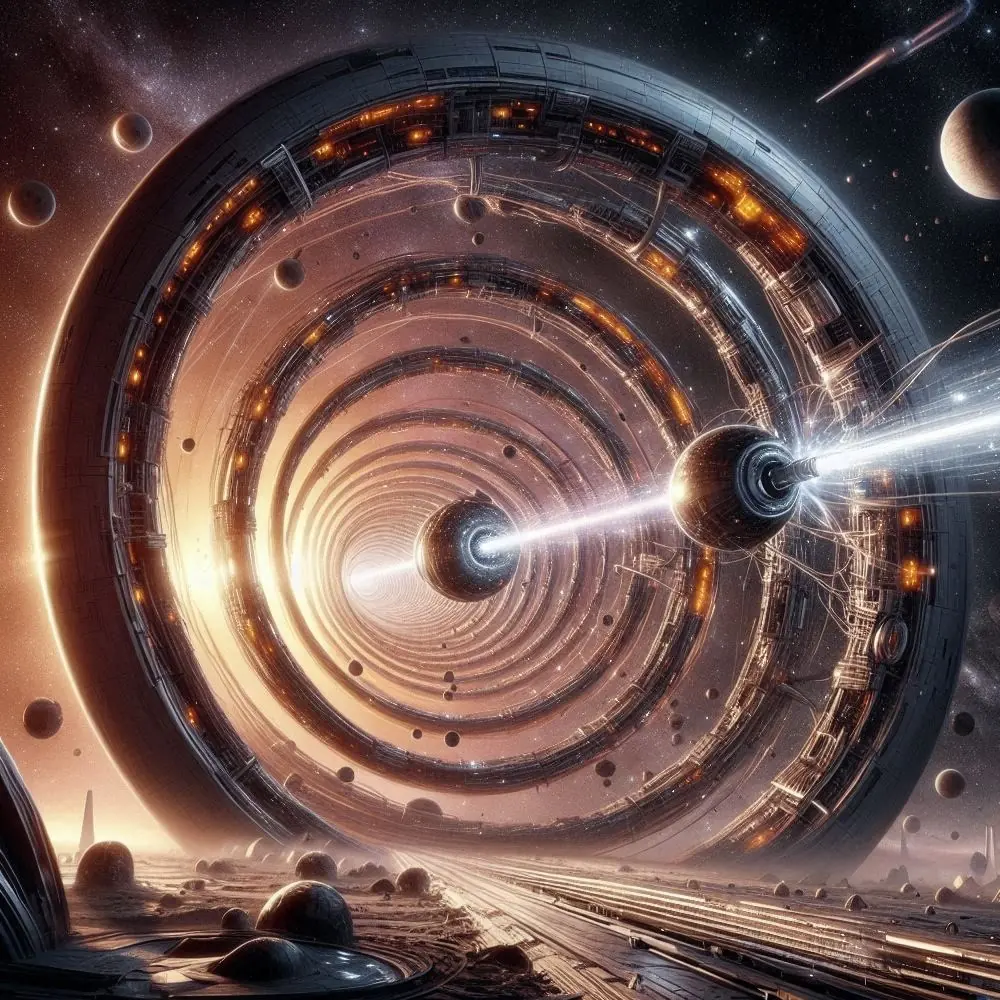
The universe communicates through a variety of messengers, with light being the most familiar to humanity. However, the cosmos also whispers its secrets through gravitational waves, invisible ripples in the fabric of spacetime itself.1 These waves, caused by massive objects undergoing acceleration or exhibiting some form of asymmetry in their movement, propagate across the universe at the speed of light, carrying with them invaluable information about their origins.1 Albert Einstein, over a century ago, first predicted the existence of these elusive phenomena as a consequence of his groundbreaking theory of general relativity.2 The subsequent detection of gravitational waves has opened an entirely new window through which to observe the universe, providing a unique perspective that transcends the limitations of the electromagnetic spectrum.2
Gravitational waves serve as a distinctive messenger, enabling the study of some of the most violent and energetic events in the cosmos, such as the collision of black holes and neutron stars, as well as the explosive deaths of stars.2 These waves offer the potential to reveal fundamental properties of gravity and to illuminate the intricate structure and evolution of the universe in ways that light alone cannot.2 This report aims to provide a comprehensive exploration of gravitational wave detection, encompassing the underlying theory, the historical pursuit of their discovery, the operational principles of the advanced detectors that have made their observation possible, a review of the significant astrophysical insights gained, the inherent challenges in this burgeoning field, and an outlook on the exciting future of gravitational wave astronomy.
The Theoretical Underpinning: Gravitational Waves in Einstein's General Relativity
Einstein's theory of general relativity revolutionized our understanding of gravity, describing it not as a force acting between objects, but as a manifestation of the curvature of spacetime caused by the presence of mass and energy.2 According to this theory, massive objects warp the fabric of spacetime, creating a "dent" or curvature in its geometry.2 When these massive objects accelerate through spacetime, they generate ripples in this curvature, which propagate outward as gravitational waves.2
These gravitational waves possess several key properties as predicted by general relativity.2 Notably, they travel at the speed of light, a fundamental constant of the universe.2 As they propagate, gravitational waves carry energy and momentum away from their source.2 The strength or amplitude of these waves diminishes as they travel farther from the event that produced them.5 A crucial characteristic of gravitational waves is their effect on spacetime: as a wave passes, it causes a stretching of space in one direction and a squeezing in the perpendicular direction.3 This rhythmic distortion is what gravitational wave detectors are designed to measure. Furthermore, the theory describes gravitational waves as a form of gravitational radiation, akin to how electromagnetic waves are a form of electromagnetic radiation.7
A Century of Pursuit: The History of Gravitational Wave Detection
The concept of gravitational waves predates Einstein's work, with early theoretical considerations by Oliver Heaviside in 1893 and Henri Poincaré in 1905.7 However, it was Einstein who, in 1916, firmly established their existence within the framework of general relativity.7 Initially, even Einstein himself harbored skepticism about the possibility of ever detecting these waves, believing their interaction with matter would be too weak to measure directly.7
The first significant experimental efforts to detect gravitational waves were spearheaded by Joseph Weber in the 1960s.83 Weber pioneered the construction of the first resonant-mass antennas, known as Weber bars, which were large aluminum cylinders designed to vibrate at their resonant frequency upon the passage of a gravitational wave.95 In 1969, Weber claimed to have detected gravitational waves, a declaration that ignited great excitement within the scientific community.7 However, subsequent attempts by other experimental groups to replicate Weber's results yielded no confirmation, leading to controversy and ultimately the discrediting of his findings.7 Despite this, Weber's pioneering work is widely regarded as having laid the foundation for the field of experimental gravitational wave detection.95
The first indirect evidence for the existence of gravitational waves emerged in 1974 from the groundbreaking observations of the Hulse-Taylor binary pulsar.7 Astronomers Russell Hulse and Joseph Taylor discovered a binary system composed of a pulsar orbiting a neutron star and found that the orbital period of this system was gradually decreasing at a rate that precisely matched the predictions of general relativity if the system were losing energy through the emission of gravitational radiation.7 This discovery provided compelling support for the existence of gravitational waves and earned Hulse and Taylor the Nobel Prize in Physics in 1993.7 The success of the Hulse-Taylor experiment spurred further research into more sensitive methods for directly detecting these elusive waves, leading to the development of laser interferometry as a promising technique.3
The Dawn of Direct Detection: Advanced Interferometric Observatories
The direct detection of gravitational waves became a reality with the advent of highly sensitive laser interferometric observatories. These instruments, employing precise measurements of spacetime distortions, have ushered in a new era of astrophysical discovery.
Principles of Laser Interferometry for Gravitational Wave Detection
The fundamental principle behind the detection of gravitational waves using laser interferometry involves measuring the minuscule changes in the relative lengths of the arms of an interferometer caused by the passage of a gravitational wave.3 These detectors typically employ a Michelson interferometer configuration, which consists of two long, perpendicular arms of equal length.3 A passing gravitational wave causes a differential change in the length of these arms: one arm is stretched while the other is squeezed.3 This change in length is detected by precisely measuring the interference pattern of laser beams that have traveled down each arm and recombined.3 The magnitude of these changes is incredibly small, requiring detectors with extreme sensitivity to measure them.3 To achieve this sensitivity, advanced interferometers employ high-power lasers with extremely stable frequencies 7, ultra-high vacuum systems to minimize interference 7, and sophisticated vibration isolation systems to minimize terrestrial noise.7
The Global Network: Current Gravitational Wave Observatories
A network of advanced gravitational wave observatories across the globe is crucial for detecting and localizing gravitational wave sources. These observatories work collaboratively to provide a more comprehensive view of the gravitational universe.
-
LIGO: Pioneering Ground-Based Detection 3 The Laser Interferometer Gravitational-Wave Observatory (LIGO) in the United States was the first to directly detect gravitational waves, marking a pivotal moment in the field.3 It consists of two identical detectors located 3000 kilometers apart, one in Hanford, Washington, and the other in Livingston, Louisiana.111 LIGO is a national facility for gravitational wave research, providing opportunities for the broader scientific community to participate in detector development, observation, and data analysis.207 The initial detection in September 2015 confirmed a major prediction of Einstein's theory and opened an unprecedented new window onto the cosmos.107
-
Virgo: Expanding the European Contribution 4 Located near Pisa, Italy, Virgo is a gravitational wave interferometer with 3km long arms 7, operated by the European Gravitational Observatory (EGO).7 Virgo joined the LIGO detectors in August 2017 and contributed to the first joint observation of a gravitational wave signal from a black hole merger.108
-
KAGRA: Cryogenic Technology in an Underground Observatory 7 The Kamioka Gravitational Wave Detector (KAGRA) in Japan is a 3km interferometer located underground in the Kamioka mine.7 Its underground location helps to reduce seismic noise, and it utilizes cryogenic mirrors to minimize thermal noise, setting it apart from other ground-based detectors.7
-
GEO600: Advancing Detector Technology 7 Located near Hannover, Germany, GEO600 is a German-British detector with 600m long arms.7 While shorter than LIGO and Virgo, GEO600 has served as an important testbed for developing and implementing advanced detector technologies that have been crucial for enhancing the sensitivity of the larger observatories.370
These observatories operate collaboratively as the LIGO-Virgo-KAGRA (LVK) collaboration, sharing data and jointly analyzing signals to increase the confidence in detections, improve the sensitivity to weaker and more distant sources, and achieve more precise measurements of source parameters, particularly their location in the sky.342
Landmark Discoveries: A New Era of Astrophysical Insights
The direct detection of gravitational waves has ushered in a new era of astrophysical exploration, providing unprecedented insights into some of the most extreme phenomena in the universe.
-
Merging Black Holes: Unveiling the Universe's Dark Giants 3 The majority of gravitational wave detections to date have been from the mergers of binary black hole systems.272 These events, involving black holes with masses ranging from a few to tens of times that of our Sun, release tremendous amounts of energy in the form of gravitational waves.2 The first detection, GW150914 in 2015, involved two black holes with masses of approximately 36 and 29 solar masses merging to form a single, more massive black hole.14 Subsequent detections have revealed a diverse population of black holes, including some with unexpected masses and spins, challenging existing astrophysical models of black hole formation and evolution.272 The study of these mergers allows for precision tests of general relativity in the strong-field regime and provides insights into the dynamics of spacetime itself.4
-
Neutron Star Collisions: Illuminating the Origin of Heavy Elements 4 The first direct detection of gravitational waves from the collision of two neutron stars, GW170817 in 2017, marked a significant milestone in multi-messenger astronomy [12
Works cited
- www.nasa.gov, accessed May 13, 2025, https://www.nasa.gov/podcasts/curious-universe/the-invisible-world-of-gravitational-waves/#:~:text=A%20gravitational%20wave%20is%20a%20ripple%20in%20spacetime%20itself%20that,has%20some%20asymmetry%20to%20it.
- The Invisible World of Gravitational Waves - NASA, accessed May 13, 2025, https://www.nasa.gov/podcasts/curious-universe/the-invisible-world-of-gravitational-waves/
- What Is a Gravitational Wave? | NASA Space Place, accessed May 13, 2025, https://spaceplace.nasa.gov/gravitational-waves/
- Hubble Gravity Waves - NASA Science, accessed May 13, 2025, https://science.nasa.gov/mission/hubble/science/science-behind-the-discoveries/hubble-gravity-waves/
- Gravitational Waves - Introduction - Imagine the Universe!, accessed May 13, 2025, https://imagine.gsfc.nasa.gov/science/toolbox/gwaves1.html
- Gravitational Waves vs. Gravity Waves: Know the Difference! - Space, accessed May 13, 2025, https://www.space.com/31879-gravitational-waves-vs-gravity-waves.html
- Gravitational wave - Wikipedia, accessed May 13, 2025, https://en.wikipedia.org/wiki/Gravitational_wave
- All About Gravitational Waves | LIGO Lab | Caltech, accessed May 13, 2025, https://www.ligo.caltech.edu/page/gravitational-waves
- Dropping In With Gravitational Waves – Science Lesson | NASA JPL Education, accessed May 13, 2025, https://www.jpl.nasa.gov/edu/resources/lesson-plan/dropping-in-with-gravitational-waves/
- Kip Thorne (BS '62) Explains the Power of Gravitational Waves - Caltech Magazine, accessed May 13, 2025, https://magazine.caltech.edu/post/kip-thorne-video-black-hole-gravitational-waves
- Hubble Science: Gravitational Waves: Ripples In Space-Time - NASA SVS, accessed May 13, 2025, https://svs.gsfc.nasa.gov/14358/
- What are Gravitational Waves? | LIGO Lab | Caltech, accessed May 13, 2025, https://www.ligo.caltech.edu/page/what-are-gw
- What are gravitational waves? - Space, accessed May 13, 2025, https://www.space.com/25088-gravitational-waves.html
- Gravitational Waves Detected for the First Time – Teachable Moment | NASA JPL Education, accessed May 13, 2025, https://www.jpl.nasa.gov/edu/resources/teachable-moment/gravitational-waves-detected-for-the-first-time/
- Gravitational Waves Through Time: Scientific Significance, Detection Techniques, and Recent Breakthroughs - arXiv, accessed May 13, 2025, https://arxiv.org/html/2312.16198v1
- (Feb. 11, 2016) In Historic First, Einstein's Gravitational Waves Detected Directly - Space, accessed May 13, 2025, https://www.space.com/31900-gravitational-waves-discovery-ligo.html
- web.mit.edu, accessed May 13, 2025, http://web.mit.edu/klmitch/classes/8.224/project/ligo.html#:~:text=How%20do%20interferometers%20detect%20gravitational,light%20sent%20along%20the%20arms.
- Detection of Gravitational Waves by Interferometry - MIT, accessed May 13, 2025, http://web.mit.edu/klmitch/classes/8.224/project/ligo.html
- How The Laser Interferometer Gravitational-Wave Observatory Detects Gravitational Waves | SYFY WIRE - YouTube, accessed May 13, 2025, https://www.youtube.com/watch?v=DfVl6sBnu7Y
- Detecting Gravitational Waves with Advanced Virgo - MDPI, accessed May 13, 2025, https://www.mdpi.com/2075-4434/10/1/28
- Detector - Virgo Collaboration, accessed May 13, 2025, https://www.virgo-gw.eu/science/detector/
- Control of the gravitational wave interferometric detector Advanced Virgo, accessed May 13, 2025, https://indico.in2p3.fr/event/16330/contributions/55575/subcontributions/4062/attachments/45169/56123/JuliaCasanueva.pdf
- A primer on LIGO and Virgo gravitational wave detectors, accessed May 13, 2025, https://dcc.ligo.org/public/0160/G1900761/001/Lecture_notes_Jo_van_den_Brand_v7.pdf
- Neutron star collision offers new source of gravitational waves | PBS News, accessed May 13, 2025, https://www.pbs.org/newshour/science/neutron-star-collision-offers-new-source-gravitational-waves
- Gravitational Waves Detected from Neutron-Star Crashes: The Discovery Explained - Space, accessed May 13, 2025, https://www.space.com/38471-gravitational-waves-neutron-star-crashes-discovery-explained.html
- Researchers advance detection of gravitational waves to study collisions of neutron stars and black holes | ScienceDaily, accessed May 13, 2025, https://www.sciencedaily.com/releases/2024/04/240426110014.htm
- WVU astronomer hunts gravitational waves by observing their stretching and squeezing of spacetime, accessed May 13, 2025, https://wvutoday.wvu.edu/stories/2024/09/09/wvu-astronomer-hunts-gravitational-waves-by-observing-their-stretching-and-squeezing-of-spacetime
- A Chorus of Gravitational Waves Emerging from the Milky Way Core: Will We Ever Hear Them? - The Daily Galaxy, accessed May 13, 2025, https://dailygalaxy.com/2025/05/a-chorus-of-gravitational-waves-milky-way/
- Guide to Gravitational Waves | astrobites, accessed May 13, 2025, https://astrobites.org/2023/11/08/guide-to-gravitational-waves/
- An Intro to Gravitational-Wave Astronomy - UChicago Data Science Institute, accessed May 13, 2025, https://datascience.uchicago.edu/insights/an-intro-to-gravitational-wave-astronomy/
- Graph Interpretation of Gravitational Waves - Physics Stack Exchange, accessed May 13, 2025, https://physics.stackexchange.com/questions/645423/graph-interpretation-of-gravitational-waves
- False positives for gravitational lensing: the gravitational-wave perspective - arXiv, accessed May 13, 2025, https://arxiv.org/html/2407.12974v1
- False positives in gravitational wave campaigns: the electromagnetic perspective | Philosophical Transactions of the Royal Society A: Mathematical, Physical and Engineering Sciences, accessed May 13, 2025, https://royalsocietypublishing.org/doi/10.1098/rsta.2024.0120
- False positives in gravitational wave campaigns: the electromagnetic perspective - PubMed, accessed May 13, 2025, https://pubmed.ncbi.nlm.nih.gov/40205868/
- False positives in gravitational wave campaigns: the electromagnetic perspective - INSPIRE, accessed May 13, 2025, https://inspirehep.net/literature/2918094
- Enhancing high frequency sensitivity of gravitational wave detectors with sloshing-Sagnac interferometer - arXiv, accessed May 13, 2025, https://arxiv.org/pdf/2109.11437
- Limits on the sensitivity of spherical gravitational wave detectors and on the accuracy of reconstructed signals | Phys. Rev. D - Physical Review Link Manager, accessed May 13, 2025, https://link.aps.org/doi/10.1103/PhysRevD.56.564
- Exploring the sensitivity of next generation gravitational wave detectors - Carleton College, accessed May 13, 2025, https://people.carleton.edu/~nchriste/Abbott_2017_Class._Quantum_Grav._34_044001.pdf
- news.ucr.edu, accessed May 13, 2025, https://news.ucr.edu/articles/2025/02/14/new-technology-enhances-gravitational-wave-detection#:~:text=Cosmic%20Explorer%20is%20the%20U.S.,largest%20scientific%20instrument%20ever%20built.
- Gravitational-wave observatory - Wikipedia, accessed May 13, 2025, https://en.wikipedia.org/wiki/Gravitational-wave_observatory
- New technology enhances gravitational-wave detection | UCR News | UC Riverside, accessed May 13, 2025, https://news.ucr.edu/articles/2025/02/14/new-technology-enhances-gravitational-wave-detection
- Third-generation gravitational-wave detectors - Einstein-Online, accessed May 13, 2025, https://www.einstein-online.info/en/spotlight/3-generation-gw-detectors/
- Einstein Telescope in brief, accessed May 13, 2025, https://www.einsteintelescope-emr.eu/en/einstein-telescope-in-brief/
- Einstein Telescope - Wikipedia, accessed May 13, 2025, https://en.wikipedia.org/wiki/Einstein_Telescope
- The Science of ET - Einstein Telescope Italia, accessed May 13, 2025, https://www.einstein-telescope.it/en/the-science-of-et/
- Einstein Telescope, accessed May 13, 2025, https://www.et-gw.eu/
- Einstein telescope, accessed May 13, 2025, https://www.einstein-online.info/en/explandict/einstein-telescope/
- A new window on the Universe - Einstein Telescope, accessed May 13, 2025, https://www.einsteintelescope-emr.eu/en/
- About Cosmic Explorer - gravitationalwaves - Syracuse University, accessed May 13, 2025, https://gravitationalwaves.syracuse.edu/about/
- Cosmic Explorer (gravitational wave observatory) - Wikipedia, accessed May 13, 2025, https://en.wikipedia.org/wiki/Cosmic_Explorer_(gravitational_wave_observatory)
- Cosmic Explorer, accessed May 13, 2025, https://cosmicexplorer.org/
- Cosmic Explorer - Einstein-Online, accessed May 13, 2025, https://www.einstein-online.info/en/explandict/cosmic-explorer/
- Cosmic Explorer - gravitationalwaves - Syracuse University, accessed May 13, 2025, https://gravitationalwaves.syracuse.edu/cosmic-explorer/
- Cosmic Explorer | NORC at the University of Chicago, accessed May 13, 2025, https://www.norc.org/research/projects/cosmic-explorer.html
- Cosmic Explorer: A Next-Generation Ground-Based Gravitational-Wave Observatory - DSpace@MIT, accessed May 13, 2025, https://dspace.mit.edu/handle/1721.1/144431
- After Three Years of Upgrades, LIGO is Fully Operational Again - Universe Today, accessed May 13, 2025, https://www.universetoday.com/articles/after-three-years-of-upgrades-ligo-is-fully-operational-again
- Our Evolving Detectors | LIGO Lab | Caltech, accessed May 13, 2025, https://www.ligo.caltech.edu/page/ligo-evol
- LIGO resumes work in 2023 with gravitational wave upgrades - Space, accessed May 13, 2025, https://www.space.com/gravitational-wave-detectors-ligo-virgo-march-2023
- Voyager GWADW 2023.pdf, accessed May 13, 2025, https://agenda.infn.it/event/32907/contributions/201043/attachments/105480/148293/Voyager%20GWADW%202023.pdf
- Uranus: Time to Boldly Go - Eos.org, accessed May 13, 2025, https://eos.org/features/uranus-time-to-boldly-go
- Virgo Update - EGO - European Gravitational Observatory, accessed May 13, 2025, https://www.ego-gw.it/virgo-update/
- Phase I of the upgrades to Advanced Virgo + completed - EGO, accessed May 13, 2025, https://www.ego-gw.it/blog/2021/05/05/phase-i-of-the-upgrades-to-advanced-virgo-completed/
- Advanced Virgo detector, status and upgrades for the future observing runs - KGWG Indico, accessed May 13, 2025, https://indico.kgwg.org/event/71/contributions/258/attachments/36/59/day2_Sibilla_VIR-0556A-24_AdvancedVirgoDetectorStatusAndUpgrades_KGWGM2024_DIPACES.pdf
- (PDF) Future Virgo Upgrades - ResearchGate, accessed May 13, 2025, https://www.researchgate.net/publication/29644994_Future_Virgo_Upgrades
- Laser Interferometer Space Antenna (LISA), accessed May 13, 2025, https://etd.gsfc.nasa.gov/our-work/laser-interferometer-space-antenna-lisa/
- ESA - LISA factsheet - European Space Agency, accessed May 13, 2025, https://www.esa.int/Science_Exploration/Space_Science/LISA/LISA_factsheet
- Laser Interferometer Space Antenna - Wikipedia, accessed May 13, 2025, https://en.wikipedia.org/wiki/Laser_Interferometer_Space_Antenna
- 1st gravitational wave detector in space 'LISA' will hunt for ripples in spacetime, accessed May 13, 2025, https://www.space.com/gravitational-wave-detector-space-lisa-ripples-spacetime-esa-nasa
- Starts With A Bang podcast #117 - Gravitational waves and the Universe - Big Think, accessed May 13, 2025, https://bigthink.com/starts-with-a-bang/starts-with-a-bang-podcast-117-gravitational-waves-and-the-universe/
- ESA - LISA - European Space Agency, accessed May 13, 2025, https://www.esa.int/Science_Exploration/Space_Science/LISA
- Digital Discovery of Interferometric Gravitational Wave Detectors | Phys. Rev. X, accessed May 13, 2025, https://link.aps.org/doi/10.1103/PhysRevX.15.021012
- Roadmap for the future of gravitational-wave research published in Nature - EGO, accessed May 13, 2025, https://www.ego-gw.it/blog/2021/04/15/roadmap-for-the-future-of-gravitational-wave-research-published-in-nature/
- Roadmap 2021 - GWIC, accessed May 13, 2025, https://gwic.ligo.org/gwic-roadmap-2021.html
- The future of gravitational wave astronomy A global plan - GWIC, accessed May 13, 2025, https://gwic.ligo.org/assets/docs/general/roadmap.pdf
- A roadmap of gravitational wave data analysis - Inspire HEP, accessed May 13, 2025, https://inspirehep.net/literature/2615239
- Gravitational Reference Sensor Technology Development Roadmap for the Mass Change Mission - NASA Science, accessed May 13, 2025, https://science.nasa.gov/wp-content/uploads/2023/05/GRS_Technology_Summary_and_Roadmap_TAGGED.pdf
- Possible roadmap for the evolution of some of the gravitational wave... - ResearchGate, accessed May 13, 2025, https://www.researchgate.net/figure/Possible-roadmap-for-the-evolution-of-some-of-the-gravitational-wave-detectors-in-the_fig2_225596673
- Roadmap for gravitational wave detection in space - a preliminary study - Inspire HEP, accessed May 13, 2025, https://inspirehep.net/literature/1416974
- Roadmap for the evolution of some of the GW detectors in the World. In... | Download Scientific Diagram - ResearchGate, accessed May 13, 2025, https://www.researchgate.net/figure/Roadmap-for-the-evolution-of-some-of-the-GW-detectors-in-the-World-In-the-last-line-the_fig4_231107964
- [1601.07050] Roadmap for gravitational wave detection in space - a preliminary study - arXiv, accessed May 13, 2025, https://arxiv.org/abs/1601.07050
- The Future of Gravitational Wave Astronomy, accessed May 13, 2025, https://gwac.wvu.edu/blog/2024/12/02/the-future-of-gravitational-wave-astronomy
- Gravitational Wave Detectors—Past, Present, and Future - Frontiers for Young Minds, accessed May 13, 2025, https://kids.frontiersin.org/articles/10.3389/frym.2024.1250122
- Imagining the future of gravitational-wave research - Symmetry Magazine, accessed May 13, 2025, https://www.symmetrymagazine.org/article/imagining-the-future-of-gravitational-wave-research?language_content_entity=und
- Gravitational-Wave Physics and Astronomy in the 2020s and 2030s - NASA Technical Reports Server (NTRS), accessed May 13, 2025, https://ntrs.nasa.gov/citations/20210011275
- What Next for Gravitational Wave Detection? - American Physical Society, accessed May 13, 2025, https://www.aps.org/publications/apsnews/201906/wave.cfm
- Gravitational waves: a new era for astronomy - Polytechnique Insights, accessed May 13, 2025, https://www.polytechnique-insights.com/en/braincamps/space/astrophysics-3-recent-discoveries-that-illuminate-our-vision-of-the-universe/gravitational-waves-a-new-era-for-astronomy/
- The Future of Gravitational Wave Detection: The Einstein Telescope - ScienceShot, accessed May 13, 2025, https://www.scienceshot.com/post/the-future-of-gravitational-wave-detection-the-einstein-telescope
- Gravitational Waves—Sooner Than Later? - www.caltech.edu, accessed May 13, 2025, https://www.caltech.edu/about/news/gravitational-waves-sooner-later-46872
- THE LASER INTERFEROMETER GRAVITATIONAL-WAVE OBSERVATORY AND THE FIRST DIRECT OBSERVATION OF GRAVITATIONAL WAVES - Nobel Prize, accessed May 13, 2025, https://www.nobelprize.org/uploads/2018/06/advanced-physicsprize2017-1.pdf
- Scientists make first direct detection of gravitational waves | MIT News, accessed May 13, 2025, https://news.mit.edu/2016/ligo-first-detection-gravitational-waves-0211
- A Brief History of LIGO - www.caltech.edu, accessed May 13, 2025, https://www.caltech.edu/about/news/brief-history-ligo
- A Brief History of LIGO, accessed May 13, 2025, https://www.ligo.caltech.edu/system/media_files/binaries/386/original/LIGOHistory.pdf
- LIGO's Beginnings - www.caltech.edu, accessed May 13, 2025, https://www.caltech.edu/about/news/ligos-beginnings-49796
- Gravitational Wave Detection History - Cosmo-ufes, accessed May 13, 2025, https://www.cosmo-ufes.org/uploads/1/3/7/0/13701821/gravitational_wave_detection_history.pdf
- A Fleeting Detection of Gravitational Waves - PHYSICS - APS.org, accessed May 13, 2025, https://physics.aps.org/story/v16/st19
- February 8, 1967: Joseph Weber submits first gravitational wave paper to PRL, accessed May 13, 2025, https://www.aps.org/apsnews/2020/02/joseph-weber-first-gravitational-wave
- Weber bar - Wikipedia, accessed May 13, 2025, https://en.wikipedia.org/wiki/Weber_bar
- Resonant-Mass Detectors - MIT, accessed May 13, 2025, https://web.mit.edu/klmitch/classes/8.224/project/resonant.html
- A primer on gravitational-wave detectors - Symmetry Magazine, accessed May 13, 2025, https://www.symmetrymagazine.org/article/a-primer-on-gravitational-wave-detectors?language_content_entity=und
- Joseph Weber - Wikipedia, accessed May 13, 2025, https://en.wikipedia.org/wiki/Joseph_Weber
- Weber's bar detector. Joseph Weber with his bar detector. The small... | Download Scientific Diagram - ResearchGate, accessed May 13, 2025, https://www.researchgate.net/figure/Webers-bar-detector-Joseph-Weber-with-his-bar-detector-The-small-metallic-squares-on_fig4_315785619
- How Joe Weber's gravity ripples turned out to be all noise | Aeon Essays, accessed May 13, 2025, https://aeon.co/essays/how-joe-weber-s-gravity-ripples-turned-out-to-be-all-noise
- gravitational waves - Joseph Weber's aluminum cylinder - Astronomy Stack Exchange, accessed May 13, 2025, https://astronomy.stackexchange.com/questions/55020/joseph-webers-aluminum-cylinder
- Resonant detectors for gravitational waves - OSTI.GOV, accessed May 13, 2025, https://www.osti.gov/etdeweb/servlets/purl/434963
- The Nobel Prize in Physics 2017 - Popular Science Background: Cosmic chirps, accessed May 13, 2025, https://www.nobelprize.org/prizes/physics/2017/popular-information/
- News | Gravitational Waves Detected 100 Years After Einstein's ..., accessed May 13, 2025, https://www.ligo.caltech.edu/news/ligo20160211
- The First Detection(s) - Virgo Collaboration, accessed May 13, 2025, https://www.virgo-gw.eu/science/gw-universe/the-first-detections/
- Gravitational-wave astronomy - Wikipedia, accessed May 13, 2025, https://en.wikipedia.org/wiki/Gravitational-wave_astronomy
- Q&A: Rainer Weiss on LIGO's origins | MIT News | Massachusetts Institute of Technology, accessed May 13, 2025, https://news.mit.edu/2016/rainer-weiss-ligo-origins-0211
- The Laser Interferometer Gravitational-Wave Observatory (LIGO): Detecting ripples in space-time, accessed May 13, 2025, https://www.space.com/LIGO-Laser-Interferometer-Gravitational-Wave-Observatory.html
- What is an Interferometer? | LIGO Lab | Caltech, accessed May 13, 2025, https://www.ligo.caltech.edu/page/what-is-interferometer
- Gravitational Waves: Ground-Based Interferometric Detectors - Scholarpedia, accessed May 13, 2025, http://www.scholarpedia.org/article/Gravitational_Waves:_Ground-Based_Interferometric_Detectors
- ELI5:Laser Interferomtery (what LIGO used to detect the gravity waves) - Reddit, accessed May 13, 2025, https://www.reddit.com/r/explainlikeimfive/comments/45bpev/eli5laser_interferomtery_what_ligo_used_to_detect/
- How does that laser interferometer of LIGO work? And how does it help in the detection of gravitational waves? - Quora, accessed May 13, 2025, https://www.quora.com/How-does-that-laser-interferometer-of-LIGO-work-And-how-does-it-help-in-the-detection-of-gravitational-waves
- LIGO's Interferometer | LIGO Lab - LIGO Caltech, accessed May 13, 2025, https://www.ligo.caltech.edu/page/ligos-ifo
- LIGO Technology | LIGO Lab - Caltech, accessed May 13, 2025, https://www.ligo.caltech.edu/page/ligo-technology
- What is LIGO? | LIGO Lab | Caltech, accessed May 13, 2025, https://www.ligo.caltech.edu/page/what-is-ligo
- LIGO - Laser Interferometer Gravitational Wave Observatory - JPL Science, accessed May 13, 2025, https://science.jpl.nasa.gov/projects/ligo/
- LIGO - Wikipedia, accessed May 13, 2025, https://en.wikipedia.org/wiki/LIGO
- Advanced LIGO, accessed May 13, 2025, https://www.advancedligo.mit.edu/
- The Virgo Interferometer - scientia.global, accessed May 13, 2025, https://www.scientia.global/the-virgo-interferometer/
- Virgo Interferometer - eoPortal, accessed May 13, 2025, https://www.eoportal.org/other-space-activities/virgo-interferometer
- Virgo interferometer - Wikipedia, accessed May 13, 2025, https://en.wikipedia.org/wiki/Virgo_interferometer
- The Virgo detector - IDPASC, accessed May 13, 2025, https://idpasc.lip.pt/uploads/talk/file/290/2016_EcoleGraspa_LR.pdf
- Fabry–Pérot interferometer - Wikipedia, accessed May 13, 2025, https://en.wikipedia.org/wiki/Fabry%E2%80%93P%C3%A9rot_interferometer
- Reducing control noise in gravitational wave detectors with interferometric local damping of suspended optics - AIP Publishing, accessed May 13, 2025, https://pubs.aip.org/aip/rsi/article/94/5/054501/2890777/Reducing-control-noise-in-gravitational-wave
- AdLIGO Upgrades - Advanced LIGO, accessed May 13, 2025, https://www.advancedligo.mit.edu/summary.html
- The Path to the Enhanced and Advanced LIGO Gravitational-Wave Detectors, accessed May 13, 2025, https://dcc.ligo.org/public/0001/P080127/001/P080127-02.pdf
- LIGO Voyager Upgrade: Design Concept, accessed May 13, 2025, https://docs.ligo.org/voyager/voyagerwhitepaper/main.pdf
- What is a Fabry-Perot Cavity? Why use a Fabry-Perot at LIGO? What limits the sensitivity of our measurements?, accessed May 13, 2025, https://dcc.ligo.org/public/0161/P1900188/002/JorgeRamirez_Interferometer_Inference_Poster.pdf
- Fabry-Perot cavity gravity-wave detectors (Chapter 12) - Cambridge University Press, accessed May 13, 2025, https://www.cambridge.org/core/books/detection-of-gravitational-waves/fabryperot-cavity-gravitywave-detectors/53381090010D8EAE3CA5523ACE8534B6
- Gravitational-Wave Detector for Postmerger Neutron Stars: Beyond the Quantum Loss Limit of the Fabry-Perot-Michelson Interferometer | Phys. Rev. X, accessed May 13, 2025, https://link.aps.org/doi/10.1103/PhysRevX.13.021019
- Dynamic Resonance of Light in Fabry-Perot Cavities, accessed May 13, 2025, https://dcc.ligo.org/public/0072/P010013/000/P010013-00.pdf
- A gravitational wave detector based on a laser interferometer with Fabry-Perot cavities in the arms and a recycling mirror for light power recyhcling - ResearchGate, accessed May 13, 2025, https://www.researchgate.net/figure/A-gravitational-wave-detector-based-on-a-laser-interferometer-with-Fabry-Perot-cavities_fig1_29596374
- Displacement-noise-free gravitational-wave detection with two Fabry-Perot cavities - Inspire HEP, accessed May 13, 2025, https://inspirehep.net/literature/791411
- Small-Sized Interferometer with Fabry–Perot Resonators for Gravitational Wave Detection, accessed May 13, 2025, https://www.mdpi.com/1424-8220/21/5/1877
- Stability of giant Fabry–Perot cavities of interferometric gravitational-wave detectors, accessed May 13, 2025, https://opg.optica.org/abstract.cfm?uri=ao-36-22-5325
- Seismic Isolation | LIGO Lab - Caltech, accessed May 13, 2025, https://www.ligo.caltech.edu/page/vibration-isolation
- Chapter 15: Seismic isolation in advanced GW detectors, accessed May 13, 2025, https://worldscientific.com/doi/abs/10.1142/9789813146082_0015
- Seismic Isolation - Stanford LIGO Group, accessed May 13, 2025, https://ligo.stanford.edu/research/seismic-isolation
- Improving seismic motion isolation of gravitational-wave detectors - Albert Einstein Institute, accessed May 13, 2025, https://www.aei.mpg.de/1001835/improving-seismic-motion-isolation-of-gravitational-wave-detectors
- Tunnel Configurations and Seismic Isolation Optimization in Underground Gravitational Wave Detectors - MDPI, accessed May 13, 2025, https://www.mdpi.com/2076-3417/12/17/8827
- [2204.04131] Tunnel configurations and seismic isolation optimization in underground gravitational wave detectors - arXiv, accessed May 13, 2025, https://arxiv.org/abs/2204.04131
- Seismic isolation of Advanced LIGO: Review of strategy, instrumentation and performance, accessed May 13, 2025, https://dcc.ligo.org/public/0089/P1200040/055/P1200040%20%20aLIGO%20Seismic%20Isolation%20-%20Review%20of%20strategy%20instrumentation%20and%20performance%20-%20Final%20Version.pdf
- Sensors for seismic isolation in gravitational wave detectors - University of Birmingham, accessed May 13, 2025, https://etheses.bham.ac.uk/id/eprint/12680/7/Ubhi2022PhD.pdf
- Thermal noise from optical coatings in gravitational wave detectors - Optica Publishing Group, accessed May 13, 2025, https://opg.optica.org/fulltext.cfm?uri=ao-45-7-1569
- Thermal Noise in Gravitational Wave Detectors - Nikhef Agenda (Indico), accessed May 13, 2025, https://indico.nikhef.nl/event/672/contributions/8922/attachments/4182/4906/Giles.pdf
- Modeling Loss and Thermal Noise in Silicon Gravitational Wave Detector Suspensions - LIGO Scientific Collaboration, accessed May 13, 2025, https://dcc.ligo.org/public/0127/T1600290/010/NikhilMathur_LIGOSURF_FINALREPORT.pdf
- SUSPENSION THERMAL NOISE ISSUES FOR ADVANCED GW INTERFEROMETRIC DETECTORS - GWIC, accessed May 13, 2025, https://gwic.ligo.org/assets/docs/theses/Lorenzini_Thesis.pdf
- Gravitational Waves Cosmic Strings - CERN Indico, accessed May 13, 2025, https://indico.cern.ch/event/726784/contributions/2991910/attachments/1648332/2635224/Blanco-Pillado.pdf
- Gravitational waves from cosmic strings - Indico, accessed May 13, 2025, https://indico.nitep.osaka-cu.ac.jp/event/130/contributions/184/attachments/173/254/Kuroyanagi.pdf
- LIGO-Virgo-KAGRA (LVK) Collaboration Detected a Remarkable Gravitational-Wave Signal, accessed May 13, 2025, https://www.ligo.caltech.edu/news/ligo20240405
- [2411.14607] Advanced LIGO detector performance in the fourth observing run - arXiv, accessed May 13, 2025, https://arxiv.org/abs/2411.14607
- The LIGO-Virgo-KAGRA Observing Run 4: ICHEP 2024, Prague - CERN Indico, accessed May 13, 2025, https://indico.cern.ch/event/1291157/contributions/5904773/attachments/2898454/5082240/20240718_ICHEP.pdf
- Gravitational Waves from Intermediate-Mass Black Holes - 大阪工業大学, accessed May 13, 2025, https://www.oit.ac.jp/labs/is/system/shinkai/Viewgraphs/201612_KASI_IMBHrate.pdf
- New populations of black holes revealed by gravitational waves - CNRS, accessed May 13, 2025, https://www.cnrs.fr/en/press/new-populations-black-holes-revealed-gravitational-waves
- Scientists detect first-of-its-kind 'intermediate-mass' black hole - Northwestern Now, accessed May 13, 2025, https://news.northwestern.edu/stories/2020/09/scientists-detect-first-of-its-kind-intermediate-mass-black-hole-gravitational-waves/
- GW170817 - Wikipedia, accessed May 13, 2025, https://en.wikipedia.org/wiki/GW170817
- LIGO–Virgo–KAGRA finds elusive mergers of black holes with neutron stars - Caltech, accessed May 13, 2025, https://www.caltech.edu/about/news/ligovirgokagra-finds-elusive-mergers-of-black-holes-with-neutron-stars
- New gravitational wave signal helps fill the 'mass gap' between neutron stars and black holes - UBC News - The University of British Columbia, accessed May 13, 2025, https://news.ubc.ca/2024/04/new-gravitational-wave-signal-neutron-stars-and-black-holes/
- LIGO-Virgo-KAGRA Finds Elusive Mergers of Black Holes with Neutron Stars - Caltech, accessed May 13, 2025, https://www.ligo.caltech.edu/news/ligo20210629
- Elusive mergers of black holes with neutron stars confirmed for first time - Penn State, accessed May 13, 2025, https://www.psu.edu/news/research/story/elusive-mergers-black-holes-neutron-stars-confirmed-first-time
- LIGO and Virgo detect rare mergers of black holes with neutron stars for the first time, accessed May 13, 2025, https://news.mit.edu/2021/merger-black-holes-neutron-stars-0629
- [2301.08763] Neutron star-black hole mergers in next generation gravitational-wave observatories - arXiv, accessed May 13, 2025, https://arxiv.org/abs/2301.08763
- Advances in gravitational wave detection lead to new discovery, accessed May 13, 2025, https://qmi.ubc.ca/advances-in-gravitational-wave-detection-technology-lead-to-new-observation/
- link.aps.org, accessed May 13, 2025, https://link.aps.org/doi/10.1103/PhysRevX.15.021012#:~:text=Thermal%20noise%2C%20together%20with%20quantum,described%20by%20Heisenberg's%20uncertainty%20principle.
- Gravitational Waves and the Effort to Detect them | American Scientist, accessed May 13, 2025, https://www.americanscientist.org/article/gravitational-waves-and-the-effort-to-detect-them
- Breaking the quantum limit in gravitational wave detectors - Advanced Science News, accessed May 13, 2025, https://www.advancedsciencenews.com/breaking-the-quantum-limit-in-gravitational-wave-detectors/
- At the quantum limit of gravitational wave detection - Optica, accessed May 13, 2025, https://www.optica.org/optica_blog/2023/june/at_the_quantum_limit_of_gravitational_wave_detecti/
- Quieting Noise in Gravitational-Wave Detectors - Physical Review Link Manager, accessed May 13, 2025, https://link.aps.org/doi/10.1103/Physics.16.189
- A guide to LIGO–Virgo detector noise and extraction of transient gravitational-wave signals - DigitalCommons@URI, accessed May 13, 2025, https://digitalcommons.uri.edu/phys_facpubs/326/
- [2110.11731] Does non-stationary noise in LIGO and Virgo affect the estimation of $H_0$?, accessed May 13, 2025, https://arxiv.org/abs/2110.11731
- A MIMO approach for longitudinal sensing and control noise projections of Advanced Virgo gravitational wave detector - Inspire HEP, accessed May 13, 2025, https://inspirehep.net/literature/2691611
- [1908.11170] A guide to LIGO-Virgo detector noise and extraction of transient gravitational-wave signals - arXiv, accessed May 13, 2025, https://arxiv.org/abs/1908.11170
- Paper about signal-to-noise ratio for LIGO/VIRGO - Physics Stack Exchange, accessed May 13, 2025, https://physics.stackexchange.com/questions/570766/paper-about-signal-to-noise-ratio-for-ligo-virgo
- Observing and interpreting gravitational waves, accessed May 13, 2025, https://imprs-gw.aei.mpg.de/4965/observing-and-interpreting-gravitational-waves
- Observing and Interpreting Gravitational Waves - Albert Einstein Institute, accessed May 13, 2025, https://www.aei.mpg.de/141056/observing-and-interpreting-gravitational-waves
- Gravitational wave spectrum - Caltech (Tapir), accessed May 13, 2025, http://www.tapir.caltech.edu/~teviet/Waves/gwave_spectrum.html
- How to interprete the gravitational wave measurement? - Physics Stack Exchange, accessed May 13, 2025, https://physics.stackexchange.com/questions/543613/how-to-interprete-the-gravitational-wave-measurement
- False positives for gravitational lensing: the gravitational-wave perspective | Philosophical Transactions of the Royal Society A: Mathematical, Physical and Engineering Sciences, accessed May 13, 2025, https://royalsocietypublishing.org/doi/10.1098/rsta.2024.0128
- Identification of false positive double-lined spectroscopic binaries in LAMOST-MRS data due to moonlight contamination | Monthly Notices of the Royal Astronomical Society | Oxford Academic, accessed May 13, 2025, https://academic.oup.com/mnras/article/539/4/3506/8128269?rss=1
- False positives in gravitational wave campaigns: the electromagnetic perspective - PMC, accessed May 13, 2025, https://pmc.ncbi.nlm.nih.gov/articles/PMC11982926/
- Was LIGO's Gravitational Wave Detection a False Alarm? - Scientific Research Publishing, accessed May 13, 2025, https://www.scirp.org/journal/paperinformation?paperid=71246
- Gravitational-wave sensitivity curves, accessed May 13, 2025, https://dcc.ligo.org/public/0114/P1400129/003/noise_curve.pdf
- Limitation of Gravitational Wave Detector Niobè Sensitivity by the Frequency Tracking Noise, accessed May 13, 2025, https://www.worldscientific.com/doi/10.1142/S2010194517600175
- Sensitivity limits of space-based interferometric gravitational wave observatories from the solar wind | Phys. Rev. D, accessed May 13, 2025, https://link.aps.org/doi/10.1103/PhysRevD.104.062003
- [1310.0383] Enhancing the sensitivity of the LIGO gravitational wave detector by using squeezed states of light - arXiv, accessed May 13, 2025, https://arxiv.org/abs/1310.0383
- At the Quantum Limit of Gravitational-Wave Detection - YouTube, accessed May 13, 2025, https://www.youtube.com/watch?v=wLzt8FUavLo
- Exploring the sensitivity of next generation gravitational wave detectors - Northwestern University, accessed May 13, 2025, https://lapt.ece.northwestern.edu/files/2017-001.pdf
- Low-frequency sensitivity of next generation gravitational wave detectors - CORE, accessed May 13, 2025, https://core.ac.uk/download/pdf/15480750.pdf
- Gravitational Wave Modelling - Research - Theoretische Astrophysik - University of Potsdam, accessed May 13, 2025, https://www.uni-potsdam.de/en/theoretical-astrophysics/thema1/uebersicht-1
- Waveform models — gwfast 1.1.2 documentation, accessed May 13, 2025, https://gwfast.readthedocs.io/en/latest/waveforms.html
- Waveform Modelling for Gravitational Wave Astrophysics - -ORCA, accessed May 13, 2025, https://orca.cardiff.ac.uk/id/eprint/166544/1/PKolitsidouPhD2024.pdf
- Gravitational Waveform Modeling - NCSA Gravity Group, accessed May 13, 2025, https://gravity.ncsa.illinois.edu/research/relativistic-compact-objects/gravitational-waveform-modeling/
- Next generation waveform models for observing run O4 - Albert Einstein Institute, accessed May 13, 2025, https://www.aei.mpg.de/1034138/new-waveform-models-for-o4
- Accurate waveform models for gravitational-wave astrophysics: synergetic approaches from analytical relativity - Inspire HEP, accessed May 13, 2025, https://inspirehep.net/literature/2176011
- [2211.01888] Accurate waveform models for gravitational-wave astrophysics: synergetic approaches from analytical relativity - arXiv, accessed May 13, 2025, https://arxiv.org/abs/2211.01888
- Gravitational Wave Waveform Models. : r/astrophysics - Reddit, accessed May 13, 2025, https://www.reddit.com/r/astrophysics/comments/mkiuct/gravitational_wave_waveform_models/
- Assessing the model waveform accuracy of gravitational waves | Phys. Rev. D, accessed May 13, 2025, https://link.aps.org/doi/10.1103/PhysRevD.106.044042
- Patricia Schmidt - Introduction to modelling gravitational waves from compact binaries, accessed May 13, 2025, https://www.youtube.com/watch?v=h1LCn3ko1JI
- The future of detecting gravitational waves: A three minute guide - YouTube, accessed May 13, 2025, https://www.youtube.com/watch?v=E_9z3VHy7Ao
- Einstein Telescope, accessed May 13, 2025, https://www.aei.mpg.de/einsteintelescope
- 10 Ways USS Voyager Changed In Star Trek's Delta Quadrant - Screen Rant, accessed May 13, 2025, https://screenrant.com/star-trek-voyager-ship-changes-delta-quadrant/
- LIGO Laboratory Statement on Long Term Future Observing Plans, accessed May 13, 2025, https://www.ligo.caltech.edu/page/ligo-lab-statement-long-term-future-observing-plans
- First observation of gravitational waves - Wikipedia, accessed May 13, 2025, https://en.wikipedia.org/wiki/First_observation_of_gravitational_waves
- About | LIGO Lab | Caltech, accessed May 13, 2025, https://www.ligo.caltech.edu/page/about
- FAQ | LIGO Lab | Caltech, accessed May 13, 2025, https://www.ligo.caltech.edu/page/faq
- Virgo – European Gravitational Observatory | Department of Physics - Università degli Studi di Trieste, accessed May 13, 2025, https://df.units.it/en/research/researchareas/researchgroups/24248
- LIGO Lab | Caltech | MIT, accessed May 13, 2025, https://www.ligo.caltech.edu/
- Reducing Thermal Noise Effects in Gravitational Wave Detectors, accessed May 13, 2025, https://cga.anu.edu.au/research/projects/reducing-thermal-noise-effects-gravitational-wave-detectors
- Laser frequency noise in next generation gravitational-wave detectors - Optica Publishing Group, accessed May 13, 2025, https://opg.optica.org/abstract.cfm?uri=oe-29-25-42144
- Noise reduction in gravitational-wave data via deep learning | Phys. Rev. Research, accessed May 13, 2025, https://link.aps.org/doi/10.1103/PhysRevResearch.2.033066
- Significance of Fabry-Perot Cavities for Space Gravitational Wave Antenna DECIGO - MDPI, accessed May 13, 2025, https://www.mdpi.com/2075-4434/12/2/13
- [2407.15972] H-infinity Optimization for Active Seismic Isolation Systems in Gravitational-Wave Detectors - arXiv, accessed May 13, 2025, https://arxiv.org/abs/2407.15972
- Seismic isolation systems for next-generation gravitational wave detectors - Inspire HEP, accessed May 13, 2025, https://inspirehep.net/literature/2818162
- [2301.00338] Unification of thermal and quantum noise in gravitational-wave detectors, accessed May 13, 2025, https://arxiv.org/abs/2301.00338
- Thermal Noise Interferometer - AEI 10 m Prototype, accessed May 13, 2025, https://10m.aei.mpg.de/sub-systems/thermal-noise-interferometer/
- Unification of Thermal and Quantum Noises in Gravitational-Wave Detectors - Physical Review Link Manager, accessed May 13, 2025, https://link.aps.org/pdf/10.1103/PhysRevLett.130.241401
- Low Mechanical Loss Coatings for Reduced Thermal Noise in Gravitational Wave Interferometers | Phys. Rev. Lett. - Physical Review Link Manager, accessed May 13, 2025, https://link.aps.org/doi/10.1103/PhysRevLett.127.071101
- [gr-qc/0109073] Thermal noise in interferometric gravitational wave detectors due to dielectric optical coatings - arXiv, accessed May 13, 2025, http://arxiv.org/abs/gr-qc/0109073
- Gravitational Astrophysics Laboratory - Research - NASA, accessed May 13, 2025, https://science.gsfc.nasa.gov/663/research/
- Sources and Types of Gravitational Waves | LIGO Lab | Caltech, accessed May 13, 2025, https://www.ligo.caltech.edu/page/gw-sources
- Astrophysical sources of gravitational waves (Chapter 2) - Cambridge University Press & Assessment, accessed May 13, 2025, https://www.cambridge.org/core/books/analysis-of-gravitationalwave-data/astrophysical-sources-of-gravitational-waves/290AE384BFB50419183146EA2B102CC4
- Gravitational Waves - Center for Astrophysics | Harvard & Smithsonian, accessed May 13, 2025, https://www.cfa.harvard.edu/research/topic/gravitational-waves
- Astrophysical Sources of Gravitational Waves - Virgo Collaboration, accessed May 13, 2025, https://www.virgo-gw.eu/science/gw-universe/astrophysical-sources-of-gw/
- What happens when a gravitational wave meets a black hole? - Big Think, accessed May 13, 2025, https://bigthink.com/starts-with-a-bang/gravitational-wave-meet-black-hole/
- Video | Two Black Holes Merge into One | LIGO Lab | Caltech, accessed May 13, 2025, https://www.ligo.caltech.edu/video/ligo20160211v3
- How black hole spectroscopy can put general relativity to the test - AIP Publishing, accessed May 13, 2025, https://pubs.aip.org/physicstoday/article/78/5/32/3345009/How-black-hole-spectroscopy-can-put-general
- Not one, but two massive black holes are eating away at this galaxy - Berkeley News, accessed May 13, 2025, https://news.berkeley.edu/2025/05/08/not-one-but-two-massive-black-holes-are-eating-away-at-this-galaxy/
- Gravitational waves rippling from black hole merger could help test general relativity | Space, accessed May 13, 2025, https://www.space.com/black-hole-ligo-merger-general-relativity-gravitational-waves
- Visualization of the binary black hole merger GW190814 | LIGO Lab - Caltech, accessed May 13, 2025, https://www.ligo.caltech.edu/video/ligo20200623v1
- First gravitational-wave detection of a mass-gap object merging with a neutron star, accessed May 13, 2025, https://news.northwestern.edu/stories/2024/04/first-gravitational-wave-detection-of-mass-gap-object-merging-with-neutron-star/
- Gravitational waves could turn colliding neutron stars into 'cosmic tuning forks' | Space, accessed May 13, 2025, https://www.space.com/the-universe/gravitational-waves-neutron-stars-cosmic-tuning-forks
- Gravity and Light: When Neutron Stars Collide | National Air and Space Museum, accessed May 13, 2025, https://airandspace.si.edu/stories/editorial/neutron-stars-collide
- Neutron star merger - Wikipedia, accessed May 13, 2025, https://en.wikipedia.org/wiki/Neutron_star_merger
- First measurement of gravitational waves of colliding neutron stars - Einstein-Online, accessed May 13, 2025, https://www.einstein-online.info/en/spotlight/GW170817/
- Black Hole vs. Magnetized Neutron Star: Matchup Predictions - AAS Nova, accessed May 13, 2025, https://aasnova.org/2025/05/12/black-hole-vs-magnetized-neutron-star-matchup-predictions/
- Video | Jets and Debris from Neutron Star Collision | LIGO Lab - Caltech, accessed May 13, 2025, https://www.ligo.caltech.edu/LA/video/ligo20171016v2
- “Our plans are measured in centuries”: Using Gravitational Waves to predict how Supernovae Collapse | astrobites, accessed May 13, 2025, https://astrobites.org/2024/04/06/our-plans-are-measured-in-centuries/
- Can we perform a Supernova Autopsy Via Gravitational Waves? - Astrobites, accessed May 13, 2025, https://astrobites.org/2024/10/08/gwautopsy/
- Gravitational Waves from Supernova Core Collapse: Current State and New Directions - MPA, Garching, accessed May 13, 2025, https://wwwmpa.mpa-garching.mpg.de/rel_hydro/axi_core_collapse/presentation/axi_core_collapse_overview.pdf
- [2302.07092] The Gravitational-Wave Signature of Core-Collapse Supernovae - arXiv, accessed May 13, 2025, https://arxiv.org/abs/2302.07092
- Gravitational Waves from Supernova Core Collapse: Old Hopes and New Results - MPA, Garching, accessed May 13, 2025, https://wwwmpa.mpa-garching.mpg.de/rel_hydro/mariage_des_maillages/presentation/mariage_des_maillages.pdf
- Core collapse supernova gravitational wave emission for progenitors of 9.6, 15, and 2 5 M, accessed May 13, 2025, https://link.aps.org/doi/10.1103/PhysRevD.107.043008
- Gravitational Waves from Core Collapse Supernovae | Friends of Oak Ridge National Laboratory, accessed May 13, 2025, https://www.fornl.org/node/661
- We Might Soon Detect the Gravitational Waves from Dying Stars - Universe Today, accessed May 13, 2025, https://www.universetoday.com/161795/we-might-soon-detect-the-gravitational-waves-from-dying-stars/
- GW: Gravitational waves from binary systems, accessed May 13, 2025, https://a2c.ijclab.in2p3.fr/en/a2c-home-en/gw-home-en/gw-gravitational-waves-from-binary-systems/
- Binary star - Wikipedia, accessed May 13, 2025, https://en.wikipedia.org/wiki/Binary_star
- gravitational waves - Binary stars system ultimate fate - Astronomy Stack Exchange, accessed May 13, 2025, https://astronomy.stackexchange.com/questions/10363/binary-stars-system-ultimate-fate
- [2305.09388] Physics of Binary Star Evolution -- from Stars to X-ray Binaries and Gravitational Wave Sources - arXiv, accessed May 13, 2025, https://arxiv.org/abs/2305.09388
- This Intense Binary White Dwarf Could Be a First-of-Its-Kind Gravitational Wave Source, accessed May 13, 2025, https://www.sciencealert.com/astronomers-say-this-binary-star-is-the-first-gravitational-wave-source-of-its-kind-ever-detected
- [2405.07113] Gravitational waves excited by binary stars orbiting around a supermassive black hole - arXiv, accessed May 13, 2025, https://arxiv.org/abs/2405.07113
- The biggest questions about the Universe's beginning - Big Think, accessed May 13, 2025, https://bigthink.com/starts-with-a-bang/biggest-questions-about-universe-beginning/
- Gravitational waves from inflation, accessed May 13, 2025, https://s3.cern.ch/inspire-prod-files-9/93936fd96623e141fc5ac172449dd045
- [1605.01615] Gravitational waves from inflation - arXiv, accessed May 13, 2025, https://arxiv.org/abs/1605.01615
- Gravitational waves and the inflation of certainty - ST Network, accessed May 13, 2025, https://st.network/science/gravitational-waves-and-the-inflation-of-certainty.html
- Gravitational waves from p-form inflation - Inspire HEP, accessed May 13, 2025, https://inspirehep.net/literature/815579
- Squeezing down the Theory Space for Cosmic Inflation - Physical Review Link Manager, accessed May 13, 2025, https://link.aps.org/doi/10.1103/Physics.14.135
- [2407.04356] Gravitational waves from inflation in LISA: reconstruction pipeline and physics interpretation - arXiv, accessed May 13, 2025, https://arxiv.org/abs/2407.04356
- Luca Visinelli's Website, accessed May 13, 2025, https://lucavisinelli.com/
- Rewriting Physics: How Gravitational Waves Could Replace Inflation in Cosmology, accessed May 13, 2025, https://www.youtube.com/watch?v=KmEgOjry6-M
- Cosmic strings and gravitational waves - Inspire HEP, accessed May 13, 2025, https://inspirehep.net/files/4c8ca2e834bcf7a7097f386e3a652ae2
- Revisiting the Cosmic String Origin of GW190521 | Phys. Rev. Lett., accessed May 13, 2025, https://link.aps.org/doi/10.1103/PhysRevLett.132.181401
- [2405.10937] Gravitational waves from low-scale cosmic strings - arXiv, accessed May 13, 2025, https://arxiv.org/abs/2405.10937
- Gravitational wave 'memories' could help us find elusive cosmic strings | Space, accessed May 13, 2025, https://www.space.com/find-cosmic-strings-with-gravitational-waves
- Cosmic Strings' Imprints in High-Frequency Gravitational Waves, accessed May 13, 2025, https://link.aps.org/doi/10.1103/Physics.17.s62
- "A Gravitational Wave Background from Cosmic Strings", Dr. José Juan Blanco-Pillado, accessed May 13, 2025, https://www.youtube.com/watch?v=QEAioufbs-8
- [2405.03740] Gravitational waves from cosmic strings in LISA: reconstruction pipeline and physics interpretation - arXiv, accessed May 13, 2025, https://arxiv.org/abs/2405.03740
- Gravitational waves from cosmic strings - Department of Physics | University of Washington, accessed May 13, 2025, https://phys.washington.edu/fields/specific/gravitational-waves-cosmic-strings
- www.ligo.caltech.edu, accessed May 13, 2025, https://www.ligo.caltech.edu/news/ligo20250320#:~:text=to%20have%20originated.-,LIGO%2DVirgo%2DKAGRA%20Announce%20the%20200th,Gravitational%20Wave%20Detection%20of%20O4!&text=On%20March%2019%2C%202025%2C%20the,and%20ongoing%20observing%20run%2C%20O4.
- Gravitational waves: LIGO, Virgo & KAGRA detect 200th signal - Innovation News Network, accessed May 13, 2025, https://www.innovationnewsnetwork.com/gravitational-waves-ligo-virgo-kagra-detect-200th-signal/56647/
- LIGO-Virgo-KAGRA Announce the 200th Gravitational Wave Detection of O4! - Caltech, accessed May 13, 2025, https://www.ligo.caltech.edu/news/ligo20250320
- News | LIGO-Virgo-KAGRA Announce the 200th Gravitational Wave Detection of O4!, accessed May 13, 2025, https://www.ligo.caltech.edu/LA/news/ligo20250320
- Communicating the gravitational-wave discoveries of the LIGO-Virgo-KAGRA Collaboration, accessed May 13, 2025, https://jcom.sissa.it/article/pubid/JCOM_2307_2024_N03/
- Recent LIGO-Virgo discoveries | Modern Physics Letters A - World Scientific Publishing, accessed May 13, 2025, https://www.worldscientific.com/doi/abs/10.1142/S021773232130010X
- Current gravitational-wave astronomy - Albert Einstein Institute - Max-Planck-Gesellschaft, accessed May 13, 2025, https://www.aei.mpg.de/gwastronomy
- News | LIGO Lab | Caltech, accessed May 13, 2025, https://www.ligo.caltech.edu/news
- Missions - LIGO/Virgo/KAGRA - NASA GCN, accessed May 13, 2025, https://gcn.nasa.gov/missions/lvk
- Astrophysicist searches for ripples in space and time in new way | ScienceDaily, accessed May 13, 2025, https://www.sciencedaily.com/releases/2025/05/250512105212.htm
- Astronomers Just Found a New Way to Hear the Universe's Gravitational Symphony—Using Quasars - ScienceBlog.com, accessed May 13, 2025, https://scienceblog.com/astronomers-just-found-a-new-way-to-hear-the-universes-gravitational-symphony-using-quasars/
- Quasars May Help Detect Gravitational Waves from Ancient Black Hole Collisions, This Astrophysicist Says - The Debrief, accessed May 13, 2025, https://thedebrief.org/quasars-may-help-detect-gravitational-waves-from-ancient-black-hole-collisions-this-astrophysicist-says/
- Gravitational Waves News - SciTechDaily, accessed May 13, 2025, https://scitechdaily.com/tag/gravitational-waves/
- Gravitational waves | Science News, accessed May 13, 2025, https://www.sciencenews.org/collections/gravitational-waves
- Deep search of the full O3 LIGO data for continuous gravitational waves from the Cassiopeia A central compact object | Phys. Rev. D, accessed May 13, 2025, https://link.aps.org/doi/10.1103/PhysRevD.110.042006
- LIGO Suspends Third Observing Run (O3) - Caltech, accessed May 13, 2025, https://www.ligo.caltech.edu/news/ligo20200326
- Overview of LIGO-Virgo-KAGRA Results from the O3 Observing Run, accessed May 13, 2025, https://dcc.ligo.org/public/0179/G2102190/003/O3_science_poster_v3.pdf
- Open Data from the Third Observing Run of LIGO, Virgo, KAGRA, and GEO - Inspire HEP, accessed May 13, 2025, https://inspirehep.net/literature/2630216
- LIGO's Third Observing Run Started with a Bang! - Caltech, accessed May 13, 2025, https://www.ligo.caltech.edu/news/ligo20190812
- Gravitational wave detectors find 56 potential cosmic collisions - Einstein-Online, accessed May 13, 2025, https://www.einstein-online.info/en/spotlight/o3/
- The O3a Data Release, accessed May 13, 2025, https://gwosc.org/O3/O3a/
- O3 is running! - EGO - European Gravitational Observatory, accessed May 13, 2025, https://www.ego-gw.it/blog/2019/05/02/o3-is-running/
- The O3b Data Release, accessed May 13, 2025, https://gwosc.org/O3/O3b/
- The Latest Results from the LIGO-Virgo O3 Observing Run, accessed May 13, 2025, https://dcc.ligo.org/public/0163/G1901973/004/Farr_AAS2020.pdf
- Gravitational-Wave Observatory Status, accessed May 13, 2025, https://gwosc.org/detector_status/
- Observing Plans | LIGO Lab - Caltech, accessed May 13, 2025, https://www.ligo.caltech.edu/page/observing-plans
- LIGO, Virgo AND KAGRA observing run plans, accessed May 13, 2025, https://observing.docs.ligo.org/plan/
- 4th LIGO-Virgo-KAGRA Observing Run - MIT Kavli Institute, accessed May 13, 2025, https://www.space.mit.edu/news/4th-ligo-virgo-kagra-observing-run/
- Gravitational-wave detector network restarts fourth observing run - Albert Einstein Institute, accessed May 13, 2025, https://www.aei.mpg.de/1141790/gravitational-wave-detector-network-restarts-fourth-observing-run
- Black Hole Basics - NASA Science, accessed May 13, 2025, https://science.nasa.gov/universe/black-holes/
- Gravitationally Lensed Gravitational Waves from Black Holes Around Black Holes - AAS Nova, accessed May 13, 2025, https://aasnova.org/2025/03/19/gravitationally-lensed-gravitational-waves-from-black-holes-around-black-holes/
- LIGO Has Seen Several Intermediate Mass Black Hole Mergers - Universe Today, accessed May 13, 2025, https://www.universetoday.com/articles/ligo-has-seen-several-intermediate-mass-black-hole-mergers
- Merge of black holes with very different masses - Physics Stack Exchange, accessed May 13, 2025, https://physics.stackexchange.com/questions/795219/merge-of-black-holes-with-very-different-masses
- [2105.15120] Search for intermediate mass black hole binaries in the third observing run of Advanced LIGO and Advanced Virgo - arXiv, accessed May 13, 2025, https://arxiv.org/abs/2105.15120
- LIGO has detected the most massive merger of two black holes observed so far; the result is an intermediate mass black hole (IMBH) of 142 solar masses and the collision emitted 8 (!!!) solar masses worth of gravitational waves - Reddit, accessed May 13, 2025, https://www.reddit.com/r/space/comments/il69pz/ligo_has_detected_the_most_massive_merger_of_two/
- Gravitational wave of intermediate-mass black holes in Population III star clusters - arXiv, accessed May 13, 2025, https://arxiv.org/abs/2207.09621
- Gravitational waves reveal 1st-of-its-kind merger between neutron star and mystery object, accessed May 13, 2025, https://www.space.com/gravitational-waves-reveal-black-hole-neutron-star-merging
- [2501.11723] Challenges and Opportunities of Gravitational Wave Searches above 10 kHz, accessed May 13, 2025, https://arxiv.org/abs/2501.11723
- Gravitational-Wave Data Analysis: Computing Challenges in the 3G Era - GWIC, accessed May 13, 2025, https://gwic.ligo.org/3Gsubcomm/docs/GWIC_Data_Analysis_Computing_Challenges.pdf
- Study describes challenges and opportunities for detection of high-frequency gravitational waves - Agência FAPESP, accessed May 13, 2025, https://agencia.fapesp.br/study-describes-challenges-and-opportunities-for-detection-of-high-frequency-gravitational-waves/37876
- Challenges in gravitational wave astronomy - PIRSA, accessed May 13, 2025, https://pirsa.org/19100057
- Pushing the boundaries of gravitational wave detection - YouTube, accessed May 13, 2025, https://www.youtube.com/watch?v=NWzrhGokjKw
- What are some criticisms of LIGO's recent gravitational wave detections that are considered valid? - Quora, accessed May 13, 2025, https://www.quora.com/What-are-some-criticisms-of-LIGOs-recent-gravitational-wave-detections-that-are-considered-valid
- Application of Non-Linear Noise Regression in the Virgo Detector - Inspire HEP, accessed May 13, 2025, https://inspirehep.net/literature/2838420
- Quantum noise in interferometric gravitational-wave detectors - YouTube, accessed May 13, 2025, https://www.youtube.com/watch?v=TyeJGxaLbPY
- Facts | LIGO Lab - Caltech, accessed May 13, 2025, https://www.ligo.caltech.edu/page/facts
- GEO600 - Wikipedia, accessed May 13, 2025, https://en.wikipedia.org/wiki/GEO600
- The 'KAGRA' gravitational wave telescope has resumed observations for the first time in three years: Possible development of a sensitivity improvement strategy through international collaboration | Stories | Science Japan, accessed May 13, 2025, https://sj.jst.go.jp/stories/2023/s0711-01p.html
- History and Impact - Stanford LIGO Group, accessed May 13, 2025, https://ligo.stanford.edu/history-and-impact
- LIGO's Dual Detectors | LIGO Lab | Caltech, accessed May 13, 2025, https://www.ligo.caltech.edu/page/ligo-detectors
- Video | What are Gravitational Waves? | LIGO Lab | Caltech, accessed May 13, 2025, https://www.ligo.caltech.edu/video/what-are-gw-waves
- Nobel Prize-winning discovery on gravitational waves came about with contributions from USC scientists, accessed May 13, 2025, https://today.usc.edu/nobel-prize-winning-discovery-on-gravitational-waves-came-about-with-contributions-from-usc-scientists/
- 2017 Nobel Prize in Physics Awarded to LIGO Founders | LIGO Lab | Caltech, accessed May 13, 2025, https://www.ligo.caltech.edu/page/press-release-2017-nobel-prize
- Nobel Prize in Physics 2017 – the Discovery of Gravitational Waves, accessed May 13, 2025, https://www.lindau-nobel.org/blog-nobel-prize-in-physics-2017-the-discovery-of-gravitational-waves/
- Press release: The 2017 Nobel Prize in Physics - NobelPrize.org, accessed May 13, 2025, https://www.nobelprize.org/prizes/physics/2017/press-release/
- UChicago physicist lauds Nobel winners who led efforts to detect gravitational waves, accessed May 13, 2025, https://news.uchicago.edu/story/uchicago-physicist-lauds-nobel-winners-who-led-efforts-detect-gravitational-waves
- 2017 Nobel Prize in physics recognises the observation of gravitational waves - UNESCO, accessed May 13, 2025, https://www.unesco.org/en/articles/2017-nobel-prize-physics-recognises-observation-gravitational-waves
- TU plays a small part in a big discovery: gravitational wave detection wins 2017 Nobel Prize | Towson University, accessed May 13, 2025, https://www.towson.edu/news/2017/nobelprize.html
- Timeline | LIGO Lab - Caltech, accessed May 13, 2025, https://www.ligo.caltech.edu/page/timeline
- Mini-Symposium: Early History of LIGO | APS Global Physics Summit, accessed May 13, 2025, https://summit.aps.org/events/APR-B04
- Video | LIGO Documentary - Caltech, accessed May 13, 2025, https://www.ligo.caltech.edu/LA/video/ligo-documentary
- Video | aLIGO Documentary Project,Episode 4: Inventing LIGO - Caltech, accessed May 13, 2025, https://www.ligo.caltech.edu/video/ligo20191015v1
- List of gravitational wave observations - Wikipedia, accessed May 13, 2025, https://en.wikipedia.org/wiki/List_of_gravitational_wave_observations
- New Gravitational Wave Catalog Reveals Black Holes of 'All Shapes and Sizes', accessed May 13, 2025, https://cns.utexas.edu/news/research/new-gravitational-wave-catalog-reveals-black-holes-all-shapes-and-sizes
- About: List of gravitational wave observations - DBpedia, accessed May 13, 2025, https://dbpedia.org/page/List_of_gravitational_wave_observations
- Our Sister Facilities | LIGO Lab - Caltech, accessed May 13, 2025, https://www.ligo.caltech.edu/page/ligo-sister-facilities
- Facilities | LIGO Lab - Caltech, accessed May 13, 2025, https://www.ligo.caltech.edu/page/facilities
- LIGO | Hanford, accessed May 13, 2025, https://www.ligo.caltech.edu/WA
- LIGO Exploration Center (LExC) | LIGO Lab - Caltech, accessed May 13, 2025, https://www.ligo.caltech.edu/WA/page/lexc
- The LIGO Scientific Collaboration - Institute for Gravitation and the Cosmos, accessed May 13, 2025, https://igc.psu.edu/collaborations/ligo/
- LIGO Scientific Collaboration - Wikipedia, accessed May 13, 2025, https://en.wikipedia.org/wiki/LIGO_Scientific_Collaboration
- Our Collaborations | LIGO Lab - Caltech, accessed May 13, 2025, https://www.ligo.caltech.edu/page/ligo-scientific-collaboration
- Laser Interferometer Gravitational Wave Observatory (LIGO), accessed May 13, 2025, https://ifs.uoregon.edu/ligo/
- LIGO Group, accessed May 13, 2025, https://ligo.stanford.edu/
- Collaborate | LIGO Lab - Caltech, accessed May 13, 2025, https://www.ligo.caltech.edu/page/collaborate
- LIGO and its Scientific Collaboration!, accessed May 13, 2025, https://dcc.ligo.org/public/0116/G1401182/003/LSC_NSFPIDay_141002.pptx.pdf
- Global Collaboration | LIGO Lab - Caltech, accessed May 13, 2025, https://www.ligo.caltech.edu/page/observatories-collaborations
- LIGO Scientific Collaboration Program (2023 Edition), accessed May 13, 2025, https://dcc.ligo.org/public/0190/M2300188/004/LSC_Program_2023.pdf
- 3 Questions: A bigger, better space-ripple detector - MIT News, accessed May 13, 2025, https://news.mit.edu/2023/bigger-space-ripple-detector-cosmic-explorer-0831
- Cosmic Explorer: A Next-Generation Ground-Based Gravitational-Wave Observatory - Inspire HEP, accessed May 13, 2025, https://inspirehep.net/literature/2149288
- A Horizon Study for Cosmic Explorer: Science, Observatories, and Community - arXiv, accessed May 13, 2025, https://arxiv.org/abs/2109.09882
- Technology Development and Migration | LIGO Lab - Caltech, accessed May 13, 2025, https://www.ligo.caltech.edu/page/technology-transfer
- LIGO's Impact on Science and Technology, accessed May 13, 2025, https://www.ligo.caltech.edu/page/science-impact
- LIGO upgrade to allow 'almost daily' detection of gravitational waves - Physics World, accessed May 13, 2025, https://physicsworld.com/a/ligo-upgrade-to-allow-almost-daily-detection-of-gravitational-waves/
- The A+ upgrade:Expanding the Advanced LIGO Horizon - UKRI gateway, accessed May 13, 2025, https://gtr.ukri.org/projects?ref=ST%2FS002464%2F1
- Virgo Collaboration, accessed May 13, 2025, https://www.virgo-gw.eu/
- The Virgo Collaboration - Semantic Scholar, accessed May 13, 2025, https://www.semanticscholar.org/author/The-Virgo-Collaboration/103064427
- Einstein Telescope launches new era in astronomy - Fraunhofer ILT, accessed May 13, 2025, https://www.ilt.fraunhofer.de/en/press/press-releases/2024/6-12-einstein-telescope-gravitational-waves.html
- Einstein Telescope will revolutionize cosmic observations - Earth.com, accessed May 13, 2025, https://www.earth.com/news/einstein-telescope-will-revolutionize-cosmic-observations/
- [2005.06534] Noise Reduction in Gravitational-wave Data via Deep Learning - arXiv, accessed May 13, 2025, https://arxiv.org/abs/2005.06534
- en.wikipedia.org, accessed May 13, 2025, https://en.wikipedia.org/wiki/Gravitational-wave_astronomy#:~:text=They%20are%20produced%20by%20cataclysmic,shortly%20after%20the%20Big%20Bang.
- Sensitivity - Virgo Collaboration, accessed May 13, 2025, https://www.virgo-gw.eu/science/detector/sensitivity/
- Observing Capabilities — LIGO/Virgo Public Alerts User Guide documentation, accessed May 13, 2025, https://rtd.igwn.org/projects/userguide/en/v5/capabilities.html
- Observing Capabilities — LIGO/Virgo Public Alerts User Guide 13+0.gec9228f.dirty documentation, accessed May 13, 2025, https://rtd.igwn.org/projects/userguide/en/v13/capabilities.html
- For Scientists - EGO - European Gravitational Observatory, accessed May 13, 2025, https://www.ego-gw.it/for-scientists/
- Scientific Collaboration – Virgo, accessed May 13, 2025, https://www.virgo-gw.eu/about/scientific-collaboration/
- VIRGO - INSPIRE, accessed May 13, 2025, https://inspirehep.net/experiments/1110601
- VIRGO - Observatoire de la Côte d'Azur, accessed May 13, 2025, https://www.oca.eu/en/virgo-gb-link
- Welcome to the Virgo Consortium! | The Virgo Consortium, accessed May 13, 2025, https://virgo.dur.ac.uk/
- GEO600: Laser interferometric gravitational wave detector - Blogs - Cardiff University, accessed May 13, 2025, https://blogs.cardiff.ac.uk/physicsoutreach/gravitational-physics-tutorial/geo600-laser-interferometric-gravitational-wave-detector/
- Gravitational Waves From Binary Black Hole Mergers: Modeling and Observations, accessed May 13, 2025, https://www.frontiersin.org/journals/astronomy-and-space-sciences/articles/10.3389/fspas.2020.00028/full
- Cosmology with Gravitational Waves: A Review - NSF Public Access Repository, accessed May 13, 2025, https://par.nsf.gov/servlets/purl/10435876
- KAGRA - Wikipedia, accessed May 13, 2025, https://en.wikipedia.org/wiki/KAGRA
- KAGRA Observatory – ICRR | Institute for Cosmic Ray Research University of Tokyo, accessed May 13, 2025, https://www.icrr.u-tokyo.ac.jp/en/facility/4219/
- Large-scale Cryogenic Gravitational Wave Telescope KAGRA | NAOJ: National Astronomical Observatory of Japan, accessed May 13, 2025, https://www.nao.ac.jp/en/research/telescope/kagra.html
- Large-scale low-temperature gravitational wave telescope KAGRA | MIRAPRO Co., Ltd., accessed May 13, 2025, https://www.mirapro.co.jp/en/technology/kagra/
- KAGRA Project | Research | Gravitational Wave Project Office, accessed May 13, 2025, https://gwpo.nao.ac.jp/en/research/kagra.html
- KAGRA project – KAGRA HomePage, accessed May 13, 2025, https://gwcenter.icrr.u-tokyo.ac.jp/en/
- GEO600 - Albert Einstein Institute, accessed May 13, 2025, https://www.aei.mpg.de/38488/geo600
- GEO600, accessed May 13, 2025, https://www.geo600.org/
- The GEO600 Gravitational Wave Detector is Getting a Big Upgrade - Universe Today, accessed May 13, 2025, https://www.universetoday.com/articles/the-geo600-gravitational-wave-detector-is-getting-a-big-upgrade
- The GEO 600 gravitational wave detector - Inspire HEP, accessed May 13, 2025, https://inspirehep.net/literature/587419
- Prof. Dr. Karsten Danzmann receives honorary doctorate from RWTH Aachen University - Leibniz Universität Hannover, accessed May 13, 2025, https://www.uni-hannover.de/en/universitaet/aktuelles/online-aktuell/details/news/prof-dr-karsten-danzmann-erhaelt-ehrendoktorwuerde-der-rwth-aachen-university
- GEO600 starts continuous search for Gravitational Waves - Interactions.org, accessed May 13, 2025, https://www.interactions.org/node/12449
- Electromagnetic follow-up of gravitational waves: review and lessons learned - Journals, accessed May 13, 2025, https://royalsocietypublishing.org/doi/10.1098/rsta.2024.0126
- Cosmology with Gravitational Waves: A Review - Inspire HEP, accessed May 13, 2025, https://inspirehep.net/literature/2759376
- Gravitational Waves Through Time: Scientific Significance, Detection Techniques, and Recent Breakthroughs - arXiv, accessed May 13, 2025, https://arxiv.org/html/2312.16198v2
- Gravitational Waves from Neutron Stars: A Review | Publications of the Astronomical Society of Australia | Cambridge Core, accessed May 13, 2025, https://www.cambridge.org/core/journals/publications-of-the-astronomical-society-of-australia/article/gravitational-waves-from-neutron-stars-a-review/1B6A2A3DE0F617EDABD4942A2E7B5657
First published . Last revised . Also on Google Docs.