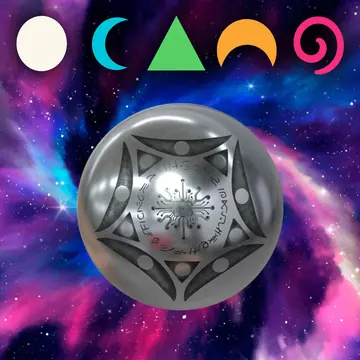
The Geometry That Speaks: Unlocking the Code of the Buga Sphere
Part 1
The Five-Phase Encoder: Turning Geometry Into Time
An electromechanical artwork that merges sacred symmetry, sound, and light into a living temporal instrument.
Introduction
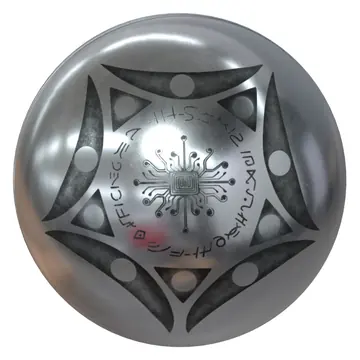
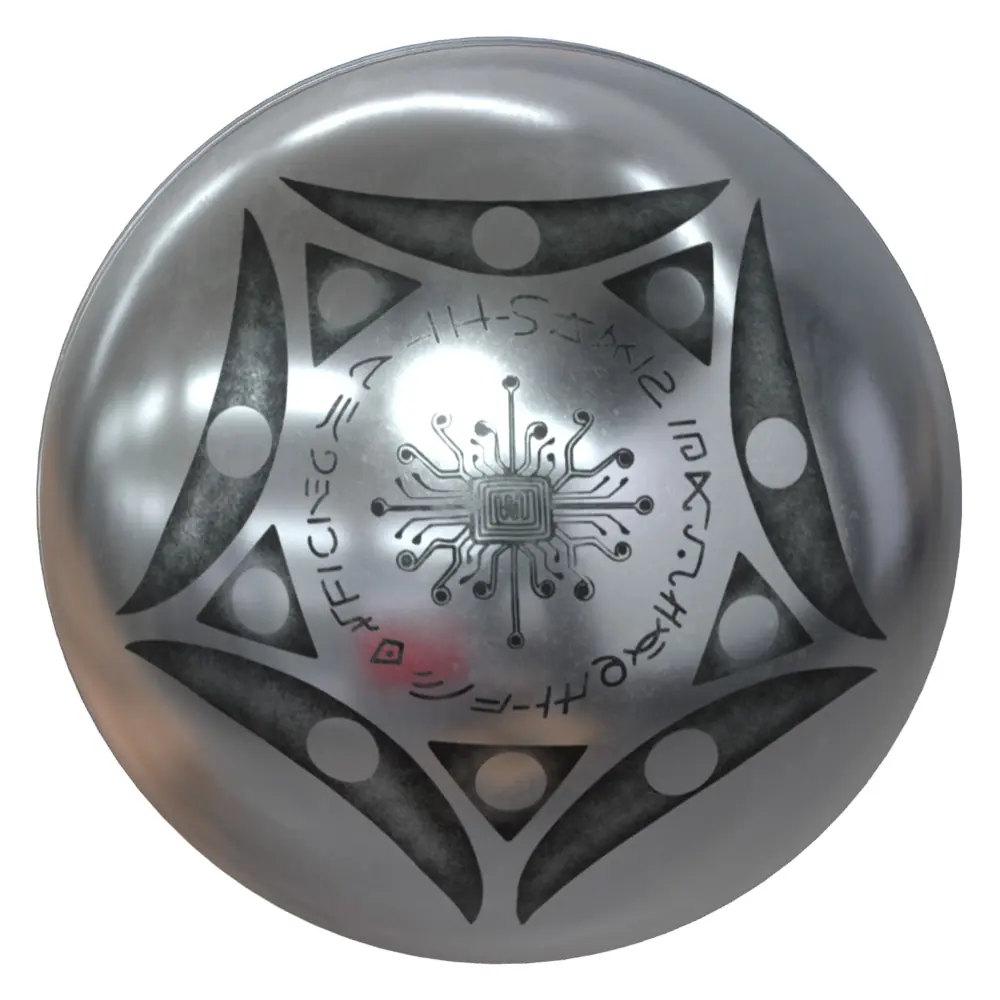
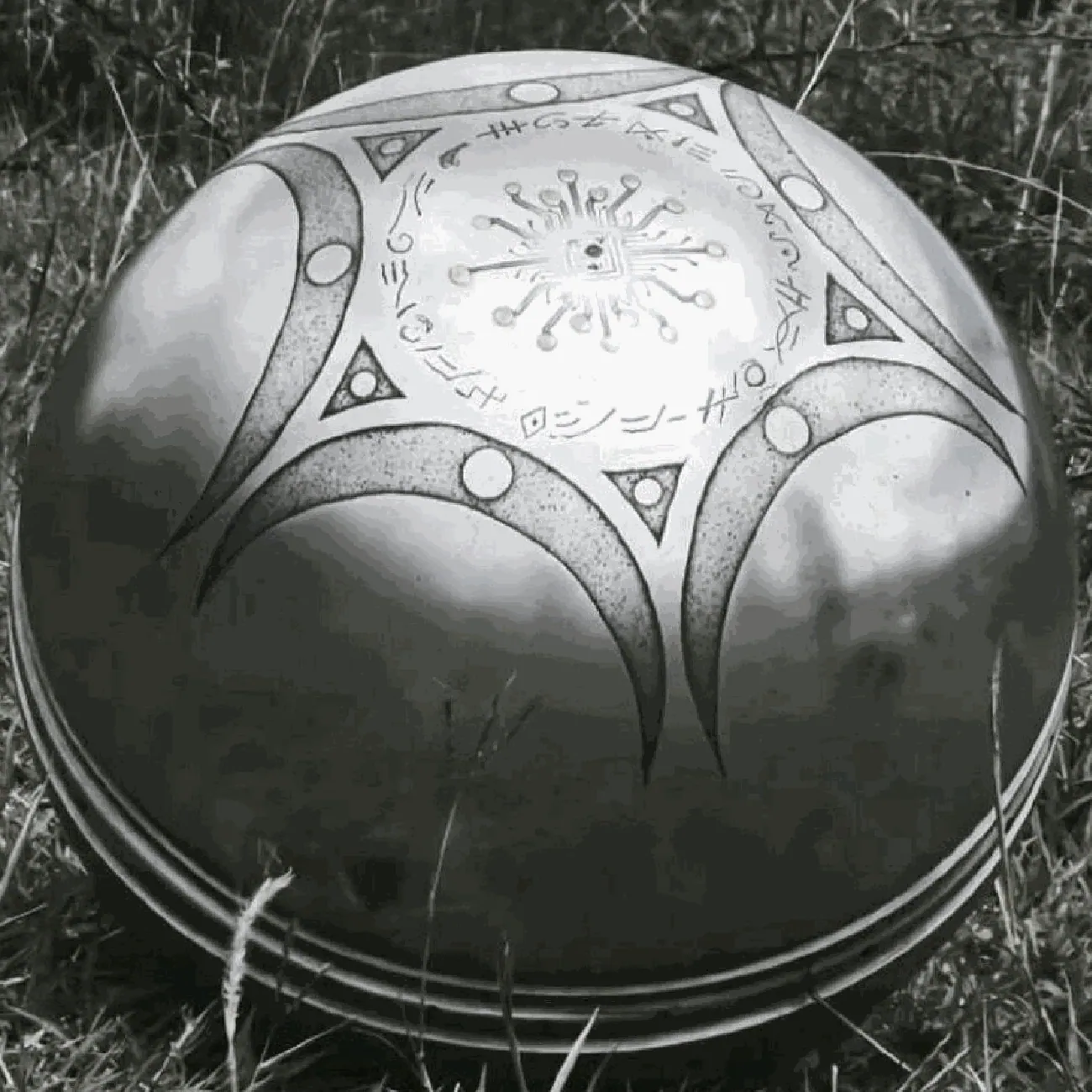
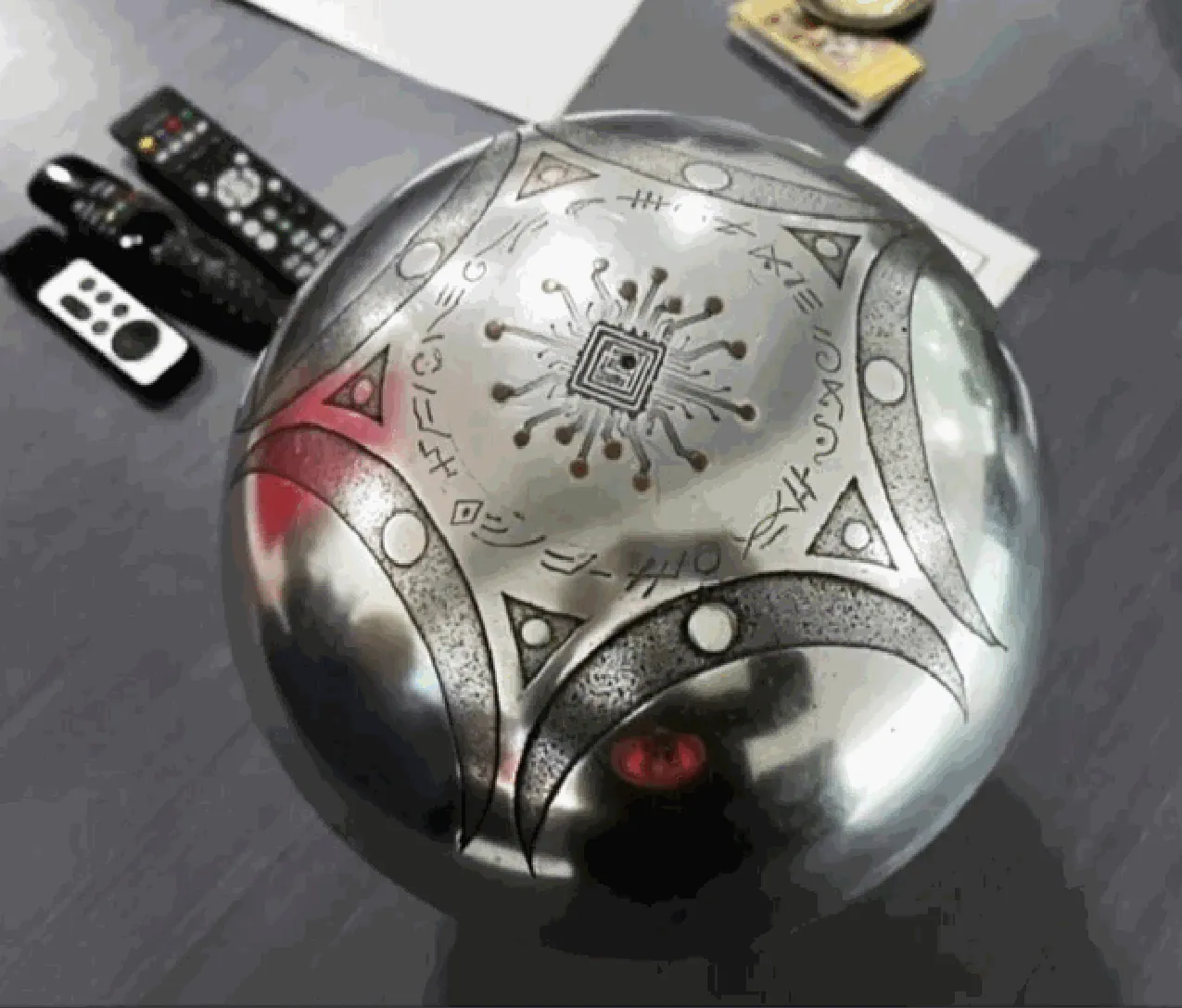
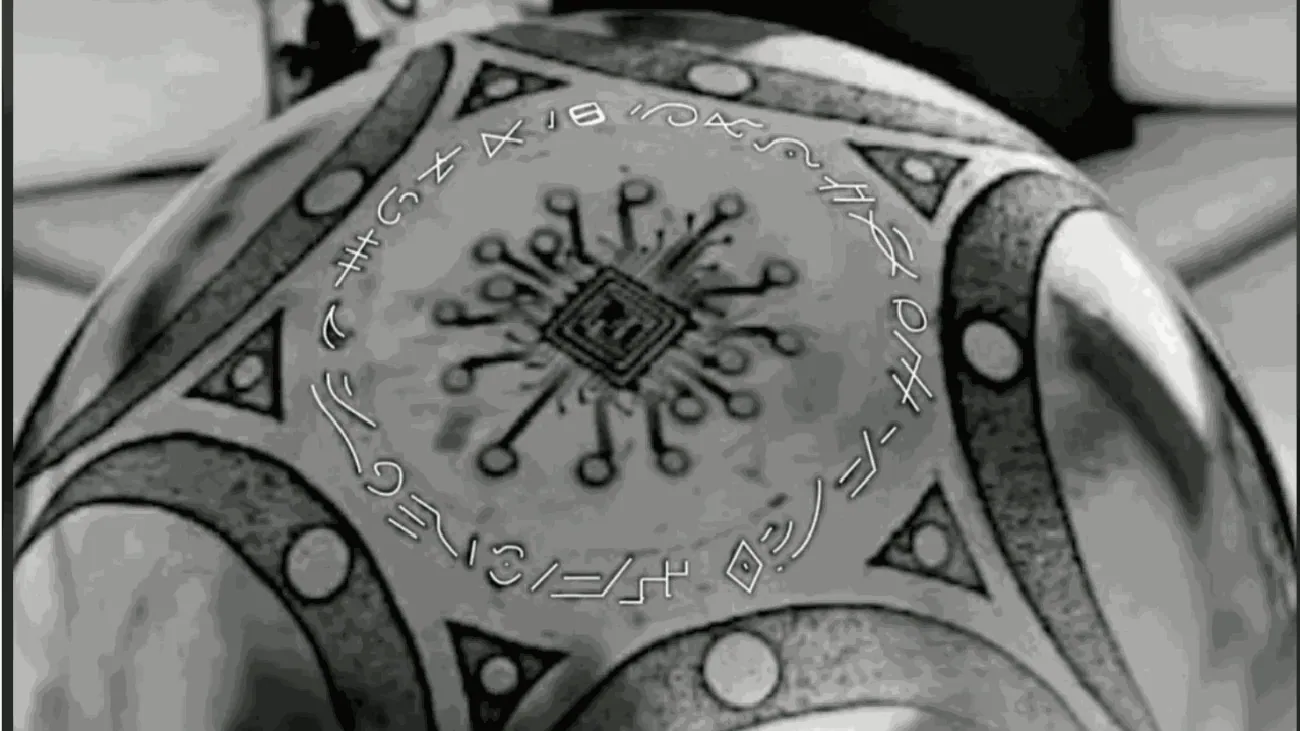
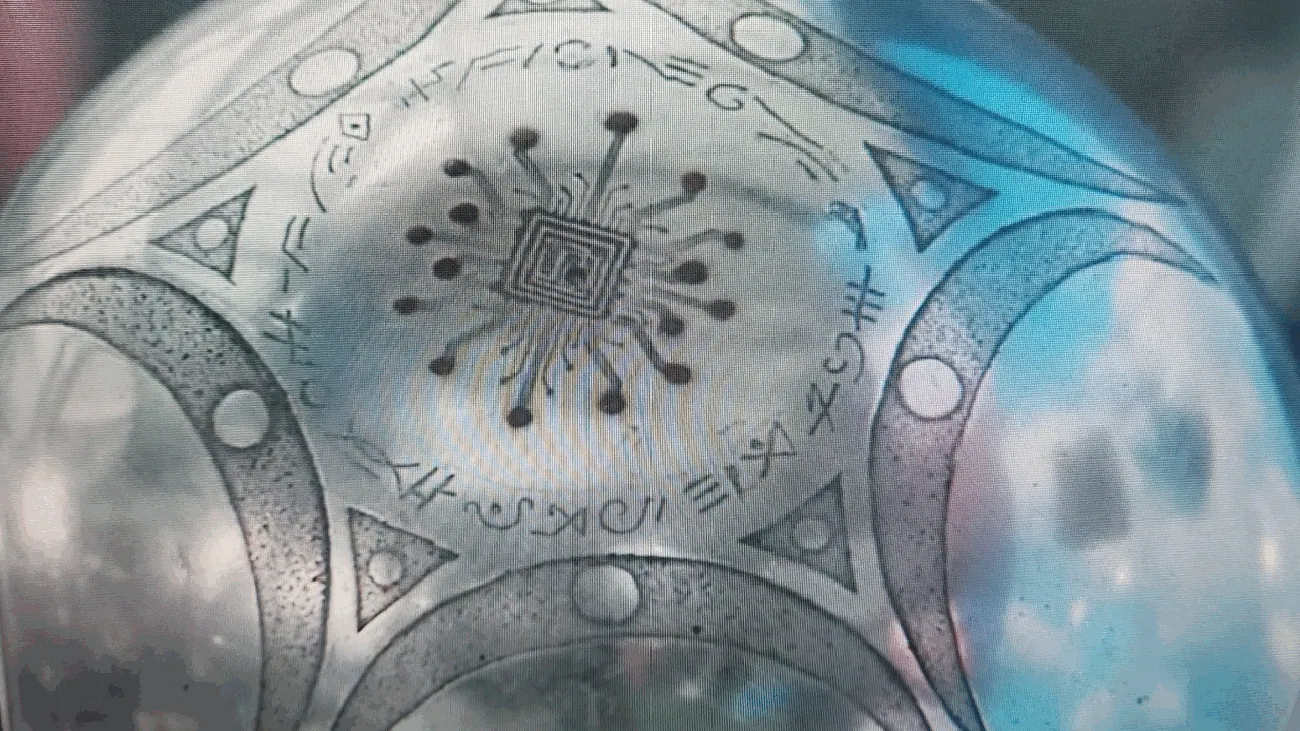
At first glance, the object appears inert: a metallic sphere engraved with an intricate five-pointed pattern radiating from a central microchip motif.
Yet hidden within its geometry lies a complete temporal architecture — a system waiting to be activated.
When paired with a microcontroller, lights, and sound, this sculpture becomes a five-phase clock of awareness.
Each sector represents a stage in a recurring process: Origin, Growth, Peak, Decline, and Renewal.
Together they form a continuous loop — the same cyclical logic encoded into galaxies, atoms, and human experience.
This project transforms static design into living rhythm.
It is part machine, part mandala, part performance — a technological meditation on time itself.
1. The Symbolic Architecture
The object’s design is built around five identical lobes — a geometry known as pentagonal symmetry.
Each lobe spans exactly 72° (360° ÷ 5), producing perfect rotational balance. In its center, an engraving resembling a microchip or neural node connects the sectors like a hub distributing energy or data.
This fivefold structure is not decorative; it is the framework for the entire system:
- Five points = Five phases
- Central hub = System clock or origin
- Circular ring = Temporal loop
Even without power, the geometry encodes harmony and recurrence. It is a physical map of process.
2. Narrative Mapping: The Five Phases
| Phase | Name | Symbolism & Meaning | Visual | Tone (Hz) |
|---|---|---|---|---|
| I | Origin – “The Spark” | The first idea; the system awakens. | White Light | 440 |
| II | Growth – “The Build” | Expansion and connection; energy gathering. | Cyan Light | 494 |
| III | Peak – “The Culmination” | Maximum power and stability. | Green Light | 556 |
| IV | Decline – “The Echo” | Energy disperses, reflection begins. | Amber Light | 624 |
| V | Renewal – “The Seed” | Preparation for rebirth; cycle resets. | Magenta Light | 702 |
When the five phases complete, the sequence returns to Origin — forming a loop that repeats infinitely, like breathing or orbiting planets.
3. The Philosophy: Time as an Experience
Whereas most clocks measure time quantitatively, the Five-Phase Encoder renders time qualitatively.
Each illumination, tone, and rotation signifies not just passing seconds but a transformation of state — an emotional narrative.
It is the artistic equivalent of NASA’s Voyager Golden Record, which transmitted human culture through physics.
The Encoder transmits human temporality through geometry. Both are messages that say: “This is how we understand time and meaning.”
4. Activation: From Sculpture to System
Core Components
| Category | Component | Function |
|---|---|---|
| Controller | Arduino Nano or Uno | Runs light and sound logic |
| Power | 5 V USB supply | Drives microcontroller and LEDs |
| Prototyping | Breadboard, jumper wires | Circuit testing and layout |
| Output | 5 LEDs (White, Cyan, Green, Amber, Magenta) | Phase indicators |
| 5 × 220 Ω resistors | LED current limiting | |
| 8 Ω mini-speaker or piezo | Phase tone output |
Optional Kinetic Portal Components
| Component | Purpose |
|---|---|
| 28BYJ-48 stepper motor + ULN2003 driver | Rotates platform 72° per phase |
| Hall effect sensor + magnet | Detects one revolution for alignment |
| Bearing or Lazy-Susan base | Smooth mechanical rotation |
5. Wiring and Logic
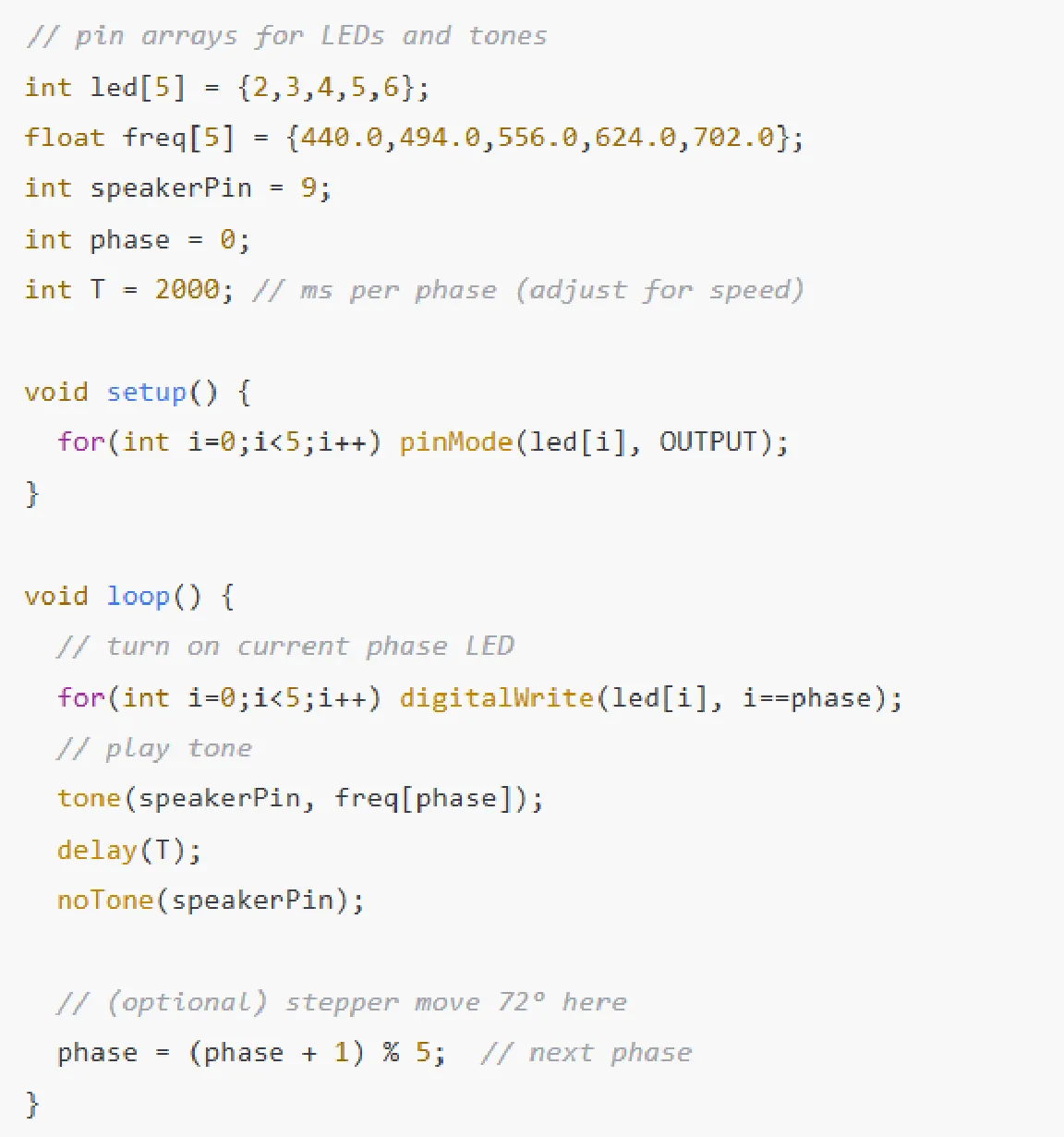
Each LED is connected to a separate Arduino pin.
A speaker connects to pin 9.
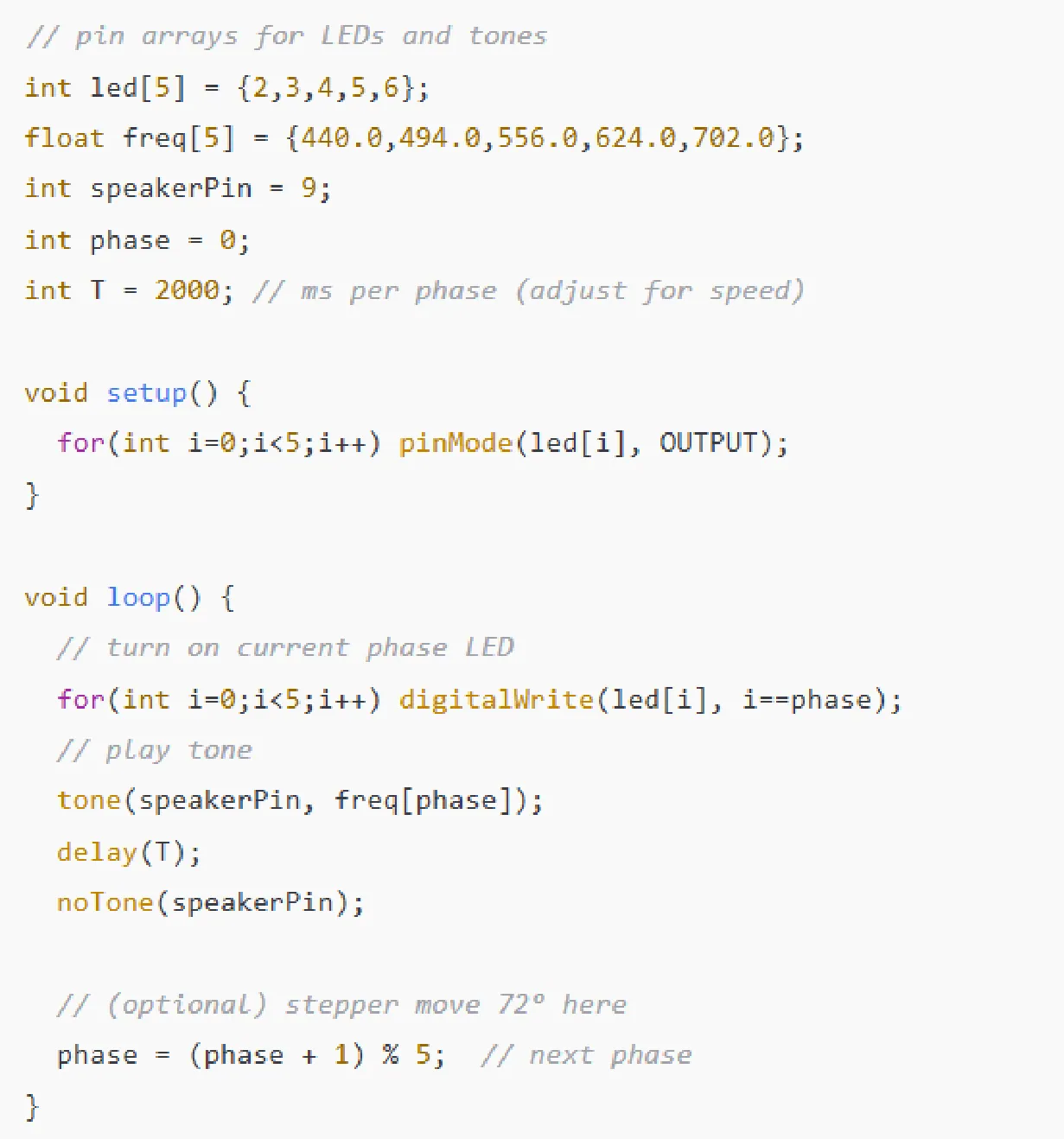
The program cycles through the five outputs, illuminating one LED and playing its tone for a fixed duration before moving to the next.
Mode 1 – Meditative Loop: slow fades, no motion, one cycle per minute. Mode 2 – Kinetic Portal: stepper rotates the platform 72° per phase; one full revolution per loop.
- Construction Steps
- Prepare the Base – build a circular housing (wood or acrylic) with five LED holes at 72° spacing.
- Mount the Speaker – underside, centered for resonance.
- Place the Sphere/Emblem – resting above LEDs so light reflects through its etched lobes.
- Connect Power – via USB or external 5 V adapter.
- Upload Code – run test sequence; confirm LEDs and tones advance in correct order.
- Finalize Housing – embed microcontroller and wires neatly inside.
Optional: add a piezo sensor to detect the sphere’s natural resonance and retune the electronic tones
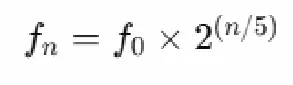
to match, creating acoustic self-symmetry.
7. The Experience
As the object runs:
- The first light flares white — Origin.
- Colors and tones rise and rotate — Growth through Peak.
- They warm and fade — Decline and Renewal.
- The sequence restarts — the system breathes again.
Observers describe a sense of calm, entrainment, and recognition — the feeling that time is cyclic, not linear.
The sculpture becomes a metronome of perception, translating the abstract flow of time into a tangible rhythm of light and sound.
8. Interpretation
| Perspective | Meaning |
|---|---|
| Scientific | Demonstrates harmonic and geometric symmetry; 5-phase oscillation system. |
| Artistic | A meditative installation that externalizes internal rhythm. |
| Philosophical | A reminder that every process — cosmic, biological, personal — passes through Origin, Growth, Peak, Decline, Renewal. |
| Symbolic | A bridge between static form (geometry) and dynamic time (frequency). |
9. The Legacy of the Golden Record
Just as the Voyager Golden Record carries a message for distant intelligences, the Five-Phase Encoder carries a message for our own consciousness: that rhythm, light, and sound are languages older than words.
Where Voyager encoded the story of Earth, this device encodes the story of becoming — a system that awakens, evolves, completes itself, and begins again.
10. Conclusion
The Five-Phase Encoder is more than an artwork; it’s a functional myth. It merges art and electronics, structure and story, logic and emotion. By animating a simple pentagonal geometry, it demonstrates that time itself can be programmed as an aesthetic experience.
To watch it is to witness time thinking — a luminous cycle that invites you to synchronize, reflect, and begin again.
Part 2: (Different version of part 1)
The Five-Phase Encoder: System Specification
1. Concept Overview
The object is a static five-fold encoder—a sculptural circuit that represents the phases of a cycle.
The electronics and narrative mapping below form its runtime layer, animating the geometry into a living rhythm of light, tone, and (optionally) motion.
2. Phase Narrative (Symbolic Firmware)
| Phase | Name | Symbolism | Light | Tone fnf_nfn | Meaning |
|---|---|---|---|---|---|
| I | Origin (The Spark) | The beginning—potential becomes existence. | White | 440 Hz | Awakening, focus, initiation |
| II | Growth (The Build) | Expansion and connection. | Cyan | 494 Hz | Construction, acceleration |
| III | Peak (The Culmination) | Full power and stability. | Green | 556 Hz | Completion, balance |
| IV | Decline (The Echo) | Reflection and releaseof energy. | Amber | 624 Hz | Memory, transition |
| V | Renewal (The Seed) | Gathering energy for rebirth. | Magenta | 702 Hz | Integration, regeneration |
At the end of Phase V the sequence returns to Phase I, completing the temporal loop — the object’s symbolic heartbeat.
3. Electronic Implementation (Hardware Blueprint)
🔹 Core Controller
| Component | Function | Notes |
|---|---|---|
| Arduino Nano (or Uno) | Runs phase logic | 5 V USB-powered |
| Breadboard & Jumper Wires | Prototyping connections | move to soldered perfboard once stable |
| 5 V USB Adapter | Power source | wall or battery pack |
🔹 Light Output
| Component | Qty | Color | Function |
|---|---|---|---|
| LED | 1 | White | Phase I |
| LED | 1 | Cyan | Phase II |
| LED | 1 | Green | Phase III |
| LED | 1 | Amber | Phase IV |
| LED | 1 | Magenta | Phase V |
| Resistors | 5 | 220 Ω | Current-limiters per LED |
Each LED corresponds to one of the five small circles on the sphere. Mount them in the base directly beneath those points so light reflects upward through the metal or gaps.
🔹 Audio Output
| Component | Qty | Type | Function |
|---|---|---|---|
| Speaker | 1 | 8 Ω mini (1–2 in) or piezo | Plays phase tone fnf_nfn |
- Optional Motion Subsystem (Mode 2: Kinetic Portal)
| Component | Function | Description |
|---|---|---|
| 28BYJ-48 Stepper Motor + ULN2003 Driver | Rotates platform in 72° steps | common Arduino tutorial motor |
| Hall Effect Sensor + Magnet | Detects each revolution | ensures perfect alignment |
| Bearing or Lazy Susan Turntable | Smooth rotation base | supports the sphere |
At each phase change:
- Motor turns 72° (one-fifth rotation).
- Hall sensor verifies alignment (magnet passes sensor once per cycle).
- Arduino lights the next LED and plays the corresponding tone.
- Control Logic (Core Loop)
- Assembly Plan
- Base Construction – wood or acrylic disk 10–12 cm diameter, hollow underside for electronics.
- LED Placement – five holes in pentagonal symmetry (use 72° template).
- Speaker Mount – center underside facing down into resonance cavity.
- Sphere Placement – rests above LEDs; reflective surfaces scatter the light.
- Power – single USB-C or 5 V DC jack at rear.
- Modes of Operation
| Mode | Duration per Phase | Description |
|---|---|---|
| Meditative Loop | 10–12 s | Gentle fades, no motion; a slow breathing rhythm. |
| Kinetic Portal | 2–3 s | Bright sequential pulses; platform rotates 72° per phase. |
| Resonant Sync | dynamic | Tunes electronic tones to sphere’s measured acoustic resonance. |
8. Expected Experience
| Dimension | Effect |
|---|---|
| Visual | Rotating color pulse that completes every five steps — a living mandala. |
| Auditory | Pentatonic harmonic cycle forming an endless rising-falling loop. |
| Kinesthetic | If motorized, tactile awareness of rotation — time made physical. |
| Cognitive | Recognition of recurrence and impermanence — the “shape of time.” |
Summary
- The object is the hardware: fivefold geometry and metallic resonance.
- The plan is the software: narrative, light, tone, and timing logic.
- Combined, they form a temporal interface — a sculptural system that teaches rhythm, awareness, and renewal through direct sensory feedback.
Part 3
A Comparative Failure Analysis of Spherical Artifacts: The Functional Consequences of Invasive Disassembly in Modular, Passive, and Integrated Systems
Introduction: A Taxonomy of Enigmatic Spheres
This report addresses the functional consequences of "cracking open" enigmatic spherical objects, specifically the contemporary "Buga Sphere" 1and similar artifacts. The query, which centers on the potential destruction of function via invasive analysis, must be addressed through a rigorous engineering framework that distinguishes between modular and integrated systems.
To provide a comprehensive analysis, this report establishes a formal taxonomy by comparing three distinct classes of spherical objects:
- The Known (Baseline): The "Five-Phase Encoder," a documented, human-made electromechanical art project. Its function is modular and its design is exoteric, or openly explained.3
- The Explained (Historical Precedent): The "Betz Sphere," a 1974 historical enigma.4Its apparently anomalous properties are now largely attributed to passive mechanics and environmental factors, with a strong consensus for a mundane explanation.4
- The Unknown (Primary Subject): The "Buga Sphere," a 2025 anomaly.1Its reported properties are hypothesized to stem from a seamless, integrated, holistic system fabricated via unknown manufacturing methods.6
The fundamental difference between these objects lies in their design philosophy. For a modular system like the Five-Phase Encoder, "cracking it open" is disassembly. Its function resides in its discrete components and the software that controls them.3For a hypothetically integrated system like the Buga Sphere, "cracking it open" is destruction. Its function is presumed to reside in its indivisible physical integrity and unique material composition.7This distinction is the single most important factor in determining the outcome of a destructive teardown.
| Feature | Five-Phase Encoder (Known) | Betz Sphere (Explained) | Buga Sphere (Unknown) |
|---|---|---|---|
| Date of Origin / Discovery | Documented Art Project 3 | Discovered 1974 4 | Recovered March 2025 2 |
| Reported Fabrication | Engraved metallic sphere 3 | Stainless steel, smooth, hollow 5 | Seamless, "no welds or joints" 8 |
| Material | Metallic 3 | High-grade stainless steel 5 | 95% aluminum 6 OR Titanium/Steel 9 |
| Known / Reported Internals | Arduino Nano, 5 LEDs, Resistors, Speaker 3 | 2-3 "spherules" (X-ray data) 10 | 9-18 "microspheres," "nucleus chip," "fiber-optic" networks (X-ray data) 8 |
| Hypothesized Function | Software-driven electromechanical clock 3 | Passive mechanics; imbalanced weighton uneven floors 4 | Integrated photonic-neural control; non-ejective propulsion; negative-mass physics 7 |
Baseline Analysis: The "Five-Phase Encoder" (The Known)
To analyze the anomalous, one must first establish a baseline for the known. The "Five-Phase Encoder" 3serves as a perfect model for a complex, human-made, electromechanical art sphere. Analysis of its design reveals a clear separation between its form and its function.
"Geometry as Hardware" - A Passive Chassis
The Encoder is described as a "metallic sphere engraved with a five-pointed pattern".3Its "hardware" contribution is purely structural and aesthetic. The "five-pointed pattern" and 72° separation" provide a geometric layout, but the sphere's key functional features are "Five circular recesses".3These are explicitly defined as "LED sockets".3
This distinction is critical. The sphere is not the source of the light-and-sound function; it is a housing for the components that create that function. It is a passive chassis, analogous to a computer case. Its geometry provides a map for the layout, but it does not participate in the computation or execution of the "five-phase clock".3
"Activation Toolkit" - A Modular, Off-the-Shelf System
The "Activation Toolkit" section details the components that generate the Encoder's function.3 These are all discrete, off-the-shelf electronics: an Arduino Nano/Uno microcontroller, LEDs (5 colors), 220 Ω resistors, a speaker or piezo, and a 5V power supply.3
The inclusion of a "Breadboard & Jumpers" 3is the definitive proof of its design philosophy. Breadboards are used specifically for prototyping—a state that implies constant, non-destructive assembly, testing, reconfiguration, and disassembly. The entire system is modular, meaning its parts are distinct, interchangeable, and connected by simple, non-permanent links (jumper wires).
"Control Logic" - A Software-Defined Function
The "temporal architecture" (Origin, Growth, Peak, Decline, Renewal) that defines the Encoder's purpose is not a physical property of the sphere itself. It is a set of instructions—a software program.3The "Control Logic" section provides the exact C++ code snippet that runs on the Arduino.3
This code defines the function: a simple for loop iterates through arrays of LED pins (int led) and frequencies (float freq), controlled by a speaker pin (int speakerPin 9).3This function is non-physical data. It can be copied, backed up, modified, or run on any other compatible hardware, entirely independent of the engraved metallic sphere.
This baseline is essential for evaluating skeptical claims about other spheres. Dr. Julia Mossbridge, for example, suggested the Buga Sphere "looks to me like a really cool art project".8The Encoder is what a complex "art project" verifiably looks like. Other advanced kinetic art spheres, like the "Vegas MiniSphere," are vastly more complex, featuring 1080 LEDs, an IMU, and UWB radios.15Yet, they adhere to the same modular philosophy; the MiniSphere is explicitly designed to be "serviceable," with "ten flexible circuit boards" and a chassis that can be "opened up for maintenance and debugging".16
Thus, all documented, complex electromechanical art spheres are modular systems. If the Buga Sphere is an "art project," it is of a fundamentally different order, one that would imply a revolutionary "emergent fabrication paradigm" 1rather than a simple assembly of known components.
Historical Case File: The "Betz Sphere," 1974 (The Explained)
The 1974 Betz Sphere provides a crucial historical parallel. It was a "black box" anomaly that baffled the public and scientists, generating hypotheses of alien origin before a mundane explanation gained consensus.
Reported Anomalous Properties
On March 27, 1974, the Betz family discovered a polished, stainless steel sphere, approximately 8 inches in diameter and weighing 22 pounds, on their property in Florida.4 Initially suspected to be a cannonball, the object soon displayed anomalous properties.17It reportedly moved on its own, changed direction, and appeared to follow people.4Most notably, it reacted to the sound of a guitar, emitting a "throbbing noise".4
Non-Invasive Analysis (The Ambiguous X-Rays)
The mystery was significantly amplified by non-invasive analysis. The object was examined by the U.S. Navy at Jacksonville Naval Air Station.17Initial X-ray attempts "failed," with the report stating the machine "wasn't strong enough to penetrate the steel".17This immediately fueled speculation of exotic materials or unknown shielding.
Subsequent tests with a more powerful 300kV X-ray machine revealed the sphere was hollow, with a shell thickness of approximately 0.5 inches.5However, these X-rays also showed ambiguous internal features, described as "two smaller spheres" 10or "three, equally-spaced spherules".11These "blobs" seen on the film 19, combined with unverified claims of multiple magnetic poles 20, became the basis for exotic theories.
The Convergent Mundane Hypothesis (Ball Check Valve)
Decades of analysis have produced a single, comprehensive, and widely accepted mundane explanation: the Betz Sphere was an industrial ball check valve.4This hypothesis effectively explains all of the reported data:
- Physical Match: The sphere's "size, weight, and metallurgical composition" (high-grade stainless steel) perfectly matched those of industrial ball check valves.4
- Autonomous Motion: The sphere was "almost perfectly balanced".4The Betz house had "uneven stone floors".4A heavy, perfectly balanced sphere on an uneven surface will appear to move autonomously, and external vibrations (like a guitar) could easily set it in motion or cause it to resonate (the "throbbing").4
- Origin: An artist named James Durling-Jones stated he had been using identical balls for sculpture and had lost several from his Volkswagen Bus's rooftop rack while driving "through the Jacksonville area" in 1971.4
The Betz Sphere case is the quintessential example of how ambiguous non-invasive data (X-rays) and anecdotal reports (movement) on a mundane but robustly-built industrial object can be misinterpreted. The parallels to the Buga Sphere are significant: both are spheres, both have ambiguous X-ray data revealing internal "spheres" 11, and both reportedly interfered with scanning attempts.12The Betz mystery endures 5precisely because the final, definitive step—destructive analysis—was never performed, as the sphere's location became unknown.5
Contemporary Enigma: The "Buga Sphere," 2025 (The Unknown)
The Buga Sphere, recovered in Colombia in March 2025 2, presents a modern iteration of the same phenomenon, but with conflicting data and claims of far more advanced physics.
Conflicting Data - A Case of Poor Provenance
A rigorous analysis of the Buga Sphere is immediately compromised by a mass of fundamental, mutually-exclusive contradictions in the public data:
- Material: It is described as being 95% aluminum 6and, in other reports, as "titanium or steel".9
- Internal Components: X-rays, presented by researcher Jose Luis Velasquez 8, reportedly show "nine microspheres".8Other reports based on press conferences claim "16 small spheres" 12or "18 microspheres".13
- Signal Emission: The sphere is variously reported to emit "strange obviously coded signals in the Hz range" 25, specifically "2.3 Hz" 6, and "variable-frequency signals (70-125 MHz)".12
These are not minor discrepancies. A 2 Hz signal (Extremely Low Frequency) and a 70-125 MHz signal (Very High Frequency) are entirely different phenomena requiring completely different physics and hardware. Furthermore, much of the "scientific" data, including X-ray scans and analysis, has been presented in press conferences organized by Jaime Maussan.6 Maussan's public "history... [of] one hoax after another" 26severely damages the credibility of any data associated with his presentations.
Technical Debunking of Key Claims
The claim of a 2-ish Hz signal 25is technically baseless from an electromagnetic perspective. As noted by engineering experts, propagating a receivable radio (RF) wave at such a low frequency is not practical. One expert on the EEVblog forum calculated that "A radiator would need to be many thousands of kilometres long to have any degree of radiation efficiency".27This is a fundamental constraint of physics. The claim is either a gross misinterpretation of a different type of field (e.g., magnetic) or, more likely, pseudoscientific jargon intended to "fool people".27
Exotic Hypotheses (Theoretical vs. Measured Data)
The most profound claims associated with the sphere—such as a "drastic ≈8.1 kg apparent mass change" and a "sustained 100W endothermic signature"—originate from a theoretical paper on the OSF.io archive.7It is crucial to understand that this paper proposes a unified cyber-physical model to explain these alleged anomalies. It is a theoretical framework invoking concepts like a "negative-mass effect" and a "photonic-neural control system".7It is not, in itself, raw, independently verified, and replicated experimental data.
The One Credible Anomaly: Seamless Fabrication
After filtering the contradictory reports, the debunked signal claims, and the unverified theoretical models, one tangible, physically profound claim remains consistent across multiple sources: the object is seamless.
Reports describe it as having "No welds, no bolts" 28and "no welds or joints".8This is the true engineering problem of the Buga Sphere. How can a complex, multi-layered object 12containing intricate internal components ("fiber-optic-like wiring," "microspheres" 6) be fabricated with no seams?
This rules out all conventional manufacturing (casting, machining, welding, and assembly). It implies an "emergent fabrication paradigm" 1, such as an unknown form of additive manufacturing (3D printing) capable of printing multiple materials (metals, dielectrics, photonics) simultaneously, or an entirely "grown" technology. This seamlessness is the entire basis for the hypothesis that it "cannot be reverse-engineered".1One cannot disassemble a machine that has no assembly.
Central Analysis: The Consequences of "Cracking It Open"
By applying a formal failure analysis, we can now directly answer the central query regarding the functional consequences of invasively opening each sphere.
Case 1: The Five-Phase Encoder (Non-Destructive Disassembly)
- System Type: Modular, Serviceable System.
- Analysis: The function is defined by software 3and executed by discrete, off-the-shelf components connected with jumpers.3The sphere is a passive chassis.3
- Consequence: "Cracking it open" is a benign, non-destructive act. It involves unplugging the jumper wires and removing the Arduino. The sphere (chassis) is unharmed, the electronics (components) are unharmed, and the function (the code) is non-physical data. The system is explicitly designed for disassembly and reassembly without functional loss.
Case 2: The Betz Sphere (Analytically Conclusive Destruction)
- System Type: Passive Mechanical System.
- Analysis: The "function" (anomalous motion) was an emergent property of its physical characteristics (mass, perfect balance) interacting with its environment (uneven floors).4
- Consequence: "Cracking it open" (e.g., cutting it in half) would be functionally destructive but analytically conclusive.
- Destructive: The act of cutting it would destroy the sphere's perfect balance and structural integrity, permanently destroying its ability to roll "anomalously."
- Conclusive: It would definitively solve the mystery 19by revealing its hollow interior and material composition, confirming (or denying) the ball check valve hypothesis. The failure to perform this act is why it remains a "mystery."
Case 3: The Buga Sphere (Catastrophic Failure of an Integrated System)
- System Type: Hypothesized: Holistic, Integrated System.
- Analysis: This case must be analyzed by assuming the most credible anomalous claim (seamlessness 8) and the related exotic hypotheses 7are true.
- This object is not a puzzle. A complex mechanical puzzle sphere, like the "Titan Puzzle" 29, is designed to be opened non-destructively via a "certain combination of moves".29The Buga Sphere's seamlessness suggests it is the opposite: it is not designed to be opened.
- If the hypotheses are correct, its function and form are inseparable. The "photonic-neural control system" 7is not a wire in the chassis; it is a network of the chassis material. The reported "fiber-optic-like wiring" 6and "negative-mass effect" 7 would depend on the total, unbroken integrity of the engineered material.
- Consequence: "Cracking it open" by any physical, brute-force means (cutting, drilling, or pressing) would be a catastrophic, irreversible failure event.
- It would not be disassembly; it would be destruction.
- A physical breach would shatter the (hypothesized) delicate internal "photonic-neural" 7 or "fiber-optic" 6networks.
- It would break any required physical state, such as a vacuum, a high-pressure containment, or a quantum-coherent resonance. The function would be instantaneously and permanently destroyed.
- This is the very reason it is considered "impossible to reverse-engineer".1An integrated system cannot be understood by studying its "parts" because it has no parts—only a continuous, functional whole.
| Artifact | Nature of Function | System Design | Result of "Cracking Open" | Potential for Reassembly / Reverse Engineering |
|---|---|---|---|---|
| Five-Phase Encoder | Software-Defined 3 | Modular / Serviceable 3 | Benign / Non-Destructive | Trivial |
| Betz Sphere (1974) | Passive-Mecha nical 4 | Monolithic / Hollow 5 | Functionally Destructive / Analytically Conclusive | Not Applicable |
| Buga Sphere (Hypothetical) | Integrated-Phy sical 7 | Integrated / Seamless 8 | Catastrophic & Total Failure | Impossible |
Synthesis and Concluding Report
This comparative analysis has examined three spherical objects on a spectrum from the known to the unknown, directly addressing the consequences of invasive analysis.
- The Encoder (Known): Represents a serviceable, modular object. Its function is separate from its form. "Cracking it open" is a trivial and non-destructive act of disassembly.3
- The Betz Sphere (Explained): Represents a passive, monolithic object. Its "function" was an emergent property misunderstood as anomalous. "Cracking it open" was the one act that would have solved the mystery, though it would have destroyed the mundane property (its balance).19
- The Buga Sphere (Unknown): Represents a contested object whose provenance is compromised by contradictory data 8and unreliable sourcing.26
The most credible anomaly of the Buga Sphere, from a materials science and engineering perspective, is its reported seamless, joint-free fabrication.8This single physical claim creates a fundamental paradox that lies at the heart of the user's query.
- If this claim is false, and the sphere is a hoax or a mundane object (like the Betz Sphere), then "cracking it open" is the only way to definitively prove its terrestrial nature. This act would be analytically conclusive.
- If this claim is true, and the sphere is a truly integrated system where function and form are inseparable 7, then "cracking it open" is an act of total destruction, not analysis. It would be akin to shattering a CPU to see how it computes; the very act of observation would permanently destroy the phenomenon.
Therefore, the Buga Sphere presents a perfect analytical trap. The only action that could definitively verify its mundane nature is the one action that would destroy its exotic nature if it is, in fact, anomalous. The seamlessness of its design, if real, is the ultimate defense against reverse engineering.

The Five-Phase Encoder described here now runs as a web app: open BugaSphere at b5pe.com.
Works cited
- Hypothesis: The Buga Sphere Represents Technological ... - OSF, accessed October 27, 2025, https://osf.io/v8tjn/
- What fell from the sky in Buga, Colombia? UFO aliens? - YouTube, accessed October 27, 2025, https://www.youtube.com/shorts/BtC-ZY28JZ0
- Five_Phase_Encoder_Article.pdf
- Betz mystery sphere - Wikipedia, accessed October 27, 2025, https://en.wikipedia.org/wiki/Betz_mystery_sphere
- Unraveling the Secrets of the Betz Mystery Sphere - Discovery UK, accessed October 27, 2025, https://www.discoveryuk.com/mysteries/unraveling-the-secrets-of-the-betz-myster y-sphere/
- The Buga Sphere: Alien Probe or Terrestrial Puzzle? A Deep Dive into a Cosmic Mystery | by E.D. Buesing | Medium, accessed October 27, 2025, https://medium.com/@EDBuesing/the-buga-sphere-alien-probe-or-terrestrial-puzzl e-a-deep-dive-into-a-cosmic-mystery-ed077337285d
- A Cyber-Physical Model of the Buga Sphere: Unifying Anomalous Dynamics through a Topo-Temporal Photonic-Neural Architecture - OSF, accessed October 27, 2025, https://osf.io/eukjb_v1/download/?format=pdf
- Mysterious 'Buga Sphere' found in Colombia sparks UFO speculation | The Jerusalem Post, accessed October 27, 2025, https://www.jpost.com/science/science-around-the-world/article-855587
- Alien art or hoax? Mysterious sphere baffles scientists in Colombia - Cybernews, accessed October 27, 2025, https://cybernews.com/tech/alien-hoax-art-uap/
- The Betz Mystery Sphere: Is it a real alien artifact? | by Call me V - Medium, accessed October 27, 2025, https://vcorner.medium.com/the-betz-mystery-sphere-is-it-a-real-alien-artifact-9d6c 5eee6662
- The Betz Sphere X-rays - Astonishing Legends, accessed October 27, 2025, https://astonishinglegends.com/xray
- the Buga Sphere's properties are highly consistent with the STLT | www.wenxuecity.com, accessed October 27, 2025, https://www.wenxuecity.com/blog/202507/69106/1413.html
- Buga Metallic sphere, claimed to be of alien origin is responding to Sanskrit chants as per viral video, accessed October 27, 2025, https://timesofindia.indiatimes.com/etimes/trending/buga-metallic-sphere-claimed-t o-be-of-alien-origin-is-responding-to-sanskrit-chants-as-per-viral-video/articleshow /123087619.cms
- Mysterious Metal Sphere Sparks UFO Debate: 'Never Seen a Piece Like This' - People.com, accessed October 27, 2025, https://people.com/mysterious-metal-sphere-sparks-ufo-debate-never-seen-a-piec e-like-this-11741579
- Vegas MiniSphere: #LED Art Sculpture at #OpenSauce '24 // Hackster.io - YouTube, accessed October 27, 2025, https://www.youtube.com/shorts/0LQo_CJT-SY
- MiniSphere | Hackaday.io, accessed October 27, 2025, https://hackaday.io/project/195182-minisphere
- The Betz Mystery Sphere Conspiracy Theory: Facts, Myths, History, accessed October 27, 2025, https://www.classicalnumismaticgallery.com/blog/1wmp-the-betz-mystery-sphere-c onspiracy-theory-facts-myths-history/
- The Mysterious Betz Sphere of Fort George Island - The Jaxson, accessed October 27, 2025, https://www.thejaxsonmag.com/article/the-mysterious-betz-sphere-of-fort-george-i sland/
- The Betz Mystery Sphere. The bowling ball that roll on its own | by Randomness - Medium, accessed October 27, 2025, https://medium.com/@wisck48/the-betz-mystery-sphere-d5560894821d
- [Unexplained Phenomena] The Betz Sphere : r/UnresolvedMysteries - Reddit, accessed October 27, 2025, https://www.reddit.com/r/UnresolvedMysteries/comments/7d3d1p/unexplained_ph enomena_the_betz_sphere/
- The Mysterious Betz Sphere of Fort George Island - The Jaxson, accessed October 27, 2025, https://www.thejaxsonmag.com/article/the-mysterious-betz-sphere-of-fort-george-i sland-page-2/
- The Betz Mystery Sphere Revisited: A 50-Year Search for Answers : r/nonmurdermysteries, accessed October 27, 2025, https://www.reddit.com/r/nonmurdermysteries/comments/1jae5mw/the_betz_myst ery_sphere_revisited_a_50year_search/
- The Betz Sphere: America's Most Bizarre Artifact - YouTube, accessed October 27, 2025, https://www.youtube.com/watch?v=oG5DPR3CMoM
- "Buga Sphere", accessed October 27, 2025, https://admin.sumatiias.com/upload/files/2508211109041.pdf
- The Mysterious Buga Sphere Transmits LF Waves! (Alien Origin?) - YouTube, accessed October 27, 2025, https://www.youtube.com/watch?v=uI62sAN5JzU
- The Buga Sphere - ET have always been here and played an integral role in humanity's history. The lost technology went skyward! : r/GrahamHancock - Reddit, accessed October 27, 2025, https://www.reddit.com/r/GrahamHancock/comments/1lghac7/the_buga_sphere_e t_have_always_been_here_and/
- Buga Sphere - EEVblog, accessed October 27, 2025, https://www.eevblog.com/forum/dodgy-technology/buga-sphere/
- the mysterious Buga Sphere by InspiringMuse | Suno, accessed October 27, 2025, https://suno.com/song/6dd87027-7e72-4ef9-92bd-15440f198cd0
- The Impossible Titan Puzzle by Felix Ure - How To Solve It - Greg Gelf, accessed October 27, 2025, https://explorepuzzles.com/en/titan/
First published . Last revised . Also on Google Docs.