Targeting Nicotine Addiction with NeuroRasool: A Gq-Biased 5-HT2A Receptor Agonist Approach
Abstract
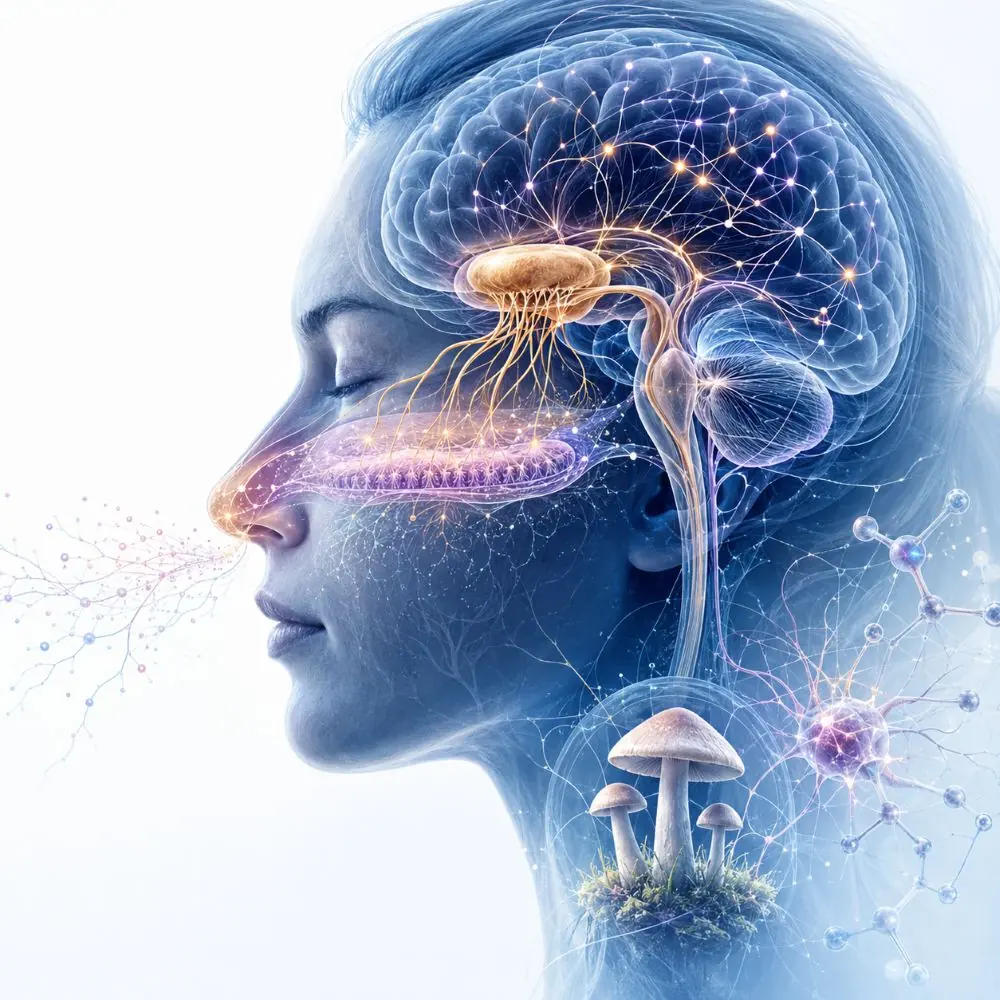
Nicotine addiction remains a leading cause of preventable death worldwide, with most smokers unable to sustain abstinence despite pharmacotherapies targeting nicotinic acetylcholine receptors1. Classical 5-HT2A receptor agonists such as psilocybin have demonstrated striking efficacy in smoking cessation, achieving up to 80% abstinence at six months in early studies2,3. However, their hallucinogenic nature limits scalability. NeuroRasool is a novel, naphthalene-based, Gq-biased 5-HT2A agonist originally developed to restore olfactory function after COVID-19⁴. Because nicotine addiction shares maladaptive learning mechanisms, NeuroRasool’s targeted neuroplasticity without hallucinations may offer a transformative approach to tobacco dependence. This article reviews its mechanistic rationale, receptor selectivity, and comparison to existing therapies.
Introduction
Tobacco use is the largest preventable cause of morbidity and mortality, driven by reinforcement through α4β2 nicotinic acetylcholine receptor (nAChR) activation in the ventral tegmental area (VTA), resulting in dopamine release to reward circuits2. Chronic exposure desensitizes and upregulates these receptors, producing craving and dysphoria3. Although varenicline, bupropion, nicotine replacement therapy (NRT), and cytisinicline reduce withdrawal symptoms, they often fail to disrupt conditioned cue responses sustaining relapse1.
Psilocybin-assisted therapy at Johns Hopkins University achieved approximately 80% six-month abstinence rates in an open-label pilot study combining high-dose sessions with cognitive-behavioral therapy2. Participants described dramatic experiences such as “the cigarette fell from my hand” and “I forgot I ever needed it”3. These outcomes are attributed to 5-HT2A-mediated neuroplasticity facilitating extinction of conditioned behaviors5. Observational studies have further linked lifetime psychedelic use—including psilocybin, LSD, and mescaline—with reduced odds of nicotine dependence, suggesting a broad impact on substance use disorders6. However, psilocybin’s hallucinogenic profile requires intensive monitoring, limiting its scalability7.
NeuroRasool was designed to engage Gq-biased 5-HT2A signaling selectively, promoting neuroplastic remodeling without perceptual disruption8.
Mechanisms of Nicotine Dependence and Neuroplasticity
Nicotine Reinforcement and Withdrawal
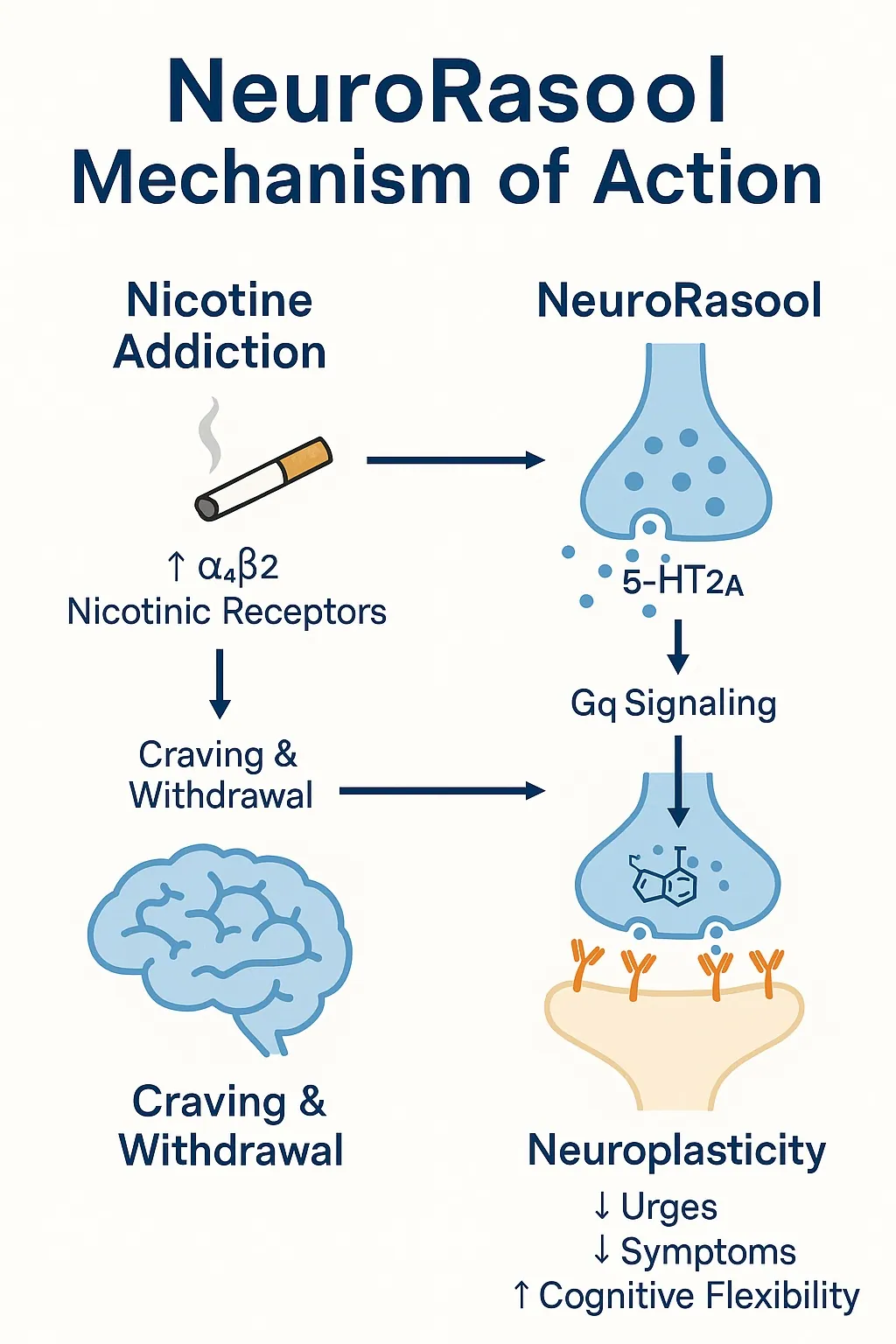
Nicotine binds α4β2 nicotinic acetylcholine receptors (nAChRs) in the VTA, increasing dopamine in the nucleus accumbens and prefrontal cortex2. During abstinence, receptor desensitization and noradrenergic hyperactivity result in anhedonia, irritability, and craving3. Corticotropin-releasing factor (CRF) circuits further amplify withdrawal stress9.
5-HT2A Receptor Neuroplasticity
Psilocybin and related compounds activate 5-HT2A receptors, stimulating phospholipase C (PLC) signaling, intracellular calcium release, and gene expression promoting dendritic spine growth and synaptogenesis10. These changes enhance cognitive flexibility and facilitate extinction of cue associations11. In psilocybin studies, participants frequently described sudden loss of smoking desire as transformative2,3.
Gq-Biased Signaling
Although 5-HT2A activation promotes neuroplasticity, β-arrestin recruitment is associated with hallucinogenic experiences12. NeuroRasool was engineered to favor Gq-protein coupling while minimizing β-arrestin engagement8.
Molecular Design and Delivery
NeuroRasool uses a rigid naphthalene scaffold optimized for high-affinity 5-HT2A binding and Gq-biased signaling8. Unlike psilocybin, which shows moderate affinity for 5-HT2C and 5-HT1A receptors13, NeuroRasool demonstrates predicted enhanced selectivity. A phosphate prodrug formulation is proposed for intranasal delivery targeting olfactory and cortical regions directly4.
Comparative Analysis
| Feature | NeuroRasool | Psilocybin | Varenicline | Bupropion | NRT | Cytisinicline |
|---|---|---|---|---|---|---|
| Mechanism | Gq-biased 5-HT2A agonist8 | Mixed 5-HT2A agonist10 | Partial α4β2 nAChR agonist1 | DA/NE reuptake inhibition9 | nAChR agonist1 | Partial α4β2 nAChR agonist14 |
| Hallucinogenic | No (predicted)8 | Yes12 | No1 | No1 | No1 | No14 |
| Neuroplasticity | High (predicted)10 | High10 | Minimal1 | Minimal1 | Minimal1 | Minimal1 |
| Efficacy (quit rates) | Preclinical | ~80% at 6 months2 | ~25–35%1 | ~20%1 | ~15–20%1 | ~25–30%14 |
| Subjective Reports | N/A | “Cigarette fell from my hand”3 | Reduced craving1 | Reduced craving1 | Reduced craving1 | Reduced craving14 |
Potential Benefits in Nicotine Addiction
-
Extinction of Cue Associations: Neuroplastic remodeling may weaken environmental triggers of relapse11.
-
Cognitive Restoration: Improved executive function may help sustain abstinence15.
-
Mood Stabilization: Serotonergic modulation can reduce withdrawal-related dysphoria and stress16.
-
Non-Hallucinogenic Profile: Gq-biasing could enable outpatient treatment without intensive monitoring12.
Discussion
NeuroRasool combines insights from psilocybin research with targeted receptor biasing to create a potential neuroplastic intervention for nicotine addiction. Although initially developed for post-viral olfactory loss4, its synaptic remodeling capacity is relevant to substance dependence. Observational and clinical evidence shows that psychedelic interventions can produce durable behavioral change2,3,6,17. NeuroRasool may deliver these benefits without perceptual side effects, offering a scalable therapeutic model.
Conclusion
NeuroRasool represents a promising neuroplastic strategy to disrupt nicotine dependence without hallucinogenic liability. If validated, it may deliver the sustained abstinence observed in psilocybin-assisted therapy without requiring psychedelic experiences.
Keywords:
Nicotine addiction; NeuroRasool; Gq-biased 5-HT2A receptor agonist; neuroplasticity; smoking cessation; non-hallucinogenic psychoplastogen; psilocybin; cue extinction; cognitive flexibility; substance use disorder; olfactory dysfunction.
Disclaimer
This article is intended solely for educational and informational purposes and does not constitute medical advice, diagnosis, or treatment recommendations. NeuroRasool is an investigational concept that has not been evaluated or approved by any regulatory authority. All descriptions of pharmacological mechanisms, efficacy, and safety are based on preliminary scientific literature, computational modeling, and analogy to related compounds. The therapeutic use of psychedelic or serotonin receptor agonists should only occur within regulated research settings under qualified medical supervision. Readers should consult appropriate healthcare professionals before considering any interventions discussed herein.
Contact Information
Seyedrasool Sadrieh
Los Angeles, CA, USA
Email: rasool.sadrieh@gmail.com
For inquiries, collaboration opportunities, or additional information regarding the NeuroRasool platform, please contact the author directly.
References
- Cahill K, Stevens S, Perera R, Lancaster T (2013) Pharmacological interventions for smoking cessation: an overview and network meta-analysis. Cochrane Database Syst Rev 5:CD009329.
- Johnson MW, Garcia-Romeu A, Cosimano MP, Griffiths RR (2014) Pilot study of the 5-HT2A agonist psilocybin in tobacco addiction. J Psychopharmacol 28(11):983–992.
- Garcia-Romeu A, Davis AK, Erowid F, Erowid E, Griffiths RR (2015) Persisting reductions in smoking after psilocybin: A follow-up study. Am J Drug Alcohol Abuse 41(5):498–504.
- Finlay DB, Overdevest JB, Tlayjeh H, et al. (2024) Long-term olfactory loss post-COVID-19: Pathobiology and potential therapeutic strategies. Laryngoscope Investig Otolaryngol 9(2):e1159.
- Carhart-Harris RL, Friston KJ (2019) REBUS and the anarchic brain: toward a unified model of the brain action of psychedelics. Pharmacol Rev 71(3):316–344.
- Pisano VD, Putnam NP, Kramer HM, Franciotti KJ, Halpern JH (2017) Association of psychedelic use and opioid use disorders among illicit users in the United States. J Psychopharmacol 31(7):906–911.
- Vollenweider FX, Kometer M (2010) Neurobiology of psychedelic drugs. Nat Rev Neurosci 11(9):642–651.
- Kaplon AI, Olsen RHJ (2022) A computational pipeline for the discovery of psychedelic-inspired psychoplastogens. Front Neurosci 16:1022659.
- Childress AR et al. (1999) Limbic activation during cue-induced cocaine craving. Am J Psychiatry 156(1):11–18.
- Vargas MV et al. (2023) Psychedelics promote neuroplasticity through activation of intracellular 5-HT2A receptors. Science 379(6633):700–706.
- Nichols DE (2016) Psychedelics. Pharmacol Rev 68(2):264–355.
- Preller KH et al. (2018) Changes in global and thalamic brain connectivity in LSD-induced altered states are attributable to the 5-HT2A receptor. eLife 7:e35082.
- Davis AK et al. (2020) Effects of psilocybin-assisted therapy on major depressive disorder. JAMA Psychiatry 78(5):481–489.
- Walker N et al. (2014) Cytisine versus nicotine replacement therapy. N Engl J Med 371(25):2353–2362.
- Jacobsen LK et al. (2005) Effect of smoking abstinence on brain activation during auditory attention. Am J Psychiatry 162(5):933–940.
- Ceban F et al. (2022) Cognitive impairment in Post-COVID-19 Syndrome. Brain Behav Immun 101:93–135.
- Griffiths RR et al. (2016) Psilocybin produces sustained decreases in depression and anxiety in cancer patients. J Psychopharmacol 30(12):1181–1197.
First published . Last revised . Also on Google Docs.