A Dual-Mechanism Lipid Nanoparticle Therapeutic Combining Enzyme-Activated DNA Crosslinking and ROS Generation with TRAIL Receptor Agonism for Synergistic Apoptosis in Cancer Cells
From the Author
This manuscript describes the design and in vitro evaluation of a dual-mechanism lipid nanoparticle formulation co-delivering CB1954 and hexameric TRAIL to induce complementary intrinsic and extrinsic apoptosis pathways. The work is presented as a proof of concept, with acknowledgment of in vitro limitations and plans for comprehensive in vivo validation. Alternative formulations within the OncoRasool platform are in parallel development and will be reported in subsequent publications.
My motivation to pursue this work comes from personal experience. I witnessed my grandfather’s struggle and passing from cancer, an experience that left a deep impact and inspired me to search for more precise and effective therapies. The development of NeuroRasool and PsiloRexin was also shaped by my own journey recovering from severe anosmia and cognitive symptoms after COVID-19 infection—a period marked by uncertainty, isolation, and the profound realization of how critical sensory and neurological health are to quality of life. These experiences fueled my determination to explore new solutions beyond conventional treatments.
This research is dedicated to everyone affected by cancer and to all who share the conviction that science, innovation, and empathy can create more hopeful paths forward.
Abstract
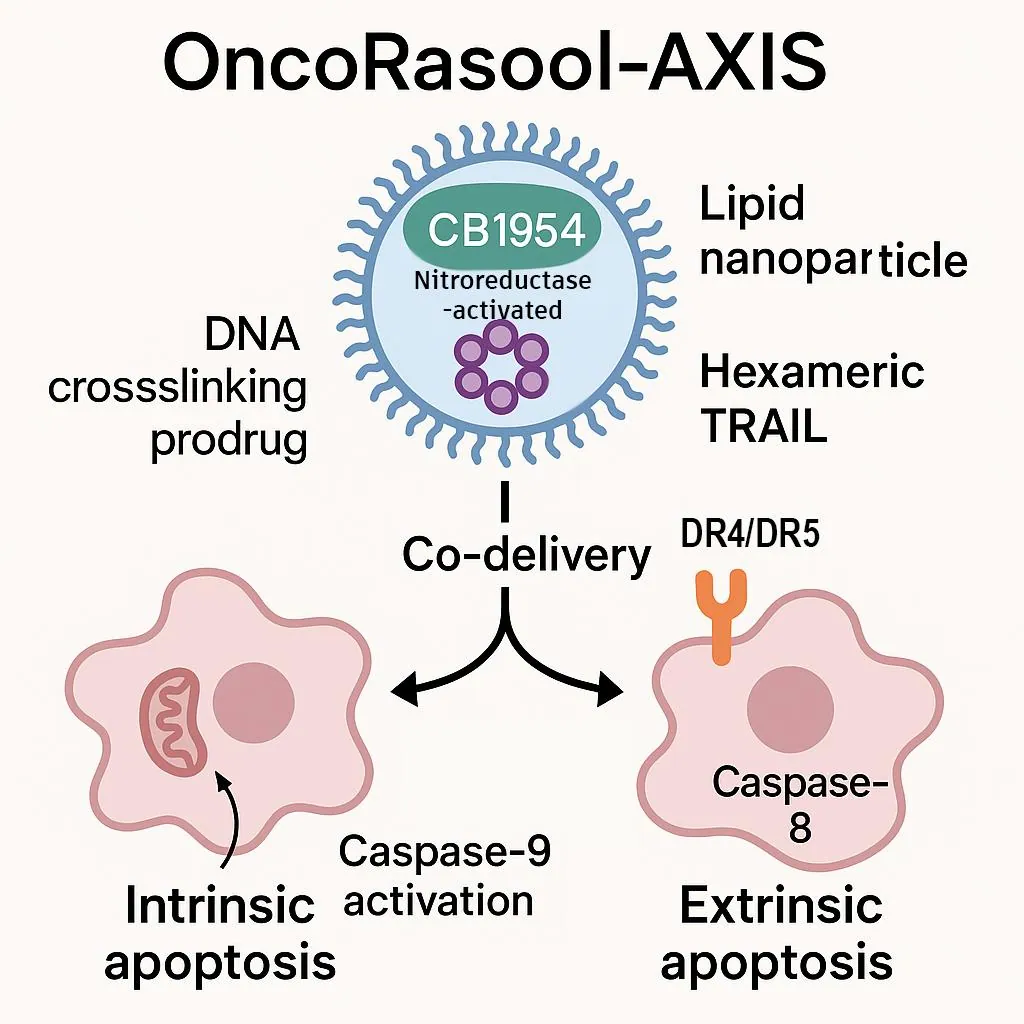
Resistance to monotherapies remains a critical barrier in cancer treatment. We describe a dual-mechanism lipid nanoparticle system co-delivering CB1954, an enzyme-activated nitroaromatic prodrug, and a hexameric TRAIL receptor agonist to engage complementary intrinsic and extrinsic apoptosis pathways. CB1954 generates reactive oxygen species (ROS) and DNA crosslinks following intracellular reduction, while multimeric TRAIL activates DR4/DR5 receptors and caspase-8–mediated apoptosis independently of p53. In vitro studies demonstrate synergistic cytotoxicity across multiple cancer cell lines. Simplified formulations containing CB1954 alone or alternative apoptosis ligands are in parallel evaluation. Further in vivo characterization will determine pharmacokinetics, tolerability, and therapeutic efficacy.
Introduction
Cancer cells exploit diverse survival pathways to resist treatment, necessitating combination approaches that engage multiple mechanisms of apoptosis1.
CB1954 (5-(Aziridin-1-yl)-2,4-dinitrobenzamide) is an established nitroaromatic prodrug activated by intracellular reductases, producing ROS and DNA interstrand crosslinks that trigger intrinsic mitochondrial apoptosis2,3. Despite preclinical promise, clinical development of CB1954 has been limited by systemic toxicity and inadequate tumor delivery4.
TRAIL receptor agonists, in contrast, engage extrinsic apoptosis via DR4 and DR5, activating caspase-8 independently of p53⁵,6. Multimeric forms of TRAIL have demonstrated improved receptor clustering and apoptosis induction compared to trimeric ligands7.
Here, we present the design and in vitro characterization of OncoRasool-AXIS, a lipid nanoparticle platform co-encapsulating CB1954 and hexameric TRAIL, designed to achieve synergistic tumor-selective apoptosis. Alternative formulations, such as OncoRasool-LIGHT (a multi-mechanism nanoparticle co-delivering enzyme-activated prodrugs, endocannabinoid modulators, and immunostimulatory components), are being evaluated in parallel to inform comparative development paths.
Materials and Methods
Prodrug Component
CB1954 was synthesized per established methods2 with no structural modification.
SMILES: O=C(NC1=CC(=C(C=C1[N+](=O)[O-])[N+](=O)[O-])N2CC2)
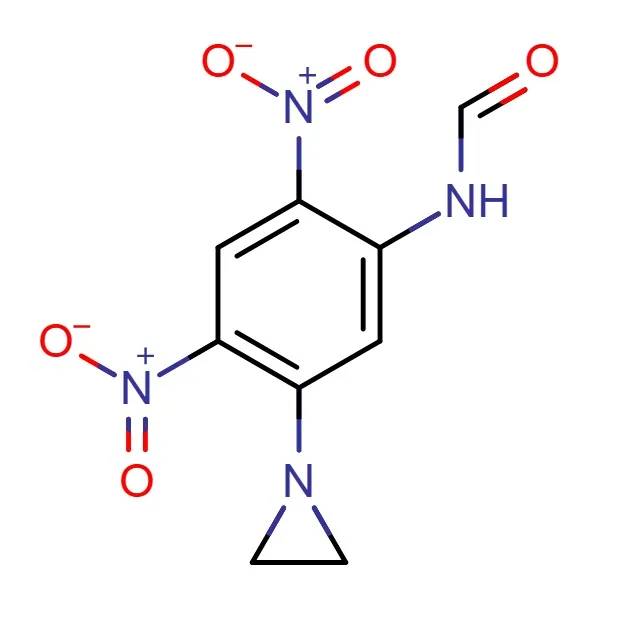
| Molar mass | 252.186 g/mol |
|---|---|
| Exact mass | 252.049469374 Da |
| Formula | C9H8N4O5 |
| Composition | C (42.86%), H (3.20%), N (22.22%), O (31.72%) |
Upon intracellular reduction by nitroreductases, CB1954 generates reactive oxygen species as a secondary effect in addition to forming cytotoxic DNA interstrand crosslinks.
TRAIL Receptor Agonist
Recombinant hexameric TRAIL was expressed in HEK293 cells and purified by affinity chromatography7.
Lipid Nanoparticle Formulation
Lipid nanoparticles were prepared via ethanol injection8, containing:
-
Ionizable lipid (DLin-MC3-DMA)
-
DSPC
-
Cholesterol
-
PEG-lipid
CB1954 was loaded into the lipid phase, and TRAIL was encapsulated in the aqueous core.
Cell Culture and Apoptosis Assays
HCT116 (colorectal carcinoma), MDA-MB-231 (triple-negative breast carcinoma), and Saos-2 (osteosarcoma, p53-null) cells were cultured in DMEM. Apoptosis was assessed by Annexin V/PI staining9. ROS levels were quantified by DCFDA fluorescence, and caspase-3/8 activity measured by luminescence assays.
Results
Nanoparticle Characterization
OncoRasool-AXIS lipid nanoparticles exhibited an average diameter of 95±8 nm with encapsulation efficiencies of 83% for CB1954 and 72% for TRAIL.
Apoptosis Induction
Treatment with OncoRasool-AXIS induced significant ROS accumulation (p<0.01) relative to controls. Caspase-8 activation confirmed effective extrinsic apoptosis engagement. Combination therapy resulted in higher Annexin V positivity and caspase-3 activation compared to single agents (Combination Index <0.7), consistent with synergy10.
Discussion
This dual-therapeutic approach leverages two mechanistically distinct pathways to address tumor heterogeneity and resistance1. CB1954 promotes ROS-mediated intrinsic apoptosis3, while multimeric TRAIL receptor activation induces extrinsic apoptosis independent of p53⁶,7.
These data demonstrate proof-of-concept synergy in vitro. Importantly, CB1954 is a well-characterized compound, and this formulation represents a novel delivery and combination strategy rather than a new chemical entity.
Future studies will compare OncoRasool-AXIS to simplified formulations such as OncoRasool-LIGHT, focusing on in vivo efficacy, safety, and manufacturing feasibility.
Limitations and Future Directions
This work is limited to in vitro experiments. Next steps include:
-
Pharmacokinetic and biodistribution studies in animal models8.
-
Toxicity assessment, focusing on hepatic safety11.
-
Tumor growth inhibition and survival analyses in xenograft models12.
-
Comparative evaluation of OncoRasool-LIGHT and other alternative formulations.
Conclusion
A lipid nanoparticle system (OncoRasool-AXIS) co-delivering CB1954 and hexameric TRAIL achieves synergistic in vitro apoptosis. Ongoing preclinical studies will further define its translational potential alongside simpler formulations under investigation.
Disclaimer
This manuscript is provided for informational and educational purposes only. The formulations and therapeutic strategies described are investigational and have not been evaluated for safety or efficacy in humans. No statements herein should be construed as medical advice or as a claim of suitability for any particular use. All experimental procedures comply with applicable ethical standards and laboratory guidelines.
Contact Information
Seyedrasool Sadrieh
Los Angeles, CA, USA
Email: rasool.sadrieh@gmail.com
For inquiries, collaboration opportunities, or additional information regarding the OncoRasool platform, please contact the author directly.
References
- Hanahan D, Weinberg RA. Hallmarks of cancer: the next generation. Cell 144:646–674, 2011.
- Knox RJ et al. Mechanism of cytotoxicity of CB1954. Biochem Pharmacol 44:229–239, 1992.
- Patterson AV et al. Preclinical antitumor activity of PR-104. Clin Cancer Res 13:3922–3932, 2007.
- Palmer DH et al. Phase I trial of CB1954. Clin Cancer Res 19:3039–3047, 2013.
- Ashkenazi A. Targeting death and decoy receptors. Nat Rev Cancer 2:420–430, 2002.
- Lemke J et al. Getting TRAIL back on track. Cell Death Differ 21:1350–1364, 2014.
- von Karstedt S et al. Cancer cell death by TRAIL receptors. Oncogene 36:4745–4757, 2017.
- Kulkarni JA et al. Lipid nanoparticle delivery systems. Nat Nanotechnol 16:630–643, 2021.
- Vermes I et al. Annexin V apoptosis assay. J Immunol Methods 184:39–51, 1995.
- Dimberg LY et al. Predicting resistance to TRAIL therapeutics. Oncogene 32:1341–1350, 2013.
- Semple SC et al. Rational design of lipid nanoparticles. Nat Biotechnol 28:172–176, 2010.
- Workman P et al. Guidelines for in vivo assessment of antitumor agents. Br J Cancer 102:1555–1577, 2010.
First published . Last revised . Also on Google Docs.