The Voyager Saga: Pioneering the Outer Solar System and Venturing into Interstellar Space
The Voyager missions, undertaken by NASA, represent a monumental chapter in the history of space exploration. Launched in 1977, the twin spacecraft, Voyager 1 and Voyager 2, were initially tasked with a detailed reconnaissance of the gas giants Jupiter and Saturn. However, their remarkable endurance and the ingenuity of their mission teams allowed for an unprecedented extension, encompassing flybys of Uranus and Neptune and culminating in their current groundbreaking journey into interstellar space. This report details the missions' origins, their transformative planetary encounters, current operational status, projected future, potential technological enhancements for such endeavors, and the significant challenges overcome throughout their multi-decade odyssey.
I. The Enduring Saga of the Voyager Probes: From Planetary Tour to Interstellar Odyssey
The Voyager missions' narrative is one of ambitious vision, pragmatic adaptation, and extraordinary scientific return, evolving from a focused planetary survey to humanity's first foray into the space between stars.
A. Genesis: From the Grand Tour Concept to Mission Launch
The conceptual seeds for the Voyager missions were sown in the late 1960s and early 1970s with the "Planetary Grand Tour" idea, notably advanced by engineers such as Gary Flandro at the Jet Propulsion Laboratory (JPL).1 This concept capitalized on a rare geometric alignment of the outer planets—Jupiter, Saturn, Uranus, and Neptune—that occurs only once every 175 years. Such an alignment presented a unique opportunity for a spacecraft to visit all four gas giants using gravity assists, thereby minimizing propellant requirements and overall trip duration.1 This celestial configuration was a fundamental enabler for the extended capabilities eventually realized by the Voyager program, underscoring the profound importance of long-term astronomical calculations in strategic mission planning.
Despite the scientific promise, the original Grand Tour proposal, envisioning multiple pairs of highly advanced Thermoelectric Outer Planets Spacecraft (TOPS), was deemed prohibitively expensive.2 Consequently, the mission was re-scoped with more modest objectives and a significantly reduced budget. Initially named Mariner Jupiter-Saturn and costing approximately $250 million, the mission was approved to conduct intensive flyby studies of only Jupiter and Saturn.2 The twin spacecraft were designed with an expected operational lifetime of five years to accomplish this two-planet survey.2 This scaling back illustrates the often-encountered pragmatic realities of space exploration funding, where ambitious scientific aspirations must frequently be reconciled with fiscal constraints. Nevertheless, the foundational design retained a degree of flexibility that would later prove crucial.
Voyager 2 was launched on August 20, 1977, followed by Voyager 1 on September 5, 1977, both departing from Cape Canaveral, Florida, aboard Titan-Centaur rockets.6 The selection of their flight paths was the result of extensive analysis, with over 10,000 potential trajectories being studied. The chosen routes optimized for close flybys of Jupiter and its large moon Io, and Saturn and its major moon Titan. Critically, Voyager 2's trajectory was designed to preserve the option of continuing on to Uranus and Neptune.2 Voyager 1's path, conversely, was tailored for a close encounter with Titan, a decision that, due to the gravitational mechanics involved, inexorably bent its trajectory northward, out of the ecliptic plane—the plane in which most planets orbit the Sun.2 This meticulous trajectory planning was fundamental not only to the initial mission's success but also to its eventual four-planet tour and Voyager 1's specific path into interstellar space.
The history of the Voyager missions presents an interesting paradox of scaled ambition yielding unforeseen longevity and scope. The initial, highly ambitious "Grand Tour" concept, involving multiple spacecraft and decades of operation 1, was curtailed due to budgetary realities, resulting in a more focused Jupiter-Saturn mission with a five-year design life.2 This might have been perceived as a significant compromise. However, the inherent robustness engineered into the spacecraft—even for this reduced scope, drawing on Mariner program heritage while also incorporating vital lessons from the Pioneer missions regarding Jupiter's harsh radiation environment 4—coupled with the strategic preservation of extended trajectory options 2, laid the groundwork for future expansion. The engineering philosophy that produced highly capable and adaptable (albeit with 1970s-era technology) spacecraft, augmented by subsequent upgrades to the Deep Space Network (DSN) 9 and remarkable in-flight reprogramming 2, meant that this "scaled-back" mission ultimately achieved, and in many ways surpassed, the scientific goals of the original Grand Tour concept. This was achieved incrementally, demonstrating that constrained beginnings, when coupled with robust design and operational ingenuity, can lead to unexpectedly grand outcomes. The mission's enduring success is a testament to designing for potential and adaptability, rather than solely for immediate, narrowly defined requirements.
B. The Planetary Grand Tour: Triumphs at Jupiter, Saturn, Uranus, and Neptune
The Voyager spacecraft conducted a series of encounters that fundamentally reshaped humanity's understanding of the outer solar system.
During their Jupiter encounters in 1979, both Voyager 1 and Voyager 2 executed detailed closeup studies, collectively capturing over 33,000 images.2 These encounters yielded a trove of groundbreaking discoveries. Perhaps the most astonishing was the observation of active volcanism on Jupiter's moon Io, a finding that overturned the prevailing notion of geologically inert satellites and was described as the "greatest surprise" of this mission phase.2 The probes also discovered Jupiter's faint ring system 7, provided unprecedented detail on the planet's dynamic atmospheric processes, enabling the creation of a time-lapse movie of its restless cloud tops 3, and identified new Jovian moons, including Thebe and Metis by Voyager 1.7 The wealth of data returned from the Jovian system effectively revolutionized the science of planetary astronomy.2
The Saturn encounters in 1980 (Voyager 1) and 1981 (Voyager 2) were equally revelatory. Voyager 1's trajectory was optimized for a close study of Saturn's largest moon, Titan. This revealed Titan's surprisingly thick, nitrogen-rich atmosphere (approximately 90% N2) 7, which hinted at the possibility of prebiotic chemical reactions occurring on its surface or within its atmosphere.7 Voyager 1 also provided detailed observations of Saturn's intricate ring structures, including the discovery of "shepherd moons" that gravitationally maintain the sharp edges of some rings.7 Additionally, Voyager 1 identified five new moons and a new ring, designated the G-ring.7 Voyager 2, following its sibling, gathered further extensive data on Saturn's rings, atmosphere, and its diverse family of moons.3 The complexity observed in Saturn's rings challenged existing theories of planetary ring formation and dynamics.
Following the resounding success of the Saturn flybys, and owing to the spacecraft's robust health and the foresight in its trajectory design, Voyager 2's mission was extended to explore Uranus and Neptune.6 To this day, Voyager 2 remains the only spacecraft to have visited these distant ice giants.6
The Uranus encounter in January 1986 unveiled a planet with a peculiar magnetic field, tilted at an astonishing 59 degrees with respect to its axis of rotation—the most tilted in the solar system. Voyager 2 also discovered new Uranian rings and ten previously unknown moons.3
Its subsequent Neptune encounter in August 1989 was similarly fruitful. The probe found an energetic weather system, including a prominent feature dubbed the "Great Dark Spot," analogous to Jupiter's Great Red Spot. Neptune's magnetic field was also found to be significantly tilted. Four new moons were discovered, and observations of Triton, Neptune's largest moon, revealed a surprisingly young and geologically active surface with cryovolcanic features.3 These encounters provided the first close-up data on the ice giants, dramatically expanding human knowledge of the diversity of planetary environments within our solar system.
The ability of the Voyager spacecraft to accomplish these extended objectives was not merely a consequence of their initial hardware capabilities but was critically dependent on the capacity for adaptive engineering and software re-programmability. The spacecraft were, in essence, enhanced in-flight.2 For the distant Uranus and Neptune encounters, where sunlight is exceedingly faint and communication times are protracted 11, significant operational modifications were imperative. Mission engineers developed special image processing techniques and reprogrammed the spacecraft's software to enable long-exposure imaging. A notable example is the Nodding Image Motion Compensation (NIMC) technique implemented for the Neptune encounter, which involved precisely rotating the entire spacecraft to track a target during exposures lasting up to 96 seconds, thereby preventing image smear.9 Furthermore, fault protection algorithms were modified to suit the long cruise phases of the Voyager Interstellar Mission.13 This capacity for remote adaptation acted as a scientific "force multiplier," allowing the mission to overcome unforeseen challenges and capitalize on new scientific opportunities. It effectively transformed a two-planet mission into a four-planet grand tour and, subsequently, an interstellar pathfinder, underscoring the immense value of designing spacecraft with substantial operational flexibility and a robust, adaptable software architecture.
C. Transition to the Stars: The Voyager Interstellar Mission (VIM)
With its planetary explorations concluded, the Voyager program embarked on an even more ambitious phase. The Voyager Interstellar Mission (VIM) officially commenced on January 1, 1990.7 The primary objective of VIM is to extend NASA's exploration beyond the realm of the outer planets, across the outer limits of the Sun's sphere of influence—known as the heliosphere—and, if possible, into true interstellar space.6 This marked a significant programmatic and scientific shift, transitioning focus from planetary science to heliophysics and the direct study of the interstellar medium, an unprecedented endeavor.
Several key milestones mark this phase of the mission. Before its imaging cameras were powered down to conserve energy for the long interstellar journey, Voyager 1, on February 14, 1990, captured the iconic "Solar System Family Portrait." This mosaic included the famous "Pale Blue Dot" image of Earth, a poignant perspective that has had a profound cultural and philosophical impact.7
As the spacecraft journeyed outward, they approached the boundaries of the heliosphere. Voyager 1 crossed the termination shock—the region where the supersonic solar wind abruptly slows down as it begins to interact with the interstellar medium—in December 2004, at a distance of approximately 94 Astronomical Units (AU) from the Sun.6 Voyager 2 followed, crossing the termination shock in August 2007 at about 84 AU.6
The next major boundary was the heliopause, considered the true edge of the heliosphere, beyond which lies interstellar space. Voyager 1 made its historic entry into interstellar space on August 25, 2012, at a distance of roughly 121-122 AU.1 This crossing was confirmed through meticulous analysis of data from its particle detectors, which showed a significant drop in solar particles and a corresponding increase in galactic cosmic rays, as well as data from its plasma wave instrument indicating a dramatic increase in plasma density.15 Voyager 2, traveling on a different trajectory and at a slightly slower speed, entered interstellar space on November 5, 2018.1 These achievements were unprecedented, marking humanity's first direct measurements of the interstellar medium and providing invaluable data on the complex interaction between our solar system and the galaxy beyond.
| Date | Spacecraft | Event / Discovery |
|---|---|---|
| August 20, 1977 | Voyager 2 | Launch |
| September 5, 1977 | Voyager 1 | Launch |
| March 1979 | Voyager 1 | Jupiter Flyby: Active volcanism on Io, Jovian ring system discovered, new moons (Thebe, Metis). |
| July 1979 | Voyager 2 | Jupiter Flyby: Further details of Jovian system, Europa's smooth, icy surface. |
| November 1980 | Voyager 1 | Saturn Flyby: Titan's thick nitrogen atmosphere, complex ring structures, shepherd moons, new moons, G-ring. |
| August 1981 | Voyager 2 | Saturn Flyby: Further details of Saturnian system, rings, and moons. Scan platform anomaly occurred. |
| January 1986 | Voyager 2 | Uranus Flyby: Highly tilted magnetic field, new moons and rings discovered. |
| August 1989 | Voyager 2 | Neptune Flyby: Great Dark Spot, geologically active Triton, new moons and rings. |
| January 1, 1990 | Both | Voyager Interstellar Mission (VIM) officially begins. |
| February 14, 1990 | Voyager 1 | Captures "Solar System Family Portrait," including the "Pale Blue Dot" image of Earth. Cameras then powered off. |
| December 2004 | Voyager 1 | Crosses the Termination Shock at ~94 AU. |
| August 2007 | Voyager 2 | Crosses the Termination Shock at ~84 AU. |
| August 25, 2012 | Voyager 1 | Enters Interstellar Space (crosses Heliopause) at ~121-122 AU. |
| November 5, 2018 | Voyager 2 | Enters Interstellar Space (crosses Heliopause). |
II. Voyagers in the Void: Current Status and Operations (as of May 2025 / Latest Data)
Having transitioned into the interstellar medium, the Voyager probes continue their journey, providing unique data from a region never before explored by human-made objects. Their current status reflects both their remarkable endurance and the ongoing challenges of operating aging spacecraft at immense distances.
A. Navigating Interstellar Space: Location, Velocity, and Environment
As of May 2025 (or the latest available mission data), Voyager 1 is the most distant human-made object, located at approximately 166.3 to 167.2 AU from the Earth and Sun.8 It is receding from the Sun at a velocity of about 3.5 AU per year, which translates to roughly 38,026 mph (17 km/s).1 Voyager 2 trails its twin, situated at approximately 139.2 to 139.8 AU from the Earth and Sun 18, and is moving outward at about 3.1 AU per year, or approximately 34,390 mph (15 km/s).1 These figures underscore the vast scale of their journey and their unique status as emissaries in interstellar space. Their velocities, achieved through multiple planetary gravity assists, are critical for their escape from the solar system's gravitational pull and dictate their long-term trajectories.
Both spacecraft are confirmed to be operating in interstellar space, having passed beyond the heliopause, the boundary delineating the Sun's direct plasma influence.1 Voyager 1 is currently traversing a region of space aligned with the constellation Ophiuchus 18, while Voyager 2 is heading in a southerly direction out of the ecliptic plane, towards the constellations of Sagittarius and Pavo.16 Their presence in this uncharted territory fulfills a key objective of the VIM: to directly sample and characterize the interstellar medium.
The data being returned by the active instruments on both probes provide invaluable insights into the interstellar environment. They are currently measuring the characteristics of interstellar magnetic fields, the flux and composition of galactic cosmic rays and other energetic particles, and the properties of plasma waves in the space between stars.15 This information is unique, as no other spacecraft have reached this region.15 Scientists eagerly anticipate further revelations about the interstellar medium and the complex ways in which our Sun's heliosphere interacts with its galactic surroundings.6
The differing exit points and times of the two Voyager spacecraft from the heliosphere offer critical, albeit sparse, three-dimensional information about its structure. Voyager 1 crossed the termination shock at approximately 94 AU, while Voyager 2 encountered it at about 84 AU.6 Similarly, their entries into interstellar space occurred at different heliocentric distances and times, with Voyager 1 heading generally "north" out of the ecliptic plane and Voyager 2 "south".2 These asymmetries strongly suggest that the heliosphere is not a perfectly uniform, spherical bubble. Instead, it appears to be a dynamic and permeable interface, likely compressed or elongated in various directions due to the Sun's motion through the local interstellar medium and the pressure exerted by that medium. The detection of a "hydrogen wall" by the Voyagers further points to complex interactions at this boundary, where interstellar neutral hydrogen accumulates.1 This understanding of the heliosphere as a structured, asymmetric, and interactive boundary, rather than a simple static shield, is a key finding derived from the Voyagers' divergent paths and is essential for refining models of our solar system's interaction with the galaxy.
B. Spacecraft Vital Signs: Power, Health, and Active Instrumentation
The longevity of the Voyager missions is inextricably linked to the health and power supply of the spacecraft. Both probes are powered by three Radioisotope Thermoelectric Generators (RTGs), which convert the heat from the natural decay of plutonium-238 into electricity.8 At launch, these RTGs provided approximately 470 watts of electrical power.8 However, due to the 87.7-year half-life of the plutonium fuel and the gradual degradation of the thermocouples that convert heat to electricity, the power output diminishes by about 4 watts each year for each spacecraft.8 This steady decline in available power is the primary limiting factor for the missions' operational lifespan and necessitates careful, strategic management, including the progressive shutdown of various instruments and their associated heaters.
As of early to mid-2025, many of the original scientific instruments have been turned off to conserve power. These include the Imaging Science Subsystem (ISS cameras, turned off in 1989 for Voyager 2 and 1990 for Voyager 1), the Ultraviolet Spectrometer (UVS), the Infrared Interferometer Spectrometer (IRIS), the Planetary Radio Astronomy (PRA) experiment, and the Photopolarimeter Subsystem (PPS).16 The focus of the VIM has been on the fields and particles instruments, deemed most crucial for studying the heliosphere and interstellar space.16
The current operational status of the key remaining science instruments is detailed in Table 2. Despite their advanced age—over 47 years of operation 18—and the harsh environment of deep space, the core systems of both Voyager spacecraft remain largely functional. This is a profound testament to their robust original design and construction.11 However, the aging hardware inevitably presents ongoing challenges and an increased likelihood of anomalies.13
| Instrument | Acronym | Primary Function | Voyager 1 Status (May 2025) | Voyager 2 Status (May 2025) | Source(s) |
|---|---|---|---|---|---|
| Imaging Science Subsystem | ISS | Wide/Narrow angle cameras for planetary imaging | Off (Feb 14, 1990) | Off (Oct/Dec 1989) | 18 |
| Ultraviolet Spectrometer | UVS | Atmospheric composition, radiation studies | Off (Apr 19, 2016) | Off (Nov 12, 1998) | 18 |
| Infrared Interferometer Spectrometer | IRIS | Temperature profiles, atmospheric composition, energy balance | Off (Jun 3, 1998) | Off (Feb 1, 2007) | 18 |
| Planetary Radio Astronomy | PRA | Planetary radio emissions, solar bursts | Off (Jan 15, 2008) | Off (Feb 21, 2008) | 18 |
| Photopolarimeter Subsystem | PPS | Surface texture, atmospheric particle properties | Off (Jan 29, 1980, degraded performance) | Off (Apr 3, 1991, degraded performance) | 18 |
| Triaxial Fluxgate Magnetometer | MAG | Measurement of planetary and interstellar magnetic fields | On | On | 18 |
| Plasma Spectrometer | PLS | Measurement of low-energy plasma particles (solar wind, interstellar plasma) | Off (Feb 1, 2007, degraded performance) | Off (Sep 26, 2024, power management) | 18 |
| Low-Energy Charged Particles | LECP | Measurement of medium/high energy particle composition, distribution, and energy spectra | On (Scheduled off in 2026) | Off (Mar 24, 2025, power management) | 18 |
| Plasma Wave Subsystem | PWS | Measurement of plasma wave electric field components, wave-particle interactions | On | On | 18 |
| Cosmic Ray Subsystem | CRS | Measurement of high-energy cosmic ray particles, their composition, and energy spectra | Off (Feb 25, 2025, power management) | On (Scheduled off in 2026) | 18 |
| Radio Science System | RSS | Utilizes communications system for determining gravity fields, masses, densities, and ring material properties | (Effectively off for primary science) | (Effectively off for primary science) | 7 |
The continued operation of the Voyager spacecraft, far exceeding their initial five-year design life 2, is not merely a passive endurance of their original hardware. Rather, it is an active, ongoing process reflecting a dynamic interplay between their robust initial design and persistent, creative human intervention. These spacecraft have encountered numerous hardware and software anomalies over nearly five decades, any one of which could have been mission-ending.24 Their survival and continued data return are the result of a dedicated team on Earth performing complex diagnostics, developing adaptive solutions, and implementing commands with extreme care. This often involves delving deep into original documentation and "getting into the heads of the original developers" 28 to understand system intricacies.11 The remote reprogramming and ingenious workarounds employed throughout the mission 2 illustrate that these are not static relics but are, in a sense, "living" systems whose functionality is co-created by their inherent design and continuous human intellectual engagement. This highlights a critical aspect of extremely long-duration missions: the "software" of human expertise, operational ingenuity, and meticulous knowledge stewardship becomes as vital as the physical hardware itself.
C. Whispers from the Cosmos: Data Transmission and Deep Space Network (DSN) Communication
Communicating with the Voyager spacecraft across the vastness of interstellar space is an extraordinary feat of engineering. Each probe is equipped with a 3.7-meter (12-foot) diameter High-Gain Antenna (HGA) that serves as its primary link to Earth.8 Commands are sent from Earth via S-band radio signals at a very low data rate of 16 bits per second. Downlink telemetry, carrying science and engineering data back to Earth, is transmitted via X-band, typically at 160 bits per second, with a higher rate of 1.4 kilobits per second available for the playback of high-rate plasma wave data stored on the onboard Digital Tape Recorder (DTR).8 The DTR itself has a limited capacity of about 67 kilobytes, used to store data when direct communication is not feasible.8 This communication system, designed and built in the 1970s, remains functional and represents humanity's most distant operational data link. The extremely low data rates, however, impose significant constraints on the volume of information that can be returned.
The immense distances involved result in extreme Round-Trip Light Times (RTLT)—the time it takes for a radio signal to travel from Earth to the spacecraft and for a response to return. As of May 2025, the one-way light time to Voyager 1 is over 23 hours, making the RTLT approximately 46 hours.18 For Voyager 2, the one-way light time exceeds 19 hours, resulting in an RTLT of about 38 hours.18 These profound delays render real-time control of the spacecraft impossible. Consequently, the Voyagers must operate with a high degree of autonomy, executing pre-programmed sequences of commands that are meticulously planned and uplinked well in advance.11 Troubleshooting any anomalies becomes a slow, painstaking process, often requiring days or weeks to send a command, receive a response, analyze the data, and formulate the next step.
All communications with the Voyager probes rely on NASA's Deep Space Network (DSN), a global array of large, highly sensitive radio antennas.8 Given the faintness of the signals from interstellar space, only the largest DSN antennas can effectively communicate with the Voyagers. Specifically, the 70-meter (230-foot) dish at the Canberra, Australia complex (DSS-43) is often the only antenna with sufficient signal power to send commands to the distant spacecraft.25 The DSN is a critical, shared resource, supporting numerous NASA and international missions. Securing adequate tracking time for Voyager can be challenging.13 Furthermore, periodic maintenance or upgrades to DSN facilities, such as the planned upgrades for DSS-43 from May 2025 through February 2026 25, can directly impact Voyager operations, sometimes creating narrow windows or imposing tight deadlines for mission teams to resolve critical issues.
D. Contemporary Challenges: Recent Anomalies and Engineering Ingenuity (as of 2023-2025)
Operating spacecraft for nearly half a century in the harsh environment of space inevitably leads to technical challenges. Recent years have seen several significant anomalies that have tested the ingenuity and perseverance of the Voyager mission team.
A notable issue affected Voyager 1's Flight Data Subsystem (FDS) starting in November 2023. The spacecraft began transmitting unreadable science and engineering data, essentially a garbled stream of alternating 1s and 0s.28 Investigation revealed that about 3% of the memory in one of the FDS computers had become corrupted.24 The FDS is responsible for packaging all science and engineering data before it is sent to Earth. The suspected cause was a single faulty memory chip, potentially damaged by an energetic particle from space or simply by wear-out after over 46 years of operation.24 Engineers at JPL embarked on a meticulous recovery process. This involved sending "poke" commands to the spacecraft to prompt it to send back a readout of the FDS memory, analyzing this data to pinpoint the corrupted code, and then carefully relocating the affected software to a working section of memory.8 This complex remote surgery was performed in stages, first to restore the flow of engineering telemetry, and subsequently to recover the science data streams. By May 2024, Voyager 1 was once again returning usable science data from all four of its active instruments.32 This successful resolution, achieved despite the extreme communication delays and the limitations of 1970s computer technology, showcased the remarkable problem-solving capabilities of the mission team.
Voyager 1 has also experienced ongoing issues with its thruster systems. The primary thrusters used for attitude control (roll maneuvers, essential for keeping the HGA pointed at Earth) experienced heater failures in 2004, leading to their deactivation.25 Since then, the spacecraft had relied on its backup roll thrusters. However, these backup thrusters began to show signs of degradation due to the buildup of residue in their fuel tubes, causing clogging.25 The Trajectory Correction Maneuver (TCM) thrusters, which had been successfully revived in 2017 for orientation control 8, also started experiencing similar clogging issues.35 The potential loss of roll control posed a severe threat to the mission, as it could prevent the spacecraft from accurately pointing its antenna towards Earth.25 In a remarkable feat of engineering in early 2025, the mission team successfully revived the primary roll thrusters that had been considered inoperable since 2004. They hypothesized that an electronics glitch, rather than an unfixable hardware failure, had caused the heaters for these thrusters to switch off. By carefully crafting and sending commands to effectively flip this suspected switch back to its correct position, the heaters were reactivated, and the primary roll thrusters were restored to operational status.25 This intricate operation was performed under significant time pressure, as the DSS-43 antenna, crucial for commanding Voyager, was scheduled for an extended period of upgrades.25
In contrast to these unexpected anomalies, Voyager 2 has undergone planned instrument shutdowns as part of its power management strategy. The Plasma Science (PLS) instrument was turned off in late 2024 (September/October) 18, and its Low-Energy Charged Particle (LECP) instrument was deactivated on March 24, 2025.18 These actions are part of the ongoing effort to conserve diminishing power reserves and prioritize the scientific investigations deemed most critical for the Voyager Interstellar Mission's objectives.
III. The Long Goodbye: Future Trajectory, Longevity, and Ultimate Fate
As the Voyager spacecraft continue their journey into the cosmos, their operational lifespan is finite, dictated primarily by their dwindling power supply. Their long-term trajectories will carry them silently through the Milky Way galaxy, serving as enduring emissaries of humanity.
A. Fading Power: Projected Operational Lifespan and Key Limiting Factors
The principal constraint on the Voyager missions' longevity is the progressive decline in power output from their Radioisotope Thermoelectric Generators (RTGs).8 Each spacecraft loses approximately 4 watts of electrical power per year due to the natural decay of their plutonium-238 fuel source and the degradation of the thermocouples converting heat into electricity.16 This unavoidable physical process necessitates a carefully managed power budget, forcing mission operators to make difficult choices about which instruments and essential heaters to turn off to prolong the operational life of the remaining systems.16
Current projections suggest that scientific data collection, with at least one instrument operational on each spacecraft, can likely continue until around 2025-2030.8 Some more optimistic estimates from the mission team suggest operations could extend into the 2030s.21 The team remains hopeful of keeping the spacecraft operational to celebrate their 50th anniversary in space in 2027.34 Beyond the cessation of science data return, it may be possible to receive basic engineering telemetry, indicating the general health and status of the spacecraft, until approximately 2036.8 This, however, depends on whether the spacecraft still possess sufficient power to transmit a detectable signal and the continued capability of the Deep Space Network to receive it.
While power decline is the primary driver, other factors also contribute to the eventual end of the missions. The reliability of nearly 50-year-old electronic circuitry is an ongoing concern, with the constant risk of faults induced by impacts from high-energy cosmic rays.38 Ironically, the older, bulkier circuitry used in Voyager is somewhat less susceptible to certain types of radiation damage than more modern, miniaturized components.38 Nevertheless, unexpected anomalies in the aging hardware remain a persistent threat.23 Maintaining robust communication links via the DSN at such extreme and increasing distances also presents a continuous challenge.16
| Milestone/Factor | Voyager 1 Projection | Voyager 2 Projection | Key Limiting Factor(s) | Source(s) |
|---|---|---|---|---|
| LECP Instrument Shutdown | 2026 | March 24, 2025 | Power Management | 18 |
| CRS Instrument Shutdown | Feb 25, 2025 | 2026 | Power Management | 18 |
| Continued Operation (at least one science instrument) | Into the 2030s (optimistic); ~2025-2030 (conservative) | Into the 2030s (optimistic); ~2025-2030 (conservative) | RTG Power Decline (4W/year/spacecraft) | 8 |
| End of Scientific Data Return | ~2025-2030 | ~2025-2030 | RTG Power Decline | 8 |
| End of Engineering Data / DSN Contact | ~2036 (estimated) | ~2036 (estimated) | RTG Power for Transmission, DSN Sensitivity | 8 |
| Hardware Reliability | Ongoing risk | Ongoing risk | Aging components, cosmic ray impacts, unforeseen anomalies | 23 |
B. Cosmic Itinerary: Long-Term Trajectories and Predicted Stellar Flybys
Having escaped the Sun's gravitational dominance, the Voyager probes are now on interstellar trajectories, their paths dictated by their final planetary encounters and the gravity assists received decades ago.
Voyager 1 is traveling at approximately 3.5 AU per year, on a path inclined about 35 degrees north of the ecliptic plane. It is heading towards the constellation Ophiuchus, generally in the direction of the solar apex (the direction of the Sun's motion relative to nearby stars).10 In approximately 40,272 AD, Voyager 1 is predicted to make a distant pass, within 1.7 light-years, of a star designated AC+79 3888, located in the constellation Ursa Minor.16 Another source mentions a similar flyby of the star Gliese 445 at a distance of 1.6 light-years in about 40,000 years 39; these may refer to the same faint star or represent slightly differing orbital calculations over vast timescales.
Voyager 2 is receding from the solar system at about 3.1 AU per year, its trajectory taking it about 48 degrees south of the ecliptic plane, towards the constellations of Sagittarius and Pavo.10 Its next predicted significant gravitational interaction will occur in approximately 40,000 years, when it is expected to pass within about 1.7 light-years of the star Ross 248, a small star in the constellation Andromeda.16
These trajectories define their silent passage into the Milky Way galaxy. The predicted stellar encounters, though exceedingly distant by human standards and occurring tens of millennia in the future, represent the next notable gravitational influences the probes will experience. Accurately predicting their paths beyond these encounters becomes exceedingly difficult due to the complex and somewhat chaotic gravitational dynamics within the galaxy.39
Long after their operational lives conclude and they cease transmitting data, the Voyager spacecraft will continue as passive test particles navigating the gravitational field of the Milky Way. Their precisely known initial trajectories and velocities, should they ever be hypothetically recoverable or observable by a vastly advanced future civilization, could serve as extraordinarily long-baseline probes for galactic dynamics. While not their intended scientific purpose, their physical presence and paths over cosmic timescales could, in theory, offer unique data points for refining models of stellar motions and the local galactic environment. This transforms them into unwitting, multi-millennial probes of our stellar neighborhood, simultaneously highlighting the immense timescales involved in interstellar travel and the inherent challenges in predicting precise stellar movements over such epochs.
C. Beyond Communication: The Voyagers as Silent Emissaries
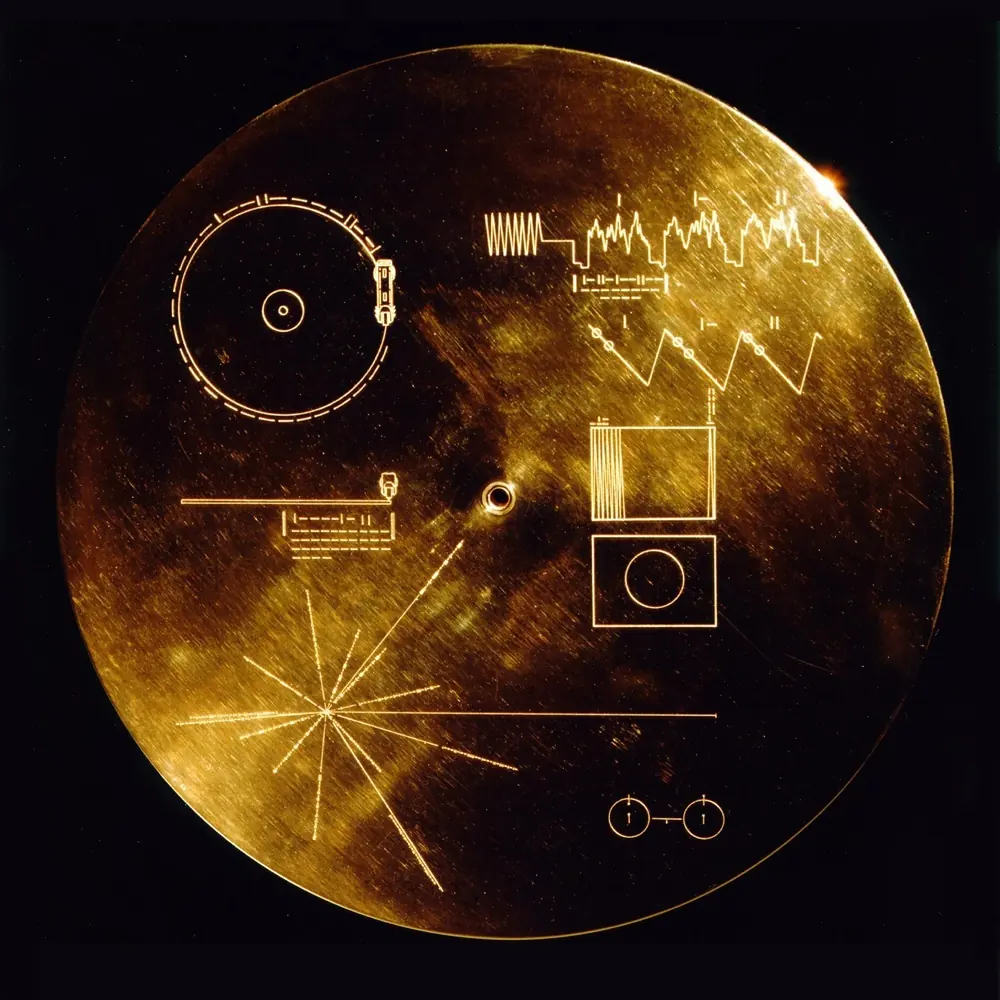
Beyond their scientific instruments, each Voyager spacecraft carries a unique artifact: the Golden Record. This is a 12-inch gold-plated copper disk containing a selection of sounds and images intended to portray the diversity of life and culture on Earth to any extraterrestrial civilization that might one day encounter the probes.6 Conceived by a committee led by the renowned astronomer Carl Sagan and radio astronomer Frank Drake 39, the record includes 115 images, a variety of natural sounds (such as those of wind, rain, and animals), musical selections from different cultures and eras, and spoken greetings in 55 ancient and modern languages. Etched onto its protective cover are symbolic instructions explaining the origin of the spacecraft and how to play the record, including a pulsar map indicating the location of our solar system relative to 14 known pulsars, and a diagram of the hydrogen atom's hyperfine transition to provide a fundamental unit of time.7
The Golden Record is a symbolic gesture, a "message in a bottle" cast into the cosmic ocean. It represents humanity's aspiration to communicate its existence and essence across vast expanses of space and time.
The ultimate fate of the Voyager probes is to wander the vast, largely empty expanses of the Milky Way galaxy. Barring an unimaginably improbable encounter with another celestial body or an advanced civilization, they are expected to drift silently for billions of years, their primary interactions being with sparse interstellar gas and microscopic dust particles.39 In this distant future, they will endure as perhaps the longest-lasting artifacts of human civilization, time capsules carrying a whisper of Earth into the galactic night.
IV. Enhancing the Exploration Frontier: Improvements and Lessons for Future Endeavors
The Voyager missions, while extraordinarily successful, were products of their time. Reflecting on their design and operational history offers insights into hypothetical improvements that might have been possible and, more significantly, provides crucial lessons and technological targets for future, more ambitious interstellar probes.
A. Retrospective Enhancements: Hypothetical Upgrades to the Voyager Design (within 1970s context or near-future tech from then)
Considering the technological landscape of the 1970s, any hypothetical enhancements to the Voyager design would have been constrained by available technology and budget.
-
Power Systems: The RTGs were the most advanced power source available for deep space missions far from the Sun.8 While exploring slightly more efficient radioisotopes or improved thermocouple materials might have offered marginal gains in power or longevity, significant breakthroughs beyond the chosen plutonium-238 RTGs were unlikely within the era's constraints. Indeed, even today, developing and sourcing adequate nuclear power systems remains a primary challenge for deep space missions, particularly regarding the availability of sufficient Plutonium-238.38
-
Data Storage and Processing: The Voyager spacecraft were equipped with a 67-kilobyte Digital Tape Recorder (DTR) for data storage.8 An increase in onboard memory capacity, perhaps using more advanced magnetic tape or early solid-state memory (if feasible within mass, power, and radiation-hardening constraints), could have allowed for greater data buffering. This would have reduced the immediate reliance on DSN downlink availability and potentially enabled the capture of more high-resolution data during flybys. Similarly, while the onboard computers (processing around 8,000 instructions per second, a stark contrast to the billions processed by modern smartphones 16) were sophisticated for their time, slightly more powerful processors might have permitted more complex autonomous operations or more efficient onboard data compression.
-
Communication Systems: The use of X-band for primary downlink was an advancement. Higher frequencies could have theoretically offered greater bandwidth, but this would have also demanded larger antennas or more power, both of which were tightly constrained. More sophisticated data compression algorithms, within the processing limits of 1970s technology, might have marginally improved effective data rates.
-
Instrumentation: The scientific payload was remarkably comprehensive for its era.7 Perhaps increased redundancy for the most critical science instruments, or the inclusion of slightly more advanced sensor technologies that fit within the stringent mass and power budgets, could have been considered. However, the selected suite represented a careful balance of capability and resource allocation.
-
Software and Autonomy: The Voyager spacecraft incorporated fault protection systems, a pioneering step in spacecraft autonomy.11 A more advanced system, perhaps akin to the Self-Test And Repair (STAR) computer concept originally envisioned for the more ambitious Grand Tour mission 4, could have provided enhanced onboard diagnostic and self-repair capabilities. However, such systems were complex and costly, and their development was a significant challenge at the time.
The Voyager missions' success suggests a careful balance was struck between leveraging mature, reliable technologies and integrating critical, targeted innovations. The original Grand Tour concept was highly ambitious, aiming to incorporate cutting-edge, and in some cases, still developmental technologies like the STAR computer.4 Budgetary pressures forced a shift towards more proven systems, drawing from the Mariner program heritage, to ensure the mission's feasibility and approval.4 However, the Voyager design was not entirely conservative; it strategically incorporated essential new technologies, such as radiation-hardened components (a critical late addition 4) and robust fault protection systems, which were indispensable for the spacecraft's survival and autonomous operation in the harsh environments of the outer solar system and beyond.11 The extraordinary longevity and scientific productivity of the missions indicate that the designers found an optimal "sweet spot." This implies that for missions characterized by extreme duration and ambitious scientific goals, a strategy based on a robust, proven core, selectively augmented with critical, well-justified innovations, is highly effective. This approach ensures both mission viability at inception and the potential for extraordinary, long-term scientific returns, demonstrating that the key is not just what could be added, but what should be added judiciously.
B. Charting New Paths: Technological Advancements for Next-Generation Interstellar Probes
Lessons from Voyager, coupled with decades of technological progress, inform the design concepts for future interstellar probes, which aim to travel farther, faster, and with significantly enhanced scientific capabilities.
-
Propulsion: A primary challenge for interstellar missions is achieving much higher velocities than Voyager's ~3.5 AU/year to reduce multi-decade or century-long travel times.
-
Solar Sails: NASA's Interstellar Probe (ISP) concept, for instance, proposed a 400-meter diameter solar sail to propel a spacecraft to 200 AU in approximately 15 years, achieving speeds around 14 AU/year.41 This requires ultra-lightweight sail materials (around 1 gram per square meter) and sophisticated deployment and control mechanisms.41
-
Electric Propulsion: Advanced electric drives, such as plasma thrusters, ion engines, or the Variable Specific Impulse Magnetoplasma Rocket (VASIMR), powered by onboard nuclear reactors, offer the potential for sustained, high-efficiency thrust, enabling higher speeds or greater payload capacity.42
-
Nuclear Thermal or Nuclear Electric Propulsion (NTP/NEP): These systems promise significantly higher performance than chemical rockets and are considered key enabling technologies for rapid transit to the outer solar system and beyond.42
-
-
Power Systems: Future probes will require more power for longer durations to support advanced instrumentation and high-bandwidth communications.
-
Advanced Nuclear Reactors: Compact, high-output nuclear fission reactors (e.g., NASA's Kilopower project, designed for 1-10 kW output) could provide ample power for electric propulsion and a full suite of instruments for many decades, far exceeding the capabilities and lifespan of RTGs.42
-
Diversified Power Sources: Augmenting a central power system with smaller, dedicated power sources like alphavoltaic cells for individual instruments could extend their operational life independently of the main system, overcoming issues like thermocouple degradation seen in RTGs.42
-
-
Instrumentation: Next-generation probes would carry instruments far superior to Voyager's.
-
The ISP concept includes a suite of miniaturized, low-power, advanced instruments for comprehensive in-situ measurements of plasma, energetic particles, magnetic fields, neutral atoms, and interstellar dust, with capabilities significantly exceeding those of Voyager.41 This includes energetic neutral atom (ENA) imagers and UV photometers for mapping large-scale heliospheric structures.41
-
The deployment of Cubesats from a primary interstellar probe could allow for distributed, multi-point measurements at various scientifically interesting locations along its trajectory.42
-
Enhanced spectrometers and detectors would allow for detailed chemical composition analysis of interstellar dust and gas, and more precise measurements of cosmic rays.41
-
-
Communication: Returning the significantly larger datasets from advanced instruments across interstellar distances necessitates higher bandwidth communication.
-
Autonomy and Onboard Processing: Given even longer round-trip light times for future, more distant probes, enhanced onboard autonomy driven by artificial intelligence will be crucial. This includes advanced fault diagnosis, autonomous scientific decision-making (e.g., identifying and prioritizing interesting phenomena), and efficient data compression and prioritization.
-
Modular Design: Designing future probes with a modular architecture could facilitate in-orbit assembly for larger, more complex spacecraft or potentially allow for future servicing or upgrades if such technologies become feasible.42 This reflects a lesson from Voyager's long life: adaptability is key.
C. Enduring Wisdom: Key Engineering, Operational, and Programmatic Lessons from the Voyager Legacy
The Voyager missions offer a wealth of lessons applicable to the design and execution of future deep space and interstellar endeavors.
-
Robust Design and Redundancy: A core principle evident in Voyager's success is designing systems not merely to meet baseline requirements but, as one project manager stated, "not to fail".23 Both Voyager spacecraft were built with extensive redundancy in critical components and subsystems.8 This engineering philosophy was paramount to their remarkable longevity and ability to overcome numerous in-flight anomalies. Lesson: For long-duration, remote missions where repair is impossible, over-engineering for reliability and incorporating comprehensive redundancy are critical investments.
-
In-flight Adaptability and Software Reprogrammability: The capacity to modify flight software and operational strategies long after launch proved indispensable for Voyager. It allowed mission controllers to address unforeseen hardware issues, optimize instrument performance in unexpected environments (like the low light at Uranus and Neptune), and repurpose systems for new objectives.2 Maintaining a complete flight software development and validation capability throughout the mission's lifecycle is vital for leveraging this adaptability.43 Lesson: Design spacecraft for evolution. They are not static entities once launched; their software and operational parameters should be viewed as adaptable assets.
-
Proactive Power Management Strategy: The systematic and conservative approach to power management, including the carefully planned, staged shutdown of instrument heaters and, eventually, instruments themselves, has been essential for maximizing the scientific return from the Voyagers' decaying RTG power sources.16 Lesson: Plan for graceful degradation. As resources dwindle on long-life missions, a clear strategy for prioritizing science objectives and managing power consumption is crucial.
-
Value of Precursor Missions: The design of Voyager benefited significantly from data returned by earlier missions, particularly the Pioneer spacecraft, whose measurements of Jupiter's intense radiation environment informed critical late-stage modifications to Voyager's radiation hardening.4 Lesson: Incremental exploration and dedicated precursor missions can significantly reduce risk and provide essential data for optimizing the design of more ambitious follow-on missions.
-
Long-Term Mission Planning and Sustained Support: Interstellar missions are inherently multi-decadal, if not generational, undertakings. This necessitates long-term vision in planning, consistent funding commitments, and strategies for maintaining staffing and expertise over extended periods.44 Lesson: Interstellar exploration requires programmatic and institutional endurance commensurate with the mission timescales.
-
Knowledge Management and Transfer: For missions spanning multiple generations of engineers and scientists, the preservation and effective transfer of critical system knowledge and operational expertise are paramount.11 The ability to troubleshoot aging, complex systems often relies on understanding the original design intent and undocumented idiosyncrasies. Lesson: Human expertise is as vital as hardware for mission longevity. Formal processes for knowledge capture, documentation, and continuous training are essential.
-
Openness to New Concepts and Innovative Processes: The Voyager missions benefited from a culture that, while grounded in proven engineering, was also open to innovation when necessary. Future missions should foster an environment that encourages new technological approaches, alternative operational modes (like the "sleep" mode of New Horizons), and even innovative management practices (such as the Cassini Resource Exchange model).44 Lesson: Cultivate a culture that embraces and strategically implements innovation to meet the unique challenges of deep space exploration.
-
International Collaboration: While Voyager was a NASA-led mission, future large-scale interstellar endeavors may benefit from or even necessitate international collaboration to distribute costs and leverage diverse expertise. Such partnerships, however, require careful coordination of planning timelines and programmatic requirements.44 Lesson: Plan for and proactively navigate the complexities and opportunities of international partnerships in major space science projects.
The remarkable endurance of the Voyager missions is not solely attributable to the initial design of the spacecraft themselves; it is also a consequence of the symbiotic evolution of both the space segment and the ground segment. Over nearly five decades, ground systems—including DSN antenna hardware, mission control software, and operational procedures—have had to adapt and be sustained to continue supporting the aging spacecraft. For instance, DSN antennas were physically upgraded to enhance sensitivity for the increasingly faint signals from Uranus and Neptune.9 Ground-based software systems used for generating command sequences (SEQTRAN) and simulating spacecraft behavior (COMSIM) had to be migrated from obsolete UNIVAC mainframe computers to more modern UNIX-based platforms.13 Operational philosophies also evolved for the VIM, emphasizing minimal ground commanding and more autonomous yearly operational cycles, driven by reduced flight team staffing and the extreme round-trip light times.13 This co-evolution is a critical, often less-publicized, aspect of mission longevity and success, underscoring that a deep space mission's viability extends far beyond the spacecraft itself and depends on the sustained capability and adaptability of its terrestrial support infrastructure.
V. Overcoming Adversity: The Toughest Challenges of the Voyager Missions
The Voyager program's journey has been marked by numerous formidable challenges, from its very inception through its ongoing interstellar voyage. The resilience of the spacecraft and the ingenuity of the mission teams in overcoming these hurdles are central to their legendary status.
A. Foundational Hurdles: Early Design, Budgetary Constraints, and the Radiation Imperative
The Voyager missions were born out of adversity. The ambitious "Grand Tour" concept, which envisioned sending four advanced spacecraft to all the outer planets, was cancelled in the early 1970s primarily due to its projected high cost (exceeding $1 billion in early 1970s currency) and the political difficulties associated with securing funding for such a long-duration, multi-administration project.3 At the time, a significant portion of NASA's budget was also being allocated to the development of the Space Shuttle, which competed for available resources.4 This led to the formulation of the more modest Mariner Jupiter-Saturn (MJS77) mission, which would later be renamed Voyager. A key decision to reduce costs for MJS77 was to leverage existing Mariner spacecraft technology and, critically, to forgo comprehensive radiation hardening of the spacecraft components, based on then-current models of Jupiter's radiation environment derived from Earth-based observations.4
This decision led to a radiation hardening crisis late in the development cycle. Data returned from the Pioneer 10 and 11 spacecraft, which flew by Jupiter in 1973 and 1974 respectively, revealed that Jupiter's radiation environment was approximately 1,000 times stronger than previously predicted.4 This information arrived after much of the design work for Voyager's electronics was complete. The new data indicated that if Voyager were to fly a trajectory far enough from Jupiter to ensure the survival of its unhardened components, the scientific return from the encounter would be minimal, rendering the mission "not worthy".4 This discovery posed an existential threat to the project. The mission team was forced to undertake a rapid and intensive effort to radiation-harden the spacecraft. This involved a multi-pronged approach: identifying and substituting existing components with inherently radiation-hard equivalents where possible, redesigning vulnerable circuits to make them more tolerant to radiation-induced degradation, and, as a last resort, adding physical shielding to protect sensitive electronics.4 This was a major and unexpected disruption to the project's development but was crucial for its ultimate success.
Even the launch phase presented challenges. During Voyager 1's launch, the Titan vehicle's LR-91 second stage engine shut down prematurely. Fortunately, the onboard intelligence of the Centaur upper stage recognized the performance deficiency and ordered a significantly longer burn of its own engines to compensate, nearly exhausting its propellant supply but successfully placing Voyager 1 on its required trajectory.8 This near-failure underscored the narrow margins involved in space launches.
B. Navigating the Giants: Complexities of Planetary Encounters
The planetary flyby phase of the mission, while scientifically triumphant, was not without its operational difficulties.
A significant anomaly occurred during Voyager 2's Saturn encounter in August 1981, when the azimuth actuator of its science scan platform seized. This platform is responsible for pointing the cameras and other remote sensing instruments at their targets.26 A similar scan platform failure had occurred on Voyager 1 during its Jupiter encounter in February 1979, which was attributed to contamination in the actuator's output gear mesh and resolved by repeatedly cycling the actuator to break down the contaminant.26 However, when this same procedure was initially applied to Voyager 2, it failed to resolve the issue.26 This loss of pointing capability for key instruments was a serious concern, as it jeopardized not only the remaining Saturn observations but also the potential for extending the mission to Uranus and Neptune. Through persistent efforts and a series of ground commands, partial operation of the scan platform was restored approximately 2.8 days after the anomaly began, allowing some scientific observations to resume.27 Subsequent investigation, including life-cycle testing of a prototype actuator in a laboratory, revealed that the problem was due to a design flaw in the actuator shaft bearing and its lubrication system, exacerbated by corrosion from dissimilar metal electrochemical reactions and a buildup of debris due to a lack of relief ports.27
Another major challenge during the planetary encounters, particularly at Uranus and Neptune, was the extremely low light levels. These ice giants are much farther from the Sun than Jupiter and Saturn, resulting in significantly less illumination for imaging with Voyager's 1970s-era vidicon camera systems.9 To capture usable images, exposure times of up to 96 seconds were sometimes necessary.9 Such long exposures, while the spacecraft was moving at high velocity relative to its targets, would normally result in severe image smear. To overcome this, JPL engineers developed sophisticated Image Motion Compensation (IMC) techniques. For the Neptune encounter, a specific technique called "Nodding Image Motion Compensation" (NIMC) was implemented. This involved reprogramming the spacecraft's flight software so that the entire spacecraft would slowly and precisely rotate to track the target while the camera shutter was open. To minimize any jitter that could blur the images, the firing duration of the attitude control thrusters was shortened to less than four milliseconds.9 After an exposure, the spacecraft would reorient its high-gain antenna towards Earth to transmit the image data, then "nod" back to its next target to acquire another image.
The faintness of the telemetry signals from Uranus and Neptune also necessitated significant upgrades to the Deep Space Network (DSN) antennas on Earth. The large dish antennas at the DSN complexes were expanded to 64 meters in diameter before the Uranus encounter and further enlarged to 70 meters for the Neptune encounter to ensure reliable data reception.9
C. The Interstellar Marathon: Sustaining Operations Against Distance, Aging, and Depleting Power
The Voyager Interstellar Mission (VIM) phase has presented its own unique and escalating set of challenges, primarily stemming from the extreme distances involved, the aging of the spacecraft hardware, and the inexorable decline of their power supply.
The extreme distance and associated communication delays are profound. With round-trip light times now approaching two days (approximately 46 hours for Voyager 1 and 38 hours for Voyager 2) 11, real-time interaction with the spacecraft is impossible. Troubleshooting anomalies becomes an exceptionally slow and deliberate process.11 Data rates are also incredibly low, typically 160 bits per second.13 To manage these constraints, the spacecraft operate with a high degree of autonomy, executing pre-programmed command sequences, often in the form of annual cyclic baseline loads that minimize the need for frequent ground commanding.13 Communication relies on the most sensitive DSN antennas, particularly the 70-meter dish in Canberra.25
Aging hardware has led to several critical anomalies in recent years. The FDS memory corruption on Voyager 1 in 2023-2024, which rendered its data unreadable for months, required an intricate remote software patching effort, relocating code from the faulty memory region to a healthy one.8 Ongoing degradation of Voyager 1's thrusters, due to clogged fuel lines and heater failures, has necessitated complex procedures to switch between primary, backup, and even trajectory correction thruster sets, including the remarkable revival of long-dormant thrusters previously deemed inoperable.8 While the scan platforms were largely shut down for power-saving reasons (Voyager 2's in 1998, Voyager 1's last scan platform instrument, UVS, in 2016 13), these events underscore the continuous effort to manage and mitigate the effects of nearly five decades of operation in a harsh environment.
The declining RTG power, with a loss of about 4 watts per year per spacecraft 16, remains the ultimate arbiter of mission duration. This has forced a strategy of progressive, prioritized shutdowns of instrument heaters and, eventually, the instruments themselves.16 Remarkably, in some cases, turning off heaters allowed instruments to continue functioning at temperatures far colder than their original design specifications.11
Finally, operational challenges include reduced DSN tracking availability and a significantly smaller flight team compared to the prime mission (from around 50 personnel at the start of VIM to approximately 12 full-time equivalents currently).13 This necessitates highly efficient operational procedures, extensive automation where possible (such as the VAMPIRE alarm monitoring tool 14), and a team of experienced engineers capable of performing multiple roles.
D. Preserving Expertise: The Challenge of Knowledge Stewardship in Multi-Decadal Missions
A unique and critical challenge for a mission as long-lived as Voyager is the preservation and transfer of expert knowledge. As the original engineers and scientists who designed, built, and initially operated the spacecraft retire, their deep, often undocumented, understanding of the systems' intricacies and idiosyncrasies is at risk of being lost.13 Current and future mission teams face the daunting task of operating and troubleshooting these nearly 50-year-old systems, often relying on aging documentation ("yellowing paper" 29) and attempting to "get into the heads of the original developers".28 The Voyager program's continued success heavily relies on the dedication of long-serving engineers, many of whom are past typical retirement age, and on informal mentoring processes.11 While NASA has broader knowledge capture initiatives 46, the specific, deeply embedded expertise related to Voyager is a precious and diminishing resource. The human infrastructure and the institutional knowledge passed down through generations of engineers have become as critical as the hardware itself.29
The obsolescence of original software and development tools also poses a challenge. For example, the ground software systems (SEQTRAN for sequence generation and COMSIM for simulation) initially ran on now-antiquated UNIVAC mainframe computers. These had to be painstakingly converted and rewritten to function on more modern UNIX-based systems (like HSSIM) early in the VIM phase, ensuring that the functionality was maintained while adapting to new platforms.13 Operating these spacecraft sometimes involves understanding machine code written before the advent of common operating systems like MS-DOS.29
The "hardest challenge" for the Voyager missions is not a single, isolated event from their past but rather an evolving condition. While acute crises such as the initial radiation-hardening imperative 4 or the recent FDS data corruption on Voyager 1 24 were undoubtedly formidable and mission-threatening at their respective times, the overarching and most profound challenge, particularly in the current VIM phase, is the sustained, resource-constrained management of these unique, irreplaceable, and progressively degrading systems operating at the very frontiers of known space and technological endurance. This involves not only dealing with the physical aging of the hardware and the inexorable decline in power but also safeguarding and applying the specialized human expertise required to diagnose and fix problems that are often without precedent, using technology that is decades old. The recent successful resolutions of the FDS and thruster issues on Voyager 1 24 are prime examples of this ongoing effort. They were not merely about fixing a component; they were about deeply understanding and carefully manipulating an ancient, incredibly distant system with significant risk and extreme difficulty. This cumulative, persistent effort to keep these venerable explorers alive and scientifically productive against the forces of distance, decay, and diminishing resources arguably represents the mission's most significant and sustained challenge to date.
| Challenge Category | Specific Challenge | Engineering Solution(s) / Mitigation | Key Phase(s) | Source(s) |
|---|---|---|---|---|
| Design & Development | Grand Tour Cancellation / Budget Constraints | Scaled-down MJS77 mission utilizing Mariner spacecraft heritage. | Pre-Launch | 3 |
| Jupiter Radiation Environment (1000x stronger than initially expected) | Late-stage, intensive radiation hardening efforts (rad-hard components, circuit redesign, physical shielding). | Pre-Launch | 4 | |
| Launch | Voyager 1 Titan Second Stage Premature Engine Cutoff | Centaur upper stage's onboard computer autonomously ordered an extended burn to compensate for velocity shortfall. | Launch | 8 |
| Planetary Encounters | Voyager 2 Scan Platform Azimuth Actuator Seizure (Saturn Encounter) | Series of ground commands for partial operational restoration; later analysis identified lubrication system/design flaw. (Initial attempts to cycle actuator, successful on V1, failed for V2). | Saturn Encounter | 26 |
| Low Light Imaging Conditions at Uranus/Neptune | Development of Image Motion Compensation (IMC) and Nodding IMC (NIMC) techniques; spacecraft software reprogramming for long exposures; precise, short thruster bursts for stability. | Uranus & Neptune | 9 | |
| Weak Telemetry Signals from Outer Planets | Significant upgrades to Deep Space Network (DSN) antenna sensitivity (dishes expanded to 64m for Uranus, 70m for Neptune). | Uranus & Neptune | 9 | |
| Interstellar Mission | Extreme Communication Delay (RTLT) & Very Low Data Rates | High degree of spacecraft autonomy; pre-programmed command sequences (e.g., annual cyclic baseline loads); minimized real-time commanding; prioritization of DSN resources. | VIM (Ongoing) | 11 |
| Voyager 1 FDS Memory Corruption (Resulting in Unreadable Data) | Intricate remote software patching; relocation of affected FDS code from faulty memory chip to a working area; multi-stage recovery process for engineering and science data. | VIM (2023-2024) | 8 | |
| Voyager 1 Thruster Degradation (Clogging, Heater Failures) | Strategic switching between primary, backup, and Trajectory Correction Maneuver (TCM) thruster sets; innovative revival of long-dormant primary roll thrusters by remotely fixing suspected heater circuit glitch. | VIM (Ongoing) | 8 | |
| Declining RTG Power Output | Systematic, strategic shutdown of instrument heaters and, subsequently, non-essential or lower-priority scientific instruments; careful power budgeting to prioritize key VIM science (fields & particles instruments). | VIM (Ongoing) | 16 | |
| General Aging Hardware Reliability | Robust original spacecraft design with extensive redundancy; continuous monitoring by experienced engineering team; creative remote troubleshooting for novel issues. | VIM (Ongoing) | 11 | |
| Mission Operations | Knowledge Retention & Transfer for Multi-Decadal Mission | Heavy reliance on long-serving, highly experienced engineers (many past retirement age); mentoring; efforts to access original documentation and understand original developer insights. | Entire Mission | 11 |
| Modernization of Antiquated Ground Software/Hardware Systems | Conversion of original UNIVAC mainframe-based ground software (SEQTRAN, COMSIM) to more modern UNIX-based systems (e.g., HSSIM). | Early VIM | 13 | |
| Reduced Staffing Levels and DSN Resource Allocation | Multi-functional roles for flight team members; increased automation in ground monitoring (e.g., VAMPIRE tool); highly efficient sequencing and operational procedures. | VIM (Ongoing) | 13 |
VI. Conclusion: The Unparalleled Legacy and Future Inspiration of the Voyager Missions
The Voyager 1 and Voyager 2 missions stand as an unparalleled triumph of scientific exploration and human ingenuity. Originally conceived for a five-year tour of Jupiter and Saturn, they transcended their initial objectives to conduct the first, and to date only, close-up reconnaissance of Uranus and Neptune, and subsequently became humanity's first emissaries to interstellar space. Their journey has fundamentally reshaped our understanding of the outer solar system, revealing the astonishing diversity of planets and moons, from the volcanic fury of Io and the shrouded mysteries of Titan to the unique environments of the ice giants and the active cryovolcanism of Triton.
The missions' transition into the Voyager Interstellar Mission marked a new era of discovery, providing the first direct measurements of the heliosphere's outer boundaries and the nature of the interstellar medium beyond. Data from their active fields and particles instruments continue to stream back, offering unique insights into the interaction between our Sun's domain and the vast galaxy that surrounds it. These achievements were made possible not only by the robust initial design of the spacecraft but also by the decades of dedicated effort from brilliant scientists and engineers who repeatedly devised ingenious solutions to overcome daunting technical challenges, from aging hardware and dwindling power to extreme communication distances. The ability to remotely reprogram and adapt these 1970s-era machines to meet new scientific goals and overcome unforeseen anomalies is a testament to exceptional engineering foresight and operational skill.
The legacy of Voyager extends beyond its direct scientific contributions. The iconic "Pale Blue Dot" image of Earth provided a profound perspective on our planet's place in the cosmos, while the Golden Records carried aboard each spacecraft serve as enduring symbolic messages to the universe. Culturally, Voyager has inspired generations and continues to highlight humanity's innate drive to explore and understand.
Furthermore, the Voyager missions serve as crucial pathfinders for future interstellar exploration. The engineering solutions developed, the operational strategies honed over nearly half a century, and the very understanding of how to maintain a spacecraft functional for such extended durations in deep space provide invaluable lessons. The challenges faced—particularly concerning power longevity, communication over vast distances, spacecraft autonomy, and the critical need for sustained knowledge management across generations of mission personnel—directly inform the design and planning for next-generation interstellar probes. These future missions will aim to build upon Voyager's foundation, incorporating advanced propulsion systems, more powerful and longer-lived energy sources, and more sophisticated instrumentation to venture even farther and faster into the cosmic unknown.
In essence, the Voyager saga is a story of audacious goals, remarkable resilience, and transformative discovery. It underscores the profound rewards that come from investing in long-term scientific exploration and stands as an enduring inspiration for humanity to continue reaching for the stars.
Works cited
- Voyager program - Wikipedia, accessed May 29, 2025, https://en.wikipedia.org/wiki/Voyager_program
- Planetary Voyage - NASA Science, accessed May 29, 2025, https://science.nasa.gov/mission/voyager/planetary-voyage/
- Voyagers 1 and 2 Explore the Outer Planets | EBSCO Research Starters, accessed May 29, 2025, https://www.ebsco.com/research-starters/history/voyagers-1-and-2-explore-outer-planets
- The Stories Behind the Voyager Mission: Bud… | The Planetary ..., accessed May 29, 2025, https://www.planetary.org/articles/stories_schurmeier
- science.nasa.gov, accessed May 29, 2025, https://science.nasa.gov/mission/voyager/fact-sheet/#:~:text=The%20twin%20spacecraft%20Voyager%201,moons%20of%20the%20two%20planets.
- Mission Overview - NASA Science, accessed May 29, 2025, https://science.nasa.gov/mission/voyager/mission-overview/
- Voyager 1 - NASA Science, accessed May 29, 2025, https://science.nasa.gov/mission/voyager/voyager-1/
- Voyager 1 - Wikipedia, accessed May 29, 2025, https://en.wikipedia.org/wiki/Voyager_1
- [AS]Giant Radio Ear: Remembering Voyager 2's Encounter With Neptune, 30 Years On, accessed May 29, 2025, http://www.forum.kosmonauta.net/index.php?topic=3774.0
- Fact Sheet - NASA Science, accessed May 29, 2025, https://science.nasa.gov/mission/voyager/fact-sheet/
- Small Steps, Giant Leaps: Episode 98: Voyager - NASA, accessed May 29, 2025, https://www.nasa.gov/podcasts/small-steps-giant-leaps/small-steps-giant-leaps-episode-98-voyager/
- The Uranus and Neptune systems - Cambridge Core - Journals & Books Online, accessed May 29, 2025, https://resolve.cambridge.org/core/services/aop-cambridge-core/content/view/50C242D8DBE952008FE6AB49E87A9C5E/9781139020961c10_p201-209_CBO.pdf/uranus_and_neptune_systems.pdf
- Voyager Interstellar Mission: Challenges of flying a very old spacecraft on a very long mission - Computer Science Club, accessed May 29, 2025, https://csclub.uwaterloo.ca/~pbarfuss/VIMChallenges.pdf
- Voyager Interstellar Mission: Challenges of flying a very old spacecraft on a very long mission, accessed May 29, 2025, https://arc.aiaa.org/doi/pdf/10.2514/6.2016-2415
- Interstellar Mission - NASA Science, accessed May 29, 2025, https://science.nasa.gov/mission/voyager/interstellar-mission/
- Frequently Asked Questions - NASA Science, accessed May 29, 2025, https://science.nasa.gov/mission/voyager/frequently-asked-questions/
- Questions for 'The biggest discoveries of Voyagers — NASA's most distant explorers', accessed May 29, 2025, https://www.snexplores.org/classroom-question/questions-for-the-biggest-discoveries-of-voyagers-nasas-most-distant-explorers
- Where Are Voyager 1 and 2 Now? - NASA Science, accessed May 29, 2025, https://science.nasa.gov/mission/voyager/where-are-voyager-1-and-voyager-2-now/
- Voyager 1 | TheSkyLive, accessed May 29, 2025, https://theskylive.com/voyager1-info
- Voyager's Scientific Toolkit - PBS, accessed May 29, 2025, https://www.pbs.org/the-farthest/science/voyagers-scientific-toolkit/
- NASA Turns Off 2 Voyager Science Instruments to Extend Mission ..., accessed May 29, 2025, https://www.jpl.nasa.gov/news/nasa-turns-off-two-voyager-science-instruments-to-extend-mission/
- Instruments - NASA Science, accessed May 29, 2025, https://science.nasa.gov/mission/voyager/instruments/
- Still Kickin' Since the '70s: NASA's Voyager Mission Keeps Exploring - NASA Science, accessed May 29, 2025, https://science.nasa.gov/missions/voyager-program/still-kickin-since-the-70s-nasas-voyager-mission-keeps-exploring/
- Engineers Pinpoint Cause of Voyager 1 Issue, Are Working on Solution - NASA Science, accessed May 29, 2025, https://science.nasa.gov/blogs/voyager/2024/04/04/engineers-pinpoint-cause-of-voyager-1-issue-are-working-on-solution/
- NASA's Voyager 1 Revives Backup Thrusters Before Command Pause, accessed May 29, 2025, https://www.jpl.nasa.gov/news/nasas-voyager-1-revives-backup-thrusters-before-command-pause/
- The Voyager 2 scan platform anomaly - NASA Technical Reports ..., accessed May 29, 2025, https://ntrs.nasa.gov/citations/19830062955
- Voyager Scan Platform Problems - Llis, accessed May 29, 2025, https://llis.nasa.gov/lesson/394
- NASA's Voyager 1 spacecraft is talking nonsense. Its friends on Earth are worried - OPB, accessed May 29, 2025, https://www.opb.org/article/2024/03/06/nasa-s-voyager-1-spacecraft-is-talking-nonsense-its-friends-on-earth-are-worried/
- NASA's Project Scientist Faces Painful Choices as Voyager Mission Nears Its End | Hacker News, accessed May 29, 2025, https://news.ycombinator.com/item?id=43595293
- How We Diagnosed and Fixed the 2023 Voyager 1 Anomaly from 15 Billion Miles Away, accessed May 29, 2025, https://www.youtube.com/watch?v=YcUycQoz0zg
- NASA's Voyager 1 Revives Backup Thrusters Before Command Pause, accessed May 29, 2025, https://science.nasa.gov/blogs/voyager/2025/05/14/nasas-voyager-1-revives-backup-thrusters-before-command-pause/
- Voyager - NASA Science, accessed May 29, 2025, https://science.nasa.gov/blogs/voyager/
- NASA resurrects Voyager 1 interstellar spacecraft's thrusters after 20 years: 'These thrusters were considered dead' | Space, accessed May 29, 2025, https://www.space.com/space-exploration/missions/nasa-resurrects-voyager-1-interstellar-spacecrafts-thrusters-after-20-years-these-thrusters-were-considered-dead
- A broken thruster jeopardized Voyager 1, but engineers executed a remote fix - NPR, accessed May 29, 2025, https://www.npr.org/2025/05/20/nx-s1-5403501/voyager-thruster-nasa-interstellar
- NASA's Voyager 1 probe swaps thrusters in tricky fix as it flies through interstellar space, accessed May 29, 2025, https://www.space.com/voyager-1-interstellar-space-thruster-fix
- NASA Turns Off 2 Voyager Science Instruments to Extend Mission, accessed May 29, 2025, https://science.nasa.gov/blogs/voyager/2025/03/05/nasa-turns-off-2-voyager-science-instruments-to-extend-mission/
- NASA switches off Voyager instruments to extend life of the two interstellar spacecraft 'Every day could be our last.', accessed May 29, 2025, https://www.space.com/nasa-switches-off-voyager-instruments-to-extend-life-of-the-two-interstellar-spacecraft
- Recently I read that the Voyagers spacecraft are 48 years old with perhaps 10 years left. If built with current technology what would be the expected life span be? : r/space - Reddit, accessed May 29, 2025, https://www.reddit.com/r/space/comments/1j8o02m/recently_i_read_that_the_voyagers_spacecraft_are/
- The Fate of the Voyagers - Space, accessed May 29, 2025, https://www.space.com/39161-fate-of-the-voyager-spacecraft.html
- Voyager 2 - Spacecraft - the NSSDCA, accessed May 29, 2025, https://nssdc.gsfc.nasa.gov/nmc/spacecraft/display.action?id=1977-076A
- www.kiss.caltech.edu, accessed May 29, 2025, https://www.kiss.caltech.edu/workshops/ism/presentations/Liewer_IS-ProbeCospar2001.pdf
- bibliotekanauki.pl, accessed May 29, 2025, https://bibliotekanauki.pl/articles/27314483.pdf
- NASA LLIS, accessed May 29, 2025, https://llis.nasa.gov/lesson/401
- Lessons learned from (and since) the Voyager 2 flybys of Uranus ..., accessed May 29, 2025, https://pmc.ncbi.nlm.nih.gov/articles/PMC7658786/
- Lessons learned from (and since) the Voyager 2 flybys of Uranus and Neptune, accessed May 29, 2025, https://www.researchgate.net/publication/346760968_Lessons_learned_from_and_since_the_Voyager_2_flybys_of_Uranus_and_Neptune
- Knowledge Capture and Transfer - nasa appel, accessed May 29, 2025, https://appel.nasa.gov/critical-knowledge/knowledge-capture-and-transfer/
- EPISODE 98: VOYAGER | APPEL Knowledge Services, accessed May 29, 2025, https://appel.nasa.gov/podcast/episode-98-voyager/
- The Smart Mission: NASA's Lessons for Managing Knowledge, People, and Projects - Amazon.com, accessed May 29, 2025, https://www.amazon.com/Smart-Mission-Managing-Knowledge-Projects/dp/0262046881
- Voyager 2 Encounter with the Saturnian System, accessed May 29, 2025, https://epizodyspace.ru/bibl/inostr-yazyki/science/1982/Stone_Miner_Voyager%202%20Encounter%20with%20the%20Saturnian%20System_---_Science_215_no_4532_(1982).pdf
First published . Last revised . Also on Google Docs.