The Last Light: A Civilization's Futile Reach for the Stars in a Dying Universe
I. Introduction: A Universe on the Brink
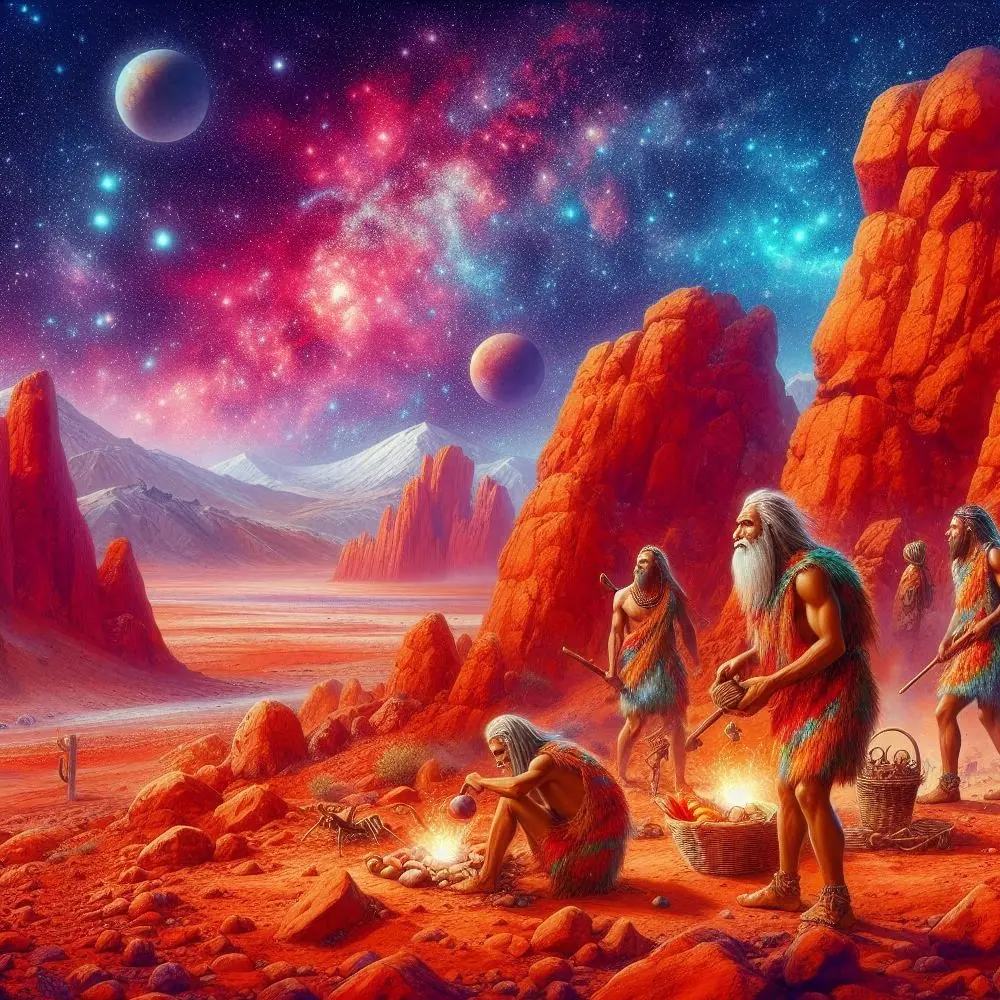
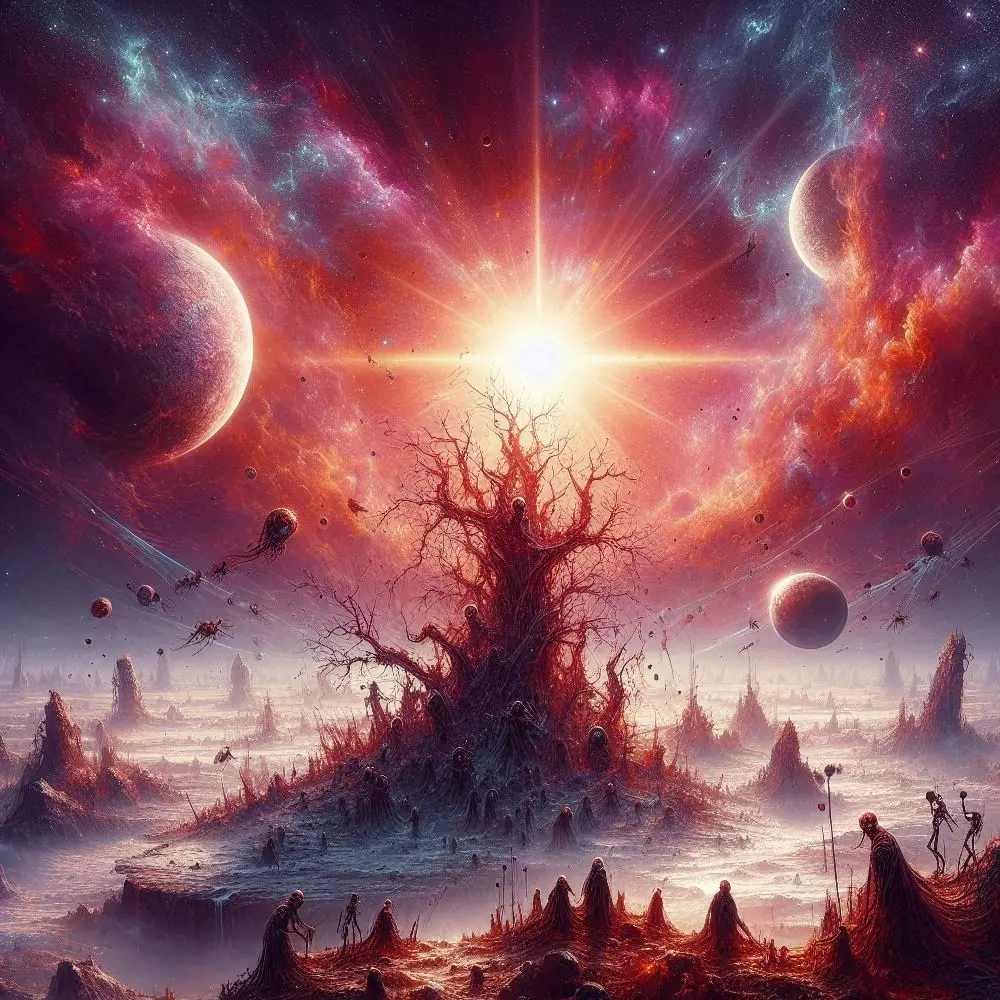
The scenario presented—a civilization, unaware of the grand cosmic finale unfolding around them, striving to reach the stars as the very last star in their vicinity expands in its death throes—is a profoundly evocative narrative. It speaks to a desperate, perhaps instinctual, drive for survival and exploration, set against a backdrop of ultimate cosmic futility: "While humans don’t know, we put them after the death of the last star of their universe! The closest to their system will die last while expanding! They will try to reach the stars while they don’t know they will never be able to do it!" This poignant image serves as a powerful thought experiment, allowing for an exploration of both scientifically projected futures for our universe and deep philosophical questions about the nature of existence, aspiration, and meaning.
The universe, much like the stars and living organisms it contains, is understood to have a lifecycle. Current cosmological models, built upon decades of observation and theoretical refinement, predict various potential end-states.1 These scenarios unfold over timescales so immense—trillions upon trillions of years—that they dwarf human comprehension and the entirety of recorded history.3 The "death of the last star" places this hypothetical civilization at an epoch almost unimaginably distant, in the deepest twilight of their cosmos.
The power of such a narrative lies in its capacity to make these abstract cosmic truths more relatable and emotionally resonant. The human mind often grapples with vast, impersonal cosmic realities through the lens of story, seeking patterns and meaning even in scenarios that point towards ultimate dissolution. Ancient philosophers, too, employed narratives of world-endings not merely as predictions, but as tools "good to think with," allowing for a contemplation of limits, change, and the human condition.5 This particular story, with its emphasis on the civilization's ignorance of their true predicament, highlights a fundamental tension: the indomitable spirit of sentient life, with its inherent drive to explore and aspire, set against the immutable and ultimately insurmountable physical laws that govern the universe's final act.6 It is this very conflict between boundless aspiration and bounded reality that forms the central axis of this report.
II. The Cosmic Twilight: The Science of a Dying Universe
The most scientifically favored scenario for the universe's ultimate fate, particularly in light of observations indicating an accelerating expansion driven by dark energy, is the "Heat Death" or "Big Freeze".1 In this scenario, the universe continues its expansion indefinitely. As it expands, it cools, asymptotically approaching a state of absolute zero temperature. This leads to a condition of maximum entropy, where all energy is uniformly distributed, and no thermodynamic free energy remains to sustain processes that increase entropy, including life and information processing.8 The universe, under this model, grows "slowly and inexorably darker" as stars exhaust their fuel and cease to shine.1
From the Stelliferous Era to the Degenerate Era
The current epoch of the universe is known as the Stelliferous Era, characterized by active star formation and the radiant light of myriad galaxies.10 Stars are expected to continue forming from interstellar gas clouds for an immense duration, estimated to be between 1012 to 1014 (1 to 100 trillion) years.1 However, the supply of gas necessary for star birth is finite.
Once this fuel is exhausted, the Stelliferous Era will give way to the Degenerate Era.10 This transition, occurring roughly 1014 years from now, marks a profound shift in the universe's composition. It will become a realm dominated by the remnants of dead stars: white dwarfs, neutron stars, and black holes, alongside brown dwarfs—objects that never achieved sustained nuclear fusion.10 This era of stellar ghosts is hypothesized to persist for an almost unimaginable span, from approximately 1015 to 1039 years.11
The "Last Stars": Red Dwarfs and Their Theoretical End
The "last stars shining in the universe" will be red dwarf stars.12 These are the most numerous type of star and possess extraordinarily long lifespans due to their low mass (typically 0.08 to 0.6 times that of the Sun) and slow rate of hydrogen fusion.12 Their lifespans can extend for trillions of years, far exceeding the current 13.8-billion-year age of the universe.3
The evolution of red dwarfs differs significantly from more massive stars like our Sun. Stars with less than about 0.25 solar masses are fully convective, meaning that hydrogen and the helium ash produced by fusion are continuously mixed throughout the star's volume.14 This efficient use of fuel prevents the buildup of an inert helium core that triggers the red giant phase in Sun-like stars. Instead, red dwarfs are predicted to burn through almost their entire hydrogen supply. As they age, over trillions of years, they are expected to gradually increase in temperature and luminosity, briefly becoming "blue dwarfs".13 For instance, a red dwarf of 0.16 solar masses might remain on the main sequence for 2.5 trillion years, followed by a 5-billion-year phase as a blue dwarf, during which it could be significantly more luminous than its earlier red dwarf stage.14 After exhausting their fuel, these stars will finally collapse into helium white dwarfs.12
These white dwarfs will then slowly cool and fade over further eons, eventually becoming theoretical objects known as black dwarfs—stellar remnants so cold they no longer emit significant heat or light.16 The timescale for a white dwarf to cool to this state is immense; estimates suggest it would take 1015 years for a solar-mass white dwarf to cool to 5 K.16 However, this cooling process could be influenced by factors such as the presence of Weakly Interacting Massive Particles (WIMPs), which could keep white dwarfs warmer for longer (around 1025 years), or by the hypothetical process of proton decay.13
Interpreting the "Expanding" Last Star
The user's description of "the closest to their system will die last while expanding" warrants careful interpretation in this cosmic context. The "last star" would indeed be an ancient red dwarf, slowly approaching the end of its multi-trillion-year life.12 The term "expanding" is less straightforward for such a star.
It is unlikely to refer to a traditional red giant phase, as low-mass red dwarfs do not undergo such a dramatic expansion.14 It could, perhaps, allude to the "blue dwarf" phase, where the star becomes hotter and more luminous, which may involve some increase in radius, though not on the scale of a red giant.13
However, a more profound interpretation of "expanding" aligns with the overarching fate of the universe itself. The star, in its death throes, is embedded within a universe undergoing accelerated expansion.18 Thus, the "expansion" can be seen as a dual phenomenon: the internal changes of the dying star and the relentless stretching of the cosmic fabric carrying it, and everything else not gravitationally bound, further into an isolating void. This duality enriches the tragic irony: the star's individual demise is mirrored and amplified by the universe's drift towards emptiness, both processes contributing to the civilization's ultimate isolation and the futility of their interstellar aspirations.
Proton Decay: The Ultimate Dissolution
The death of the last star, and the subsequent cooling of all white dwarfs into black dwarfs, is a profound end, but potentially not the ultimate end for matter itself. Many Grand Unified Theories in physics predict that protons, fundamental constituents of atomic nuclei, are not perfectly stable and will eventually decay over extraordinarily long timescales, perhaps greater than 1034 years.20
If proton decay occurs, then all baryonic matter—the substance of stars, planets, and any structures a civilization might build—will eventually disintegrate.11 Black dwarfs would slowly evaporate into a sea of leptons and photons. This would usher in the Black Hole Era, where black holes are the dominant cosmic entities. They too are not eternal; they are predicted to slowly evaporate via Hawking radiation over even vaster timescales (1067 years for a solar-mass black hole, up to 10100 years for supermassive black holes).1 Following the evaporation of the last black hole, the universe would enter its final theorized stage: the Dark Era, an almost unimaginably empty void, populated only by a diffuse bath of photons and perhaps some elementary particles, with the temperature approaching absolute zero.1 This hierarchy of cosmic endings—the cessation of starlight, the decay of matter, the evaporation of black holes—paints an increasingly bleak picture, where each stage of dissolution makes the universe a more hostile and empty place. The civilization in the query is struggling against the end of stars, unaware that even the matter they are composed of has a far deeper, more fundamental decay awaiting it.
As the universe ages and transitions through these eras, the very definition of what constitutes a "resource" for any hypothetical surviving civilization would shift dramatically. In the Stelliferous Era, abundant hydrogen fuels stars and, by extension, planetary systems. In the deep Degenerate Era, the faint thermal radiation from cooling white dwarfs might be the only ambient energy source. If proton decay occurs, the energy released by decaying matter itself could, for a time, be a resource, even as it dissolves the very structures that might harness it.16 Eventually, even the Hawking radiation from evaporating black holes would be a fleeting, diffuse energy source. This progressive degradation of available energy and organized matter makes any energy-intensive endeavor, such as interstellar travel, an increasingly formidable, and ultimately impossible, challenge.
The following table summarizes the key characteristics of these far-future cosmic eras and their implications:
| Era | Approximate Timescale (Years from Big Bang) | Key Cosmic Features | Dominant Stellar/Cosmic Objects | Star Formation Rate | Availability of Resources (Energy & Matter) | Feasibility of Interstellar Travel (Qualitative) | Dominant Physical Processes |
|---|---|---|---|---|---|---|---|
| Stelliferous Era | 106 to 1014 | Active star formation, bright galaxies | Main sequence stars, giants, supernovae, planets | High, then declining | Abundant (stellar radiation, hydrogen for fusion) | Theoretically possible (immense challenges) | Nuclear fusion, gravity, cosmic expansion |
| Degenerate Era | 1014 to 1039 | Star formation ceases, stars die, universe darkens | White dwarfs, neutron stars, black holes, brown dwarfs | Zero | Extremely low (cooling remnants, potential proton decay energy) | Increasingly impossible | Gravitational interactions, cooling of remnants, (hypothetical) proton decay |
| Black Hole Era | 1040 to 10100 | Matter decayed (if proton decay occurs), black holes dominate | Black holes | Zero | Negligible (Hawking radiation) | Impossible | Black hole evaporation (Hawking radiation), continued cosmic expansion |
| Dark Era | > 10100 | Empty space, low-energy photons, leptons | Diffuse photons, leptons | Zero | Essentially zero | Impossible | Continued cosmic expansion, approach to absolute zero temperature, maximum entropy |
Data Sources: 1
III. The Impossible Journey: Interstellar Aspirations in a Fading Cosmos
The ambition to traverse the gulfs between stars is a recurring theme in human thought and fiction, symbolizing hope, expansion, and the quest for knowledge. However, even within the context of our relatively young and vibrant Stelliferous Era, interstellar travel presents monumental challenges. For a civilization in the twilight of a dying universe, these challenges escalate to absolute impossibilities.
Fundamental Hurdles to Interstellar Travel
The difficulties of interstellar travel are deeply rooted in fundamental physics:
-
Vast Distances: The distances between stars are astronomical. Our nearest stellar neighbor, Proxima Centauri, is over 4 light-years away, or approximately 268,770 Astronomical Units (AU).22 To put this in perspective, the Voyager 1 spacecraft, one of the fastest objects launched by humanity, would take over 70,000 years to cover such a distance, even if it were aimed correctly (it is not).
-
Enormous Energy Requirements: To achieve speeds that could make interstellar journeys feasible within human or even multi-generational timescales (i.e., a significant fraction of the speed of light, c), the energy required is colossal.23 Accelerating a mere one-ton spacecraft to 10% of light speed (0.1c) necessitates at least 450 petajoules (4.5×10¹⁷ joules) or 125 terawatt-hours of energy, comparable to a significant fraction of current global annual energy consumption, and this does not account for propulsion inefficiencies or deceleration.24
-
Propulsion Limitations: No currently existing propulsion technology is capable of achieving interstellar travel within reasonable timeframes. Hypothetical methods include:
-
Fusion Rockets: These would harness the energy from nuclear fusion, but require immense quantities of fuel (e.g., deuterium and tritium) and face challenges in achieving and sustaining controlled fusion reactions for propulsion.24
-
Solar/Laser Sails: These would use the pressure of sunlight or powerful laser beams to accelerate. While feasible for small, light probes (like the Breakthrough Starshot concept 26), scaling this to larger, crewed vessels or achieving high speeds without an existing, incredibly powerful, and long-lasting energy source for the laser becomes problematic.28
-
Antimatter Propulsion: Theoretically the most efficient, as it converts mass directly to energy, but producing and storing significant quantities of antimatter is currently far beyond our capabilities and incredibly energy-intensive.24
-
Exotic Propulsion (e.g., Alcubierre "Warp" Drive): These concepts, while mathematically interesting, rely on hypothetical phenomena like negative mass-energy or "exotic matter" for which there is no observational evidence, and they often present unresolved paradoxes.24 Bussard ramjets, which would collect interstellar hydrogen as fuel, face critical issues with drag exceeding thrust and the difficulty of igniting proton-proton fusion.31
-
-
Relativistic Effects and Communication: At speeds approaching c, relativistic effects like time dilation become significant, leading to discrepancies in time experienced by travelers versus those who remain behind.33 Communication across interstellar distances would suffer from extreme delays, measured in years or decades, even at the speed of light.23
-
Interstellar Hazards: Space is not empty. High-velocity travel through the interstellar medium poses risks from radiation (cosmic rays, stellar flares) and collisions with micrometeoroids and interstellar dust, which could be catastrophic at relativistic speeds.22
The Accelerating Expansion: An Insurmountable Barrier
The challenges listed above are formidable even in the current universe. In the far future, as depicted in the user's scenario, they are compounded to an infinite degree by the universe's own evolution. The accelerating expansion of the universe, driven by a mysterious force termed dark energy, is a critical factor.1 This expansion isn't just carrying distant galaxies away from us; it's increasing the very fabric of space between all gravitationally unbound objects.
This leads to the concept of the Cosmic Event Horizon.35 This is not a physical barrier, but a conceptual boundary in spacetime. It represents the maximum comoving distance from which light emitted now can ever reach a given observer in the future. As the universe's expansion accelerates, galaxies and stars beyond this horizon recede from us at apparent speeds greater than the speed of light (due to the expansion of space itself, not because they are locally breaking the light speed limit). Consequently, their light will never reach us, and they become causally disconnected from our region of the universe.35 Effectively, the "reachable" universe for any civilization is not just vast but actively shrinking over cosmic timescales. After approximately 150 billion years, intergalactic travel and communication beyond the Local Supercluster (the gravitationally bound collection of galaxies that includes our Milky Way and Andromeda) will become causally impossible due to this expansion.10 Eventually, if the acceleration continues unabated, even stars within our own future merged galaxy ("Milkomeda") could, over truly extreme timescales, become unreachable. The civilization in the query is thus engaged in a desperate race against an ever-receding finish line, as their potential destinations are swept away by the cosmic tide.
Resource Depletion and the Absence of Destinations
The Degenerate Era, where the user's scenario is set, is characterized by profound resource scarcity and a lack of viable destinations for any conceivable form of life.
-
End of Star Formation: With no new stars being born, there are no new planetary systems forming.10 The stellar nurseries have run dry.
-
Fate of Existing Planets: Over trillions of years, existing planets are unlikely to remain in stable orbits around their dead stellar remnants. Gravitational interactions with other passing remnants will tend to eject planets into the cold darkness of interstellar space, or cause them to spiral into their parent white dwarf or neutron star.10
-
Inhospitable Remnants: The only remaining "destinations" are the cooling embers of stars: white dwarfs, neutron stars, and black holes.10 These are not sources of abundant energy. White dwarfs are cooling towards absolute zero.16 Neutron stars are incredibly dense and possess extreme magnetic fields. Black holes, by their nature, consume matter and energy. None offer conditions remotely hospitable for life as we know it or for the establishment of new civilizations.
-
Scarcity of Raw Materials: The raw materials needed to construct and fuel interstellar spacecraft would be locked up within these degenerate objects or dispersed thinly throughout an increasingly empty void. If proton decay occurs, these materials would themselves be slowly dissolving.16 The notion of mining asteroids or planets for fuel and construction materials, challenging even today 38, becomes absurd in such a depleted cosmos.
The Scientific Verdict: An Impossible Dream
Considering these factors, the premise "they will never be able to do it" is scientifically sound. The combination of:
-
The already immense challenges of interstellar travel.
-
The accelerating expansion of the universe, rendering potential destinations causally unreachable due to the cosmic event horizon.
-
The complete lack of new star formation and the destruction or ejection of existing planets, leading to no viable destinations.
-
The extreme scarcity of energy resources needed for propulsion or sustaining a civilization.
-
The eventual decay of all baryonic matter through proton decay, eliminating even the building blocks of spacecraft and travelers.
This paints a picture of insurmountable obstacles. The fundamental laws of thermodynamics (specifically the second law, dictating the inexorable increase of entropy and the decay towards Heat Death 8) and general relativity (governing cosmic expansion and the existence of event horizons 35) conspire to make interstellar travel for such a late-stage civilization an impossible dream.
The "last star," particularly if it is the "closest" one, might appear as a beacon of hope, a singular point of focus for a desperate civilization's aspirations. However, this beacon is profoundly deceptive. Its own death is an immutable future event. Its light, likely from a fading red dwarf transitioning through a brief blue dwarf phase before becoming a white dwarf, is a finite resource.12 Crucially, cosmic expansion ensures that this star, like all other unbound objects, is receding, making it an ever-more-difficult target to reach. It symbolizes a false promise, a mirage of salvation in a universe that is systematically closing off all avenues of escape. Furthermore, any long-term interstellar project initiated by this civilization would face not just technological obsolescence, as described by Robert L. Forward's "incessant obsolescence postulate" where faster ships overtake slower ones 24, but a more fundamental cosmological obsolescence. The universe itself is evolving in ways that would invalidate the mission's parameters—the target recedes beyond reach, energy sources deplete faster than anticipated, or the very fabric of the spacecraft dissolves. This renders strategic, long-term planning for interstellar voyages an exercise in ultimate futility.
IV. Echoes in the Void: Philosophical Reflections on a Civilization's End
The scientific prognosis for a civilization attempting interstellar travel at the twilight of its universe is bleak. This scenario, however, transcends mere physical limitations, prompting profound philosophical reflections on meaning, aspiration, and the nature of existence when confronted with ultimate cosmic futility.
The Tragedy of Unknowing Striving
The core of the user's narrative lies in the poignant phrase: "they don’t know they will never be able to do it!" This ignorance is the wellspring of their continued effort and the heart of the scenario's tragedy. There is an inherent pathos in the image of a society investing its final resources, its collective hope, and perhaps its very identity into an endeavor doomed by cosmic realities that lie beyond its perception or comprehension.7 Their striving, born from a desire to survive or transcend, becomes a testament to a profound cosmic irony. They are playing a game whose rules are rigged against them, and they are unaware of the true nature of the game itself.
Existential Themes in a Dying Cosmos
This narrative forces a confrontation with several core existential themes:
-
Meaning in the Face of Futility: If all endeavors, all achievements, all memory of a civilization are destined to be erased by the universe's end, what is the value of their striving? Does meaning require permanence or cosmic significance to be valid? Many philosophical traditions grapple with this.39 Some argue that meaning is created by individuals and cultures, valid within its context, regardless of ultimate cosmic fate.7 Others might find the eventual erasure of all things to retroactively render all prior efforts meaningless. The civilization in question, by its unknowing actions, implicitly champions the former by continuing to act with purpose.
-
Aspiration Versus Cosmic Limits: The innate drive to explore, to overcome limitations, and to perpetuate existence is a powerful force, perhaps characteristic of all sentient life. This scenario places this fundamental aspiration in stark opposition to the ultimate, unyielding limits imposed by the laws of physics and the universe's inexorable decay.6 It is the grandest possible stage for the drama of ambition versus constraint.
-
Cosmicism and Indifference: The narrative resonates strongly with the philosophy of cosmicism, often associated with the works of H.P. Lovecraft. Cosmicism posits that humanity (and by extension, any sentient life) is an insignificant speck in a vast, ancient, and utterly indifferent universe.44 The forces governing the cosmos operate on scales and with motivations (if any) that are beyond human comprehension and are unconcerned with the fates of fleeting civilizations. The Heat Death of the universe is perhaps the ultimate expression of this cosmic indifference.8 The struggles of the civilization to reach the stars are met not with malice, but with the cold, unseeing mechanics of a dying cosmos.
-
Existential Freedom and Responsibility: Even in a universe devoid of inherent purpose and heading towards oblivion, existentialist thought emphasizes the freedom of conscious beings to create their own values and define their own essence through their choices and actions.7 Could this civilization, even in its ignorance, find meaning in the act of striving itself, in the courage to face the unknown, or in the communal effort to achieve an impossible goal? Their ignorance, however, complicates this: are they truly free if they don't understand the fundamental conditions of their existence?
The "unknowing" aspect of their struggle is particularly significant. If they were aware of the true cosmic situation—the accelerating expansion, the eventual Heat Death, the impossibility of their quest—how might their endeavors change? Would knowledge lead to paralyzing despair and a cessation of all effort? Or could it, paradoxically, liberate them to find different, perhaps more attainable, forms of meaning in their final eons? Perhaps they might turn to art, philosophy, the deepening of consciousness, or the simple cherishing of their remaining time—activities not predicated on physical escape.5 Their ignorance, while fueling their tragic pursuit of a false hope, might also shield them from a despair that could extinguish all aspiration. Yet, it also means they may be missing opportunities for other forms of meaning-making that are compatible with their ultimate fate.
Literary and Cultural Echoes
The themes embedded in this scenario have long been explored in science fiction and philosophical discourse:
-
Isaac Asimov's "The Last Question": This seminal short story directly tackles the concept of entropy, the relentless human pursuit of knowledge across cosmic timescales, and the ultimate fate of the universe.46 Humanity, through its evolving supercomputers (Multivac to the universal AC), repeatedly asks if the process of entropy can be reversed. The computer's recurring answer, "INSUFFICIENT DATA FOR A MEANINGFUL ANSWER," mirrors the inherent impossibility faced by the civilization in the user's query.47 However, a key difference emerges: Asimov's characters are acutely aware of entropy and the universe's eventual demise. The civilization in the query, by contrast, seems to be grappling with a more localized problem (their star dying) without full awareness of the overarching cosmic decay. Their "question" to the universe is not the grand one about reversing entropy, but a more immediate, yet equally doomed, "Can we reach that star?" This lack of ultimate cosmic awareness deepens their tragedy.
-
Olaf Stapledon's Cosmic Epics: Works like Star Maker and Last and First Men paint vast canvases of cosmic evolution, the rise and fall of countless civilizations, and the search for meaning against a backdrop of immense timescales and often indifferent cosmic forces.48 Stapledon's "Star Maker," the creator entity, is depicted as an artist who assesses its creations (universes) with detachment, unconcerned with the suffering of their inhabitants—a powerful parallel to the indifferent universe of the Heat Death scenario.
-
Far-Future Science Fiction Tropes: The "Dying Earth" subgenre, along with themes of entropy, dissolution, post-apocalyptic landscapes, and the ultimate fate of the universe, are staples of far-future science fiction, reflecting a persistent human fascination with, and anxiety about, ultimate endings.48
-
Ancient Philosophers on Cosmic Endings: Thinkers from ancient Greece and Rome also contemplated the end of their world, often viewing it as a natural, cyclical process rather than a singular, final event.5 While their cosmology differs vastly from modern science, their willingness to engage with concepts of cosmic limits and the transience of civilizations provides a historical precedent for such existential inquiries. They found the end of the world "good to think with," a way to reflect on human development and limitations.5
The civilization's predicament can also be viewed as a kind of Kardashev Scale in reverse.52 The Kardashev Scale classifies hypothetical civilizations by their ability to harness increasing amounts of energy (planetary, stellar, galactic). In a dying universe, however, available energy resources are inexorably dwindling.1 Any advanced civilization would find itself regressing on this scale, its capabilities contracting, its grandest projects becoming echoes of a more energetic past. Their desperate attempt at interstellar travel might be fueled by the very last dregs of accessible energy, a final, magnificent burst of effort before the lights go out entirely.
The Nature of Hope and Despair
In such an extreme future, the concepts of hope and despair acquire a unique poignancy. What could hope mean when oblivion is not just a personal fate but a universal one? Is it a mere psychological defense mechanism, a delusion necessary to maintain sanity and action?39 Or can it be a fundamental orientation, a way of being in the present that affirms value even in the face of annihilation?54 Theological perspectives often ground hope in a divine promise or a transcendent reality beyond the material cosmos.54 In a universe governed by indifferent physical laws, such a foundation is absent. Despair, then, might seem the only rational response. Yet, the very act of striving, of attempting to reach the stars, suggests that hope, however ill-founded, persists.
The philosophical weight of being the "last" is immense. If individuals within this civilization were to become aware of their true situation—that they are the final representatives of their lineage, that all their history, culture, and aspirations will vanish without a trace—the psychological burden would be extraordinary.7 This scenario touches upon Nietzsche's concept of the "last man," a creature tired of life, seeking only comfort, devoid of great passion or the ability to dream.56 The striving civilization in the query is, in a sense, the antithesis of the last man, still dreaming, still aspiring, even if their dreams are cosmically impossible. Their tragedy is that their passion is directed towards an illusion.
V. Conclusion: The Silence After the Stars
The narrative of a civilization unknowingly striving for interstellar travel as the last star in their universe dies is a potent allegory for the intersection of aspiration, ignorance, and inexorable cosmic fate. Scientific understanding of stellar evolution and cosmology paints a clear picture: in a universe succumbing to Heat Death, where star formation has long ceased and existing stars have faded into degenerate remnants, and where accelerating expansion pushes galaxies beyond causally connected horizons, the resources and destinations for such a journey would be non-existent, and the energy requirements insurmountable.1 The laws of physics, particularly thermodynamics and general relativity, erect absolute barriers against such endeavors in the universe's ultimate twilight.
The philosophical implications are equally profound. The scenario compels a confrontation with themes of cosmic futility, the meaning of endeavor in a transient existence, and the poignant human (or sentient) drive to explore and survive against overwhelming odds.7 The civilization's ignorance of its true predicament is central to the tragedy, fueling a noble yet doomed effort. This unknowing striving highlights the often-unperceived cosmic context that frames all existence.
Narratives like this, whether arising from speculative fiction such as Asimov's "The Last Question" 47 or Stapledon's Star Maker 50, or from philosophical thought experiments, resonate deeply because they magnify our own existential concerns. They force us to contemplate mortality, legacy, and the value of our actions on the grandest possible scale. The "last star" becomes a powerful symbol of ultimate endings, prompting reflection on what truly matters in the face of inevitable dissolution.
Even if this hypothetical civilization vanishes without a trace, their unfulfilled aspiration—their implicit question to the universe of whether they can escape and survive—becomes their silent, unrecorded legacy. Unlike in Asimov's tale, where the ultimate question outlives humanity to eventually find an answer, here the question remains unanswered, a testament to the finality of cosmic limits. Their story serves as a stark reminder of the universe's profound indifference to the fates of the life it may temporarily harbor.44
Yet, this very indifference can be seen not just as a source of existential dread, but as a neutral canvas upon which meaning, however local or temporary, can be created.40 The tragedy of the depicted civilization is perhaps not solely the universe's indifference, but their inability—due to their ignorance of the full scope of their cosmic predicament—to find a sustainable form of meaning within those ultimate constraints. Their focus on an impossible physical escape might preclude the exploration of other modes of existence or meaning-making that could have been pursued in their final eons.
Ultimately, such contemplations of the far future encourage a broader perspective on our own place in the cosmos. They foster a sense of humility and perhaps a deeper appreciation for the current, relatively vibrant Stelliferous Era we inhabit. The human, or sentient, condition may well be defined by this persistent striving, this relentless pursuit of knowledge and understanding.57 Even if all efforts are ultimately subsumed by the silence that follows the stars, the act of questioning, of reaching, of attempting to comprehend our existence, may itself be the most profound meaning we can achieve.
Works cited
- Ultimate fate of the universe - Wikipedia, accessed May 29, 2025, https://en.wikipedia.org/wiki/Ultimate_fate_of_the_universe
- The Fate of the Universe - CSIRO Parkes Observatory, accessed May 29, 2025, https://www.parkes.atnf.csiro.au/people/sar049/eternal_life/universe/universe.html
- Star Basics - NASA Science, accessed May 29, 2025, https://science.nasa.gov/universe/stars/
- Stellar evolution | EBSCO Research Starters, accessed May 29, 2025, https://www.ebsco.com/research-starters/physics/stellar-evolution
- How the ancient philosophers imagined the end of the world ..., accessed May 29, 2025, https://psyche.co/ideas/how-the-ancient-philosophers-imagined-the-end-of-the-world
- Conclusion and Call to Action: Aspire as the Human Aspiration Justifies itself to the Persistent Instinct, to the Deliberate Reason and to the Intuition of Mankind, accessed May 29, 2025, https://incarnateword.in/compilations/the-human-aspiration-annotated-with-kireet-joshis-comments/conclusion-and-call-to-action-aspire-as-the-human-aspiration-justifies-itself-to-the-persistent-instinct-to-the-deliberate-reason-and-to-the-intuition-of-mankind
- The Last Human: A Tale of Cosmic Irrelevance - Andrew, accessed May 29, 2025, https://andrewggibson.com/2023/10/01/the-last-human-a-tale-of-cosmic-irrelevance/
- Heat death of the universe - Wikipedia, accessed May 29, 2025, https://en.wikipedia.org/wiki/Heat_death_of_the_universe
- www.britannica.com, accessed May 29, 2025, https://www.britannica.com/science/thermodynamics/Entropy-and-heat-death#:~:text=Indeed%2C%20the%20implication%20is%20that,useful%20work%20would%20be%20possible.
- Future of an expanding universe - Wikipedia, accessed May 29, 2025, https://en.wikipedia.org/wiki/Future_of_an_expanding_universe
- The Degenerate Era: When the universe stops making stars - Astronomy Magazine, accessed May 29, 2025, https://www.astronomy.com/science/the-degenerate-era-when-the-universe-stops-making-stars/
- Red dwarf star | Definition, Facts, & Temperature | Britannica, accessed May 29, 2025, https://www.britannica.com/science/red-dwarf-star
- Four Types of Stars That Will Not Exist for Billions or Even Trillions of Years, accessed May 29, 2025, https://www.smithsonianmag.com/science-nature/four-types-stars-will-not-exist-billions-or-even-trillions-years-180971299/
- Red dwarf - Wikipedia, accessed May 29, 2025, https://en.wikipedia.org/wiki/Red_dwarf
- Stellar evolution - Wikipedia, accessed May 29, 2025, https://en.wikipedia.org/wiki/Stellar_evolution
- Black dwarf - Wikipedia, accessed May 29, 2025, https://en.wikipedia.org/wiki/Black_dwarf
- Black dwarf, the hypothetical star - BBC Sky at Night Magazine, accessed May 29, 2025, https://www.skyatnightmagazine.com/space-science/black-dwarf-star
- What is Dark Energy? Inside Our Accelerating, Expanding Universe - NASA Science, accessed May 29, 2025, https://science.nasa.gov/dark-energy/
- Accelerating expansion of the universe - Wikipedia, accessed May 29, 2025, https://en.wikipedia.org/wiki/Accelerating_expansion_of_the_universe
- bigthink.com, accessed May 29, 2025, https://bigthink.com/hard-science/will-protons-last-forever-why-scientists-are-searching-for-signs-of-decay/#:~:text=The%20Universe's%20stability%20over%20billions,like%20protons%20from%20breaking%20down.
- Will protons last forever? Why scientists are searching for signs of decay - Big Think, accessed May 29, 2025, https://bigthink.com/hard-science/will-protons-last-forever-why-scientists-are-searching-for-signs-of-decay/
- Challenges of space travel - Space exploration - National 5 Physics Revision - BBC Bitesize, accessed May 29, 2025, https://www.bbc.co.uk/bitesize/guides/zqm4fcw/revision/3
- en.wikipedia.org, accessed May 29, 2025, https://en.wikipedia.org/wiki/Interstellar_travel#:~:text=To%20travel%20between%20stars%20within,to%20the%20speed%20of%20light.
- Interstellar travel - Wikipedia, accessed May 29, 2025, https://en.wikipedia.org/wiki/Interstellar_travel
- en.wikipedia.org, accessed May 29, 2025, https://en.wikipedia.org/wiki/Interstellar_travel#:~:text=Hypothetical%20interstellar%20propulsion%20systems%20include,solar%20sail%2C%20and%20antimatter%20rocket.
- Breakthrough Starshot - Wikipedia, accessed May 29, 2025, https://en.wikipedia.org/wiki/Breakthrough_Starshot
- The Pressure to Explore: Caltech Researchers Take First Experimental Steps Toward Lightsails that Could Reach Distant Star Systems, accessed May 29, 2025, https://www.caltech.edu/about/news/the-pressure-to-explore-caltech-researchers-take-first-experimental-steps-toward-lightsails-that-could-reach-distant-star-systems
- Interstellar Travel with Sailing (Space) Ships - AAS Nova, accessed May 29, 2025, https://aasnova.org/2020/03/31/interstellar-travel-with-sailing-space-ships/
- Alcubierre drive - Wikipedia, accessed May 29, 2025, https://en.wikipedia.org/wiki/Alcubierre_drive
- Can we even make Alcubierre wrap drive in future? : r/askastronomy - Reddit, accessed May 29, 2025, https://www.reddit.com/r/askastronomy/comments/1j8z3vl/can_we_even_make_alcubierre_wrap_drive_in_future/
- Bussard ramjet - Wikipedia, accessed May 29, 2025, https://en.wikipedia.org/wiki/Bussard_ramjet
- Interstellar Ramjets, accessed May 29, 2025, https://i4is.org/interstellar-ramjets/
- en.wikipedia.org, accessed May 29, 2025, https://en.wikipedia.org/wiki/Interstellar_travel#:~:text=Time%20dilation,-Main%20article%3A%20Time&text=Physicists%20generally%20believe%20faster%2Dthan,speed%20of%20light%20are%20attained.
- Communicating With a Relativistic Spacecraft Gets Pretty Weird - Universe Today, accessed May 29, 2025, https://www.universetoday.com/articles/communicating-with-a-relativistic-spacecraft-gets-pretty-weird
- Event horizon - Wikipedia, accessed May 29, 2025, https://en.wikipedia.org/wiki/Event_horizon
- Event horizon - Wikipedia, accessed May 29, 2025, https://en.wikipedia.org/wiki/Event_horizon#Cosmic_event_horizon
- Thought experiment about the Cosmic Event Horizon : r/AskPhysics - Reddit, accessed May 29, 2025, https://www.reddit.com/r/AskPhysics/comments/1eft624/thought_experiment_about_the_cosmic_event_horizon/
- Fermi paradox - Wikipedia, accessed May 29, 2025, https://en.wikipedia.org/wiki/Fermi_paradox
- Existential Guilt and the Fear of Death - PMC - PubMed Central, accessed May 29, 2025, https://pmc.ncbi.nlm.nih.gov/articles/PMC5597483/
- Existentialism - Wikipedia, accessed May 29, 2025, https://en.wikipedia.org/wiki/Existentialism
- Cosmic Futility : r/nihilism - Reddit, accessed May 29, 2025, https://www.reddit.com/r/nihilism/comments/17cv0z3/cosmic_futility/
- The “heat death” hypothesis might not hold | Hacker News, accessed May 29, 2025, https://news.ycombinator.com/item?id=35074966
- The Cosmic Life Instinct Points the Way to a Healthy Ecological Civilization - PhilArchive, accessed May 29, 2025, https://philarchive.org/archive/BARTAP-22
- Cosmicism - Wikipedia, accessed May 29, 2025, https://en.wikipedia.org/wiki/Cosmicism
- Lovecraft's Cosmicism Vs. American Idealism, by John A. DeLaughter, accessed May 29, 2025, https://lovecraftzine.com/2014/01/23/lovecrafts-cosmicism-vs-american-idealism-by-john-a-delaughter/
- The Last Question Summary and Study Guide - SuperSummary, accessed May 29, 2025, https://www.supersummary.com/the-last-question/summary/
- The Last Question: Themes | SparkNotes, accessed May 29, 2025, https://www.sparknotes.com/short-stories/the-last-question/themes/
- Far future in fiction - Wikipedia, accessed May 29, 2025, https://en.wikipedia.org/wiki/Far_future_in_fiction
- Star Maker - Olaf Stapledon - Amazon.com, accessed May 29, 2025, https://www.amazon.com/Star-Maker-Olaf-Stapledon/dp/1618957333
- Star Maker - Wikipedia, accessed May 29, 2025, https://en.wikipedia.org/wiki/Star_Maker
- Apocalyptic and post-apocalyptic fiction - Wikipedia, accessed May 29, 2025, https://en.wikipedia.org/wiki/Apocalyptic_and_post-apocalyptic_fiction
- Kardashev scale - Wikipedia, accessed May 29, 2025, https://en.wikipedia.org/wiki/Kardashev_scale
- Existential crisis - Wikipedia, accessed May 29, 2025, https://en.wikipedia.org/wiki/Existential_crisis
- Be the Hope You Seek - Christian Scholar's Review, accessed May 29, 2025, https://christianscholars.com/be-the-hope-you-seek/
- Martin Luther on Christian Hope and the Hope for Eternal Life | Oxford Research Encyclopedia of Religion, accessed May 29, 2025, https://oxfordre.com/religion/display/10.1093/acrefore/9780199340378.001.0001/acrefore-9780199340378-e-332?p=emailAGr1qz3toKjHQ&d=/10.1093/acrefore/9780199340378.001.0001/acrefore-9780199340378-e-332
- Does human progress ultimately reduce individuals to Nietzsche's last men?, accessed May 29, 2025, https://philosophy.stackexchange.com/questions/33385/does-human-progress-ultimately-reduce-individuals-to-nietzsches-last-men
- www.supersummary.com, accessed May 29, 2025, https://www.supersummary.com/the-last-question/themes/#:~:text=In%20conclusion%2C%20%E2%80%9CThe%20Last%20Question,stretches%20of%20time%20and%20space.
First published . Last revised . Also on Google Docs.