Luigi Mozzani: A Polymath of Music and Lutherie in Early Twentieth-Century Italy
I. Introduction: The Multifaceted Genius of Luigi Mozzani
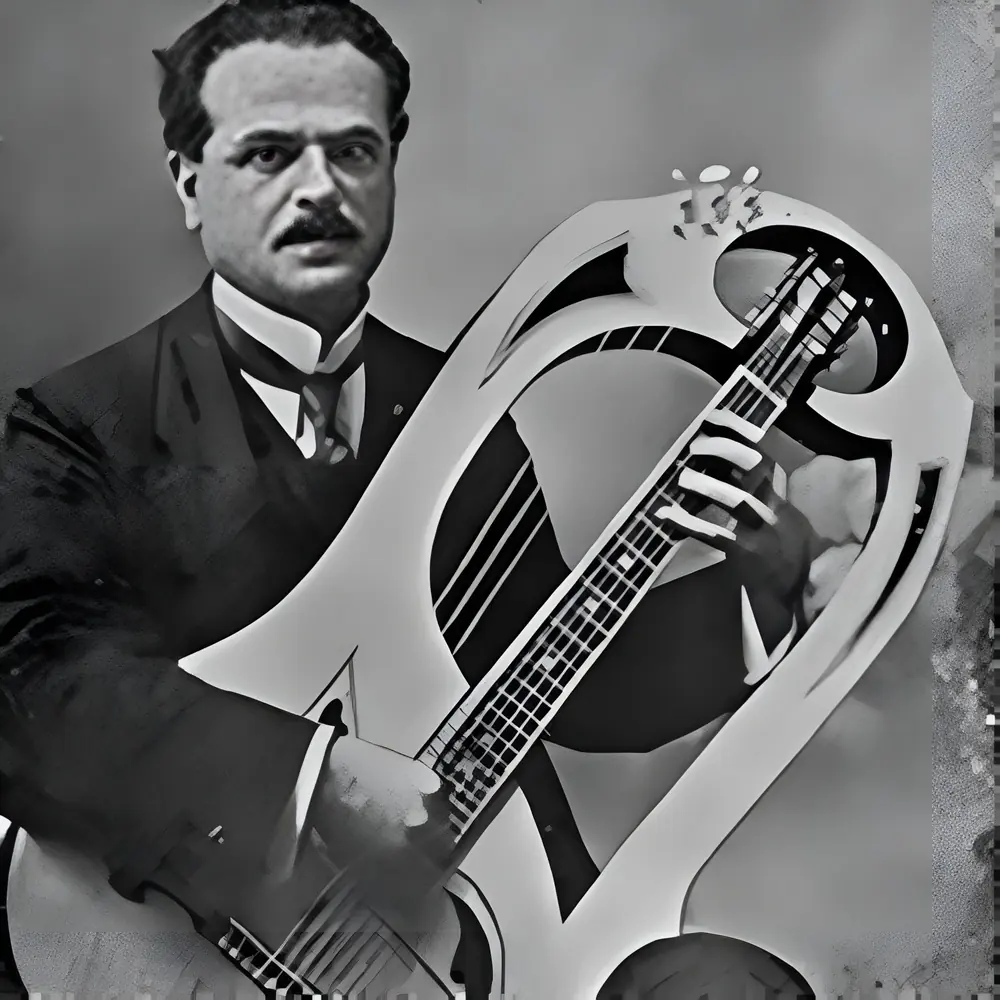
Luigi Mozzani (1869-1943) stands as a remarkable, if at times under-appreciated, figure in the landscape of early twentieth-century European music. His career was characterized by an extraordinary versatility, encompassing the roles of virtuoso guitarist and accomplished oboist, a prolific composer, an innovative luthier, and a dedicated pedagogue.1 This breadth of activity has led to descriptions of Mozzani as "one of the most eclectic artists of 20th-century Italian music" and a "true Renaissance-type genius," capable of seamlessly integrating art and craftsmanship in unique and original ways.4 While he achieved considerable international recognition during his lifetime, a comprehensive understanding of his multifaceted contributions and their enduring impact warrants continued scholarly attention. This report aims to provide a detailed examination of Luigi Mozzani's life and work, synthesizing his achievements across these varied fields to illuminate his significant, yet complex, legacy in the history of music and lutherie.
Mozzani's diverse talents were not merely a collection of separate pursuits; rather, they formed an interconnected ecosystem where each facet of his work informed and enriched the others. His profound understanding as a performing musician, particularly on the guitar1, undoubtedly shaped his approach to instrument design and construction, driving his quest for enhanced playability and tonal quality. This practical experience is evident in his numerous lutherie innovations.4 Similarly, his compositions were naturally tailored to the instruments he knew intimately, often those he himself had built or modified. As a teacher, he was able to draw upon this holistic knowledge, offering his students a comprehensive perspective that bridged performance, theory, and the physical nature of the instruments. This synergy suggests that Mozzani's contributions possess a depth that might have been less profound had he confined himself to a single specialization, representing a holistic engagement with music that became increasingly rare with the growing specialization of the twentieth century.
Furthermore, Mozzani's "strong entrepreneurial spirit," noted from his early years1, was a crucial catalyst for his achievements, particularly in lutherie and education. The establishment of multiple workshops in cities like Faenza, Cento, Bologna, and Rovereto, alongside several pioneering, albeit sometimes fraught, attempts to found lutherie schools, required not only artistic vision and technical skill but also considerable organizational acumen, resource management, and the ability to attract patronage and students.2 This entrepreneurial drive provided the necessary platforms for his innovations to be realized, disseminated, and taught, underscoring that the success of historical artisans often hinged on a pragmatic blend of artistic talent and business sense—a dimension sometimes overlooked in purely art-historical narratives.
II. Early Life and Musical Awakening (1869 - c. 1890s)
Luigi Mozzani was born in Faenza, in the historic Romagna region of Italy, on March 9, 1869. His family, originally from Ancona, lived in conditions of extreme poverty; his father was a cobbler and his mother a weaver.2 This socio-economic background profoundly shaped his early life and, arguably, fueled the remarkable drive and resourcefulness he displayed throughout his career. The family's financial hardship was such that young Luigi was compelled to abandon his formal schooling after only the first year, at the tender age of six.2
Despite these limitations, Mozzani's innate musicality soon found avenues for expression. His first rudimentary musical lessons were on the trumpet, taught to him by a local baker. This initial instruction enabled him to secure a position as a clarinetist in the town band of Faenza.2 A pivotal moment in his musical development occurred one summer evening when he heard the guitar for the first time. Deeply captivated by its sound, he acquired an old, dilapidated guitar on loan. Displaying an early aptitude for lutherie, he managed to repair the instrument himself and subsequently embarked on a course of self-study, utilizing popular guitar methods of the time by Ferdinando Carulli and Mauro Giuliani.2 This act of repairing his first instrument, born of necessity and fascination, can be seen as a foundational experience, a nascent stirring of the lutherie skills that would later define a significant part of his career. It demonstrated an inherent curiosity about the physical construction of instruments, not merely their performance, an intuitive, problem-solving engagement that likely demystified the instrument and sparked a deeper interest.
Concurrently, Mozzani pursued the study of the oboe, a decision likely motivated by the pragmatic need to find stable employment in the musical field. His talent and dedication led him to the prestigious Conservatory of Bologna, which he entered at the age of 22, eventually graduating with full honors in oboe.2 This formal training provided him with a solid theoretical and practical grounding in music. His early career as an oboist was marked by extensive touring, taking him to Africa, Japan, and various European countries, including Russia, where he achieved notable success. A significant engagement during this period was his two-year tenure (1894-1896) as an oboist in the New York Philharmonic.2 This international exposure would have considerably broadened his musical perspectives and experiences.
Mozzani's early career trajectory, balancing his passion for the guitar with professional engagement as an oboist, illustrates a practical negotiation between artistic inclination and economic reality. The oboe offered more conventional pathways to employment and formal training, providing a degree of financial stability. This stability, in turn, likely afforded him the means and opportunity to later pursue his guitar-related interests—composition, performance, and lutherie—with greater intensity. This path challenges any romanticized notion of an artist solely following an unhindered muse, instead revealing a common reality for many musicians of his era: the careful navigation of passion and pragmatism.
| Year(s) | Event | Snippet(s) Reference |
|---|---|---|
| 1869 | Born March 9 in Faenza, Italy | ² |
| c. 1875 | Abandons formal schooling due to poverty | ² |
| c. 1891 | Enters Conservatory of Bologna (studies oboe) | ² |
| 1894-1896 | Oboist in the New York Philharmonic; publishes "Studies for guitar" (3 vols.) in New York (1896) | ² |
| Late 1890s | Establishes himself in Paris; contact with Cottin, Gélas, Llobet; begins interest in guitar making | ² |
| c. 1899 | Returns to Italy; first workshop in Faenza; publishes "Preghiera" | ² |
| 1905-1908 | Tours Germany and Austria; sees Schenck harp guitars in Munich | ² |
| 1906 | Wins Il Plettro contest with Serenata (later Feste Lariane) | ² |
| 1908 | Publishes "Colpo di vento," "Mazurka," "Valzer lento" in Berlin | ² |
| c. 1909 | Claudio Gamberini becomes his pupil in Cento | ¹⁴ |
| 1910 | Establishes workshop in Cento for guitar making | ⁶ |
| 1912 | Patents device for regulating neck angle of guitar-lyras | ² |
| 1910-1924 | Makes bowed instruments and instruments for plectrum orchestras | ² |
| 1917 | Begins making violins in Cento | ⁶ |
| c. 1923 | Mario Maccaferri leaves Mozzani's workshop | ¹⁸ |
| 1927 | Moves to Bologna; Cento laboratory becomes "Italian School of Lutherie Luigi Mozzani," later in Bologna | ² |
| 1928 | Claudio Gamberini becomes teacher at Mozzani's school in Bologna | ¹⁴ |
| 1929 | Mozzani laboratory-school granted official status | ³ |
| 1933/1934 | Bologna school closed for "political reasons" | ² |
| 1936 | Reconnects with Andrés Segovia in Genoa; begins project for Segovia's guitars | ⁴ |
| 1937 | Segovia tests six Mozzani guitars, chooses No. 4 for North American tour | ⁴ |
| Until 1939 | Continues public performances; records three 78 rpm albums | ³ |
| 1942 | Opens lutherie school in Rovereto | ² |
| 1943 | Dies August 12 in Rovereto (some sources say Bologna6) | ² |
| Until 1947 | Rovereto school continues under his wife and Rino Federici | ² |
III. Luigi Mozzani: The Performer and Composer
Luigi Mozzani's musical identity was deeply rooted in his capabilities as both a virtuoso performer and a distinctive composer. His activities in these domains, particularly concerning the guitar, were foundational to his subsequent work as a luthier and educator.
A. The Virtuoso Performer
Mozzani earned a significant reputation as a guitar virtuoso, with some commentators considering him the "Italian equivalent of Tárrega".3 This comparison, though perhaps broad, indicates the high esteem in which his playing was held. However, his early professional life was centered on the oboe. He held positions such as First Oboe at the Saint Carl Theatre of Naples and, as previously noted, was a member of the New York Philharmonic.2
A curious and arguably pivotal turn in his performing career occurred following an "ill-fated tour of America" with an orchestra under the direction of Arturo Toscanini, which resulted in Mozzani being stranded in America for approximately two years. It was during this challenging period that he joined a banjo trio, an experience that "began his career of performing guitarist and, later, guitar teacher".3 This unforeseen circumstance and his adaptive response appear to have been a catalyst, redirecting his professional focus towards plucked string instruments and, ultimately, solidifying his path as a guitarist. Had the orchestral tour proceeded without incident, his primary identity might have remained that of an orchestral oboist, potentially diminishing or delaying his significant contributions to the guitar world. This episode illustrates how unexpected life events can profoundly shape an artist's trajectory, sometimes guiding them toward their most impactful endeavors through unconventional routes.
Upon his return to Europe, Mozzani embarked on extensive concert tours, performing in England (where he lived for about six months), France, Germany, and Austria, as well as throughout Italy.2 His public performances as a guitarist continued until 1939, the same year he made his significant 78 rpm recordings.3
B. The Composer and Pedagogue
Parallel to his performing career, Mozzani was a prolific composer and a dedicated pedagogue, creating a substantial body of work for the guitar that encompassed both performance pieces and instructional materials.
His most renowned pedagogical work is the three-volume "Studies for guitar," published in New York by F.A. Mills in 1896. These studies, often referred to as "Mozzani's Method," were not intended for beginners but were rather a collection of exercises, chords, arpeggios, and scales aimed at advanced players. Each study was designed to develop instrumental technique with a specific focus on the guitar's tonal and harmonic extensions.2 The enduring value of this method is attested by modern guitarists, one of whom expressed a wish for it to be "mandatory in conservatorium training".9 This focus on advanced techniques and the exploration of the guitar's broader musical possibilities indicates a sophisticated pedagogical vision. Mozzani was evidently concerned not just with the mechanics of playing but with empowering guitarists to explore the full expressive potential of the instrument, thereby contributing to the elevation of technical and artistic standards in guitar performance. Later in his career, his pedagogical interests manifested in works like the "6 Capriccios," which occupy a space between prelude and study, and a major, though unfinished, didactic work intended to comprise a series of preludes or studies centered on the "cantabile arpeggio".10
Mozzani's compositions for performance began to appear in print around the turn of the century. His original works were first published in Paris in 1899 by Alfred Cottin and Jacques Pisa, and subsequently in Germany in 1908 by Verlag Gitarrefreund and Gebrüder Hug.10 Among his notable early pieces is the "Preghiera" (Prayer), published in 1899.2 While in France, he also composed "8 Pieces for solo guitar," which were published posthumously by Bèrben in 1963.2 Other significant compositions include "Colpo di vento" (Wind Gust), "Mazurka," and "Valzer lento," all published in Berlin in 1908.2
Perhaps his most famous piece, Feste Lariane, has a complex history. In 1906, Mozzani anonymously submitted a Serenata to a musical contest organized by the Italian magazine Il Plettro, winning first prize and a gold medal. This composition was subsequently published under the title Feste Lariane, an air with variations. Despite questions regarding its originality—it has been identified as a reworking of Melodia nocturna by Jos Sancho (published two years earlier in Argentina) and its thematic material reportedly appears in works by other composers—the piece significantly boosted Mozzani's reputation, especially internationally.2 The piece is described as Mozzani's most popular, admired for its "memorable melody and moderate technical demands".11 This situation is intriguing: Mozzani's fame as a composer was substantially enhanced by a piece that, by modern standards of authorship, might be considered an arrangement. It suggests that in that period, the act of skillful arrangement and popularization was highly valued, and that a composer's reputation could be solidified on such foundations, even while, as one source notes, "far more important compositions of his sank into oblivion until around 1995".10 This highlights the vagaries of musical posterity and the cultural factors influencing a work's success, as well as the crucial role of later scholarship in re-evaluating a composer's complete oeuvre.
Stylistically, Mozzani's compositions are often characterized by a strong melodic sense and a mastery of concise forms. The piece Recueillement (Meditation) is cited as a perfect example of his style, showcasing his melodic gift and structural skill. His music often exhibits a "lightness of touch." Other pieces noted for their distinct qualities include the harmonically dense and emotional Prélude in F sharp, the somewhat bleak Psalmodie, the mystical Prière (notable for its use of repeated notes), and the virtuosic Coup de vent with its "audacious glissando".10 Overall, his compositional voice is seen to embody a distinctive expressive identity, blending elements of Belle Époque culture from an Italian perspective with Mozzani's personal inclination towards "heartfelt introspection".10 His body of work has been favorably compared to that of Francisco Tárrega, offering an "agreeable guitar synthesis" of late nineteenth-century Italian music, capturing both the "rustic Italy of the popular singing" and the "bourgeois Italy of the Veristic epoch and of the 'Ideal'".7 Many of Mozzani's scores are available through modern publishers, ensuring their accessibility for study and performance.8
| Title | Genre/Type | Approx. Date/Publication | Publisher (if known) | Notes | Snippet(s) Reference |
|---|---|---|---|---|---|
| Studies for guitar (3 volumes) | Pedagogical (Advanced Studies) | 1896 (New York) | F.A. Mills | "Mozzani's Method"; focuses on technique, tonal/harmonic extensions | ² |
| Preghiera (Prayer) | Solo Guitar Piece | 1899 | Famous early piece | ² | |
| 8 Pezzi per Chitarra Solista | Solo Guitar Pieces | Composed in France; pub. 1963 | Bèrben (posthumous) | Collection of 8 pieces | ² |
| Feste Lariane (Air with variations) | Solo Guitar Piece | 1906 (as Serenata) | Vizzari (Milan) | Won Il Plettro contest; popular; questions of originality (reworking of Sancho's Melodia nocturna) | ² |
| Colpo di vento (Wind Gust) | Solo Guitar Piece | 1908 (Berlin) | Verlag Gitarrefreund / Gebrüder Hug | Virtuosic sound picture | ² |
| Mazurka | Solo Guitar Piece | 1908 (Berlin) | Verlag Gitarrefreund / Gebrüder Hug | ² | |
| Valzer lento (Slow Waltz) | Solo Guitar Piece | 1908 (Berlin) | Verlag Gitarrefreund / Gebrüder Hug | ² | |
| Recueillement (Meditation) | Solo Guitar Piece | Pub. 1899-1908 | Example of Mozzani's style, melody, short genre mastery | ¹⁰ | |
| Prélude in F sharp | Solo Guitar Piece | Pub. 1899-1908 | Harmonically dense, emotional | ¹⁰ | |
| Psalmodie | Solo Guitar Piece | Pub. 1899-1908 | Somewhat bleak | ¹⁰ | |
| 6 Capriccios für Gitarre | Pedagogical (Prelude/Study) | Posthumous/Later publication | Middle ground between prelude and study; focus on cantabile arpeggio | ¹⁰ | |
| Unfinished major pedagogical work | Pedagogical (Preludes/Studies) | Unfinished | Intended series focusing on cantabile arpeggio | ¹⁰ |
IV. The Art and Craft of Lutherie: Mozzani's Workshops and Innovations
Luigi Mozzani's contributions as a luthier are as significant and multifaceted as his work as a performer and composer. His deep engagement with instrument making spanned several decades, marked by the establishment of influential workshops, the production of a diverse range of instruments, and the introduction of notable technical innovations.
A. Establishment and Evolution of Workshops
Mozzani's interest in the craft of guitar making reportedly began during a stay in Paris towards the end of the nineteenth century.2 Upon returning to Italy, he established his first workshop in his hometown of Faenza.2 A more substantial phase of his lutherie career commenced when he settled in Cento, in the province of Ferrara, during the first decade of the 1900s. It was here, in 1910, that he formally established a workshop dedicated to guitar making, often collaborating with local craftsmen.6 The Cento workshop was initially located at via Gennari and later moved to via M. Provenzali.14 The success of this venture allowed for expansion into larger quarters in Cento.3
In 1927, Mozzani relocated his primary operations to Bologna.6 His workshop in Bologna, situated in via Barberia, became a significant center for his activities, including the construction of guitars for Andrés Segovia.4 Despite these established centers, Mozzani's lutherie work also saw him operate workshops again in Cento and, finally, in Rovereto, where he spent his last years and passed away in 1943.2
B. Instrument Types and Characteristics
Mozzani's workshops produced a wide array of stringed instruments, though he is perhaps best known for his guitars, particularly his innovative lyre-guitars.
Guitars:
-
Standard Guitars: In Bologna, Mozzani was known to craft guitars based on a Guadagnini model.2 His standard six-string guitars achieved a level of recognition that attracted the attention of prominent performers. Most notably, Andrés Segovia chose a Mozzani guitar, and in 1937, Mozzani famously built a batch of six instruments for Segovia to try. Segovia selected guitar No. 4 from this group, a unique instrument featuring a spruce top with back and sides of 'alberaccio' (a Po Valley poplar variant), and incorporating Mozzani's characteristic soundboard bracing with seven perfectly vertical struts.3
-
Lyre-Guitars / Harp Guitars (Chitarra-Lyra): These instruments represent Mozzani's most distinctive contribution to lutherie. His interest in them was sparked during a visit to Munich between 1905 and 1908, where he encountered harp guitars built by Austro-German makers such as Friedrich Schenck, Knaffl, and Raab. Mozzani was particularly intrigued by their construction, the use of sub-bass strings, and the expanded technical possibilities they offered.2 He adopted the term "chitarra-lyra" for all his hollow-arm harp guitars, irrespective of whether they possessed one or two arms.15 The chitarra lyra a due bracci (double-armed lyre-guitar) was directly inspired by Friedrich Schenck's designs from the 1840s. These instruments featured unusual hollow "arms" that joined at the headstock. A key innovation by Mozzani was a neck that was free from the body, held in place by six adjustable metal bolts—a mechanism he patented in 1912.5 An exemplary model from circa 1915, constructed from maple, spruce, ebony, and metal, is now part of the collection at The Metropolitan Museum of Art in New York.5 Mozzani also produced the Chitarra Lyra un braccio (single-armed lyre-guitar); an example from 1930 is noted for its spruce soundboard and poplar back and sides.14 Mozzani himself considered his lyre-guitars superior to the conventional 'Spanish' guitar in terms of expressiveness and sonority.4 These instruments are often cited as showing "greater workmanship" than his bowed instruments and are described as "outrageous and distinctive".3
-
Travel Guitar: Demonstrating his practical ingenuity, Mozzani also designed and made a portable folding travel guitar.2
Bowed Instruments (Violins, Violas, Cellos):
Mozzani expanded his lutherie activities to include bowed instruments, beginning to make violins in Cento from 1917.6 For his violins, violas, and cellos, he generally followed a Guadagnini model and typically finished them with a dark red varnish.6
The critical reception of his bowed instruments presents a somewhat mixed picture. One detailed account praises a fine Italian violin No. 47, made in Milan in 1921, as "strikingly lovely and acoustically excellent." This instrument is described as having a two-piece maple back with deep, tight flames, a spruce top with fine to moderate grain, a luminous orange-brown varnish, a refined narrow model, charmingly shaped sound holes, and a deeply carved scroll. Its sound is characterized as "mature, clear and timbre-rich," "radiant and powerful," possessing the "typical soft note" often sought in Italian instruments.16 Auction records show Mozzani violins selling for prices in the range of £3,000-£5,000, and a cello by Mozzani achieved an auction record of $43,685 in 2014.6
However, a contrasting assessment comes from the respected expert John Dilworth, who noted that Mozzani's violins, violas, and cellos were "None of very great quality or integrity".6 This discrepancy suggests several possibilities: there might have been variability in the output of his workshop, particularly if he delegated aspects of construction; alternatively, the standards of judgment among experts may differ, with Dilworth perhaps comparing Mozzani's work to the very highest echelons of classical Italian violin making. It is also plausible that Mozzani's primary passion and deepest expertise lay with guitars, his original instrument, which could have led to more consistent excellence in that domain. Indeed, the same source citing Dilworth also notes that Mozzani's guitars, and particularly his lyre-guitars, "show greater workmanship".6
Other Plucked Instruments:
Reflecting the musical trends of his time, Mozzani's workshop also produced instruments for plectrum orchestras between 1910 and 1924, including mandolins and mandolas.2 This diverse output underscores a luthier keenly aware of and responsive to the varied musical needs of the era.
C. Technical Innovations and Design Features
Luigi Mozzani was not merely a producer of instruments but also a significant innovator. His most celebrated patent, granted in 1912, was for a device that allowed the angle of the neck on his guitar-lyras to be regulated by a system of screws.2 This addressed a key structural and playability aspect of these complex instruments.
Beyond this, Mozzani introduced several other technical innovations in guitar construction, aimed at improving sound, intonation, and structural integrity4:
-
A particular 'inverted' dovetail graft for attaching the headstock to the neck.
-
The use of a 'zero fret' near the nut.
-
The employment of T-shaped frets.
-
The splitting of the bridge saddle (bone) into two sections for potentially better intonation.
-
A distinctive soundboard bracing system featuring seven perfectly vertical struts, which was used in the guitars he built for Andrés Segovia.
His inventive mind also extended to pedagogical aids; he designed and manufactured a wooden "counterbore" with metallic parts for training the fingers of the left hand, and a pocket-sized stringed tablet of hollow wood for right-hand training.2
Mozzani's approach to lutherie, particularly evident in his work on the harp guitar, demonstrates a pattern of building upon existing traditions with a strong inventive and practical engineering mindset. He recognized the potential in Schenck's designs and then applied his technical ingenuity to adapt and improve them, aiming to realize his own ideals of sound and playability. This synthesis of artistic vision and engineering solutions characterizes much of his innovative work. His broad output, ranging from concert instruments and experimental designs to items for popular ensembles and training tools, reveals a luthier deeply engaged with the musical ecosystem of his time, willing to experiment across a wide spectrum of stringed instrument making and its associated needs.
| Instrument Type | Key Models/Examples | Notable Construction Features | Patented Innovations / Design Features | Materials Used (Examples) | Varnish (Examples) | Summary of Critical Reception/Notes | Snippet(s) Reference |
|---|---|---|---|---|---|---|---|
| Guitar - Standard | Guadagnini model; Segovia No. 4 | Seven vertical strut bracing (Segovia guitars) | 'Inverted' dovetail headstock graft, 'zero fret', T-frets, split bridge bone | Spruce top, Poplar or Rosewood back/sides | Segovia initially praised No. 4; generally considered high quality; "among best of 20th-c. Italian lutherie"4 | ², ⁴ | |
| Guitar - Lyre/Harp | Chitarra lyra a due bracci; Chitarra lyra un braccio | Hollow arms, Schenck-inspired design | 1912 Patent: Adjustable neck angle via screws; sub-bass strings | Maple, Spruce, Ebony, Metal, Poplar | Shows "greater workmanship"6; "outrageous and distinctive"3; Mozzani considered them superior4; Met Museum example is ca. 1915⁵ | ², ³ ⁵, ⁶, ¹⁴ | |
| Guitar - Travel | Portable folding model | Designed for portability | Innovative practical design | ² | |||
| Violin | No. 47 (Milan, 1921) | Guadagnini model; refined narrow model; deep flamed maple back, fine grain spruce top | Charming sound holes, deeply carved scroll | Maple, Spruce | Dark red; Luminous orange-brown | Mixed: "strikingly lovely and acoustically excellent"16 vs. "None of very great quality or integrity"6 | ⁶, ¹⁶ |
| Viola, Cello | Guadagnini model | Dark red | Dilworth's critique suggests lesser quality6; Cello auction record $43,685¹⁷ | ⁶, ¹⁷ | |||
| Mandolin, Mandola | For plectrum orchestras | Part of diverse workshop output | ² | ||||
| Pedagogical Tools | Left-hand "counterbore"; Right-hand training tablet | Wooden with metallic parts (counterbore); Hollow wood tablet | Designed for finger/hand training | Wood, Metal | Shows engagement with teaching needs | ² |
V. Collaborations and Key Relationships
Luigi Mozzani's career was not pursued in isolation; it was enriched and shaped by a network of collaborations, apprenticeships, and significant professional relationships that influenced his work as a luthier, performer, and educator.
Among his earliest and most impactful partnerships in lutherie was with Carlo Carletti. When Mozzani began crafting stringed instruments around 1910, he joined forces with Carletti, a luthier with deep roots in the esteemed traditions of modern Italian violin making, having studied with masters such as Fiorini, Pollastri, and Sofritti. This collaboration was instrumental in establishing the Mozzani workshop as a notable venue for sophisticated musicians, offering a select but high-quality range of instruments.16
Several key figures emerged from Mozzani's workshops and schools, becoming significant luthiers in their own right. Claudio Gamberini was a pupil of both Carletti and, more centrally, of Mozzani himself, starting his apprenticeship in 1909 at the Cento workshop. Gamberini played a crucial role in the fabrication of instruments, including leading the construction of the 1930 "Chitarra Lyra un braccio".14 His expertise was recognized when he was appointed as a teacher at Mozzani's "School of Violin Making Italian Luigi Mozzani" in Bologna in 1928. After this school's closure, Gamberini continued to collaborate with Mozzani, alongside Rino Federici, in a private workshop.3
Another prominent figure to emerge from Mozzani's tutelage was Mario Maccaferri. Described as a "young and skillful" individual within Mozzani's establishment, Maccaferri enrolled as Mozzani's student at the remarkably young age of eleven. He spent thirteen years immersed in instrument design, construction, and performance, eventually rising to supervise Mozzani's instrument production before leaving in 1923 to pursue his own distinguished career as a concert guitarist and, later, an innovative luthier, particularly famous for his "Selmer-Maccaferri" guitars.2 The success of these pupils suggests that Mozzani's workshop model effectively blended his visionary designs and standards with the skilled craftsmanship of his collaborators and apprentices, a system essential for achieving the scale and diversity of his output. Mozzani likely functioned as the master of the workshop, the "director of the 'laboratory'"3, providing the overarching designs, innovative concepts, and quality control, while relying on this skilled team for much of the intricate construction. This collaborative environment was also the means by which his influence was directly transmitted to the next generation of instrument makers.
Rino Federici was another important associate, collaborating with Mozzani and Gamberini in their private workshop following the closure of the Bologna school. After Mozzani's death, Federici took on the responsibility of directing Mozzani's final lutherie school in Rovereto (some sources indicate Trento province) until its eventual closure in 1947.3
Perhaps the most widely discussed of Mozzani's professional relationships was his collaboration with the legendary guitarist Andrés Segovia. Their initial meeting took place in Milan in 1926, during Segovia's Italian debut. Mozzani, already an established luthier, was keen to create an instrument that would meet the exacting requirements of the great virtuoso. He meticulously measured Segovia's then-current Manuel Ramirez/Santos Hernandez guitar, intending to incorporate his own soundboard bracing concepts.4 The collaboration gained new impetus in 1936 when Segovia, having sought refuge in Genoa due to the Spanish Civil War and urgently needing a concert instrument, re-established contact with Mozzani. This led to Mozzani constructing a batch of six guitars for Segovia to evaluate in Bologna in January 1937. Segovia selected instrument No. 4, distinguished by its poplar back and sides, spruce top, 653 mm scale length, and Mozzani's signature vertical bracing. Segovia took this guitar on an extensive North American tour and initially praised its qualities. However, the instrument later suffered structural damage, attributed partly to the significant hygrometric variations between continents, and Segovia also found it to lack the "power" he desired. Consequently, the guitar was abandoned in New York and considered lost for many years until its recent rediscovery.4 This episode, while prestigious for Mozzani, underscores the practical challenges inherent in crafting instruments for international performers, including the impact of climate on wood and the subjective, evolving preferences of artists. It serves as a valuable case study in luthier-performer dynamics and the unpredictable life of a concert instrument. A modern recording by Giulio Tampalini features a "Luigi Mozzani” guitar that belonged to Andrès Segovia, possibly this rediscovered instrument.19
Mozzani's network also included early collaborations with Neapolitan mandolin builders in Bologna.3 Furthermore, his time in Paris brought him into contact with prominent guitarists of the era such as Alfredo Cottin, Gélas, and Miguel Llobet.2 This exposure to the leading edge of guitar performance and repertoire at the turn of the century was likely crucial, influencing his own compositional style and his understanding of the qualities that virtuoso performers sought in their instruments, providing both a benchmark and a vital connection within the international guitar community.
VI. The Mozzani Schools of Lutherie: A Vision for Education
A significant, though ultimately challenging, aspect of Luigi Mozzani's career was his persistent effort to establish formal institutions for lutherie training. This pedagogical vision aimed to systematize and elevate the craft of instrument making in Italy, moving beyond purely traditional apprenticeship models.
Mozzani's ambition to create a lutherie school was a consistent thread throughout his later career.3 His most notable early endeavor in this domain began in 1927 when his workshop in Cento was transformed into the "Italian School of Lutherie Luigi Mozzani" through an agreement with the local municipality. This school was later transferred to Bologna.2 It gained official status in 1929, and admission was highly selective, requiring prospective students to pass a contest.2 The curriculum was comprehensive, offering courses in the making of guitars, mandolins, cellos, and violins, as evidenced by the experience of his pupil Mario Maccaferri.18 Claudio Gamberini, a former pupil and key collaborator, served as a teacher at the Bologna school from 1928, specifically in charge of plucked instruments.3 However, this promising institution was relatively short-lived, closing in 1933 or 1934 due to "political reasons".2
Despite this setback and the "financial difficulties and disappointments related to the pioneering lutherie schools he started several times"4, Mozzani did not abandon his educational aspirations. In 1942, with support from local authorities, he succeeded in opening another school, this time in Rovereto (or the province of Trento).2 Tragically, Mozzani passed away the following year, in 1943. The Rovereto school, however, continued to operate until 1947 under the guidance of his wife, Alfonsina, and a trusted instructor, Rino Federici, until the municipality decided to cease its operations.2
The establishment of these formal, selective lutherie schools represented a significant step towards professionalizing the craft in Italy. By requiring entry via contest and offering a structured curriculum, Mozzani aimed to ensure a high caliber of students and provide a comprehensive education. This was a forward-thinking approach, intended to cultivate a new generation of skilled luthiers through a more meritocratic and systematic system. However, the repeated closure of his schools underscores the vulnerability of such artistic and educational enterprises to external forces. The turbulent political climate of Italy in the 1930s and 1940s, and perhaps shifting administrative priorities after his death, ultimately hampered his vision. The fate of these schools serves as a historical reminder that cultural initiatives, however valuable, can be fragile and dependent on stable, supportive environments.
It is noteworthy that Mozzani himself was a product of the lutherie tradition in the Pieve di Cento area. Sources indicate that both Luigi Mozzani and Mario Maccaferri "passed through the ancient school of lute-making" run by the Carletti family and Orsolo Gotti in Pieve di Cento at the beginning of the 1900s.20 This suggests a lineage of craft that Mozzani inherited and then sought to formalize and expand through his own pedagogical initiatives. His desire to found schools may well have stemmed from his own training experiences, perhaps inspiring him to refine and institutionalize the process. Thus, Mozzani was both an inheritor and an innovator in craft education. While his own schools were located in Cento, Bologna, and Rovereto, the town of Pieve di Cento continues to honor his connection to its rich lutherie heritage. The Museo della Musica in Pieve di Cento houses a significant collection of Mozzani's instruments and also highlights the town's ongoing Luthier School, which continues a local tradition of plucked instrument making dating back to the 1700s.20
VII. Luigi Mozzani on Record: Preserving the Sound
Luigi Mozzani's musical legacy is further enriched by a small but significant corpus of sound recordings he made towards the end of his performing career. These recordings offer invaluable direct insight into his performance style, his music, and the sound of his unique instruments.
It is documented that Mozzani recorded three 78 rpm albums or discs, featuring much of his own music. These recordings were made by 1939 and are reported to be still preserved.2 One specific recording that has been identified is "Granada / 5.a Danza Spagnola," released as a 10-inch, 78 RPM shellac disc on the prestigious La Voce Del Padrone label (catalog number GW 1754) in 1939.25 The label identifies the recording as "Assolo Di Chitarra" (Guitar Solo) and indicates it was manufactured by "Società Anonima 'La Voce Del Padrone - Columbia - Marconiphone' - Milano".26 The fact that this recording was issued by La Voce Del Padrone (His Master's Voice in Italy), a major international record label, signifies a notable level of commercial recognition for Mozzani as a recording artist at that time. It suggests his performances and repertoire had an audience and marketability recognized by the burgeoning recording industry, placing him alongside other classical musicians who embraced this new technology for disseminating their art.
Crucially, further details about the content of Mozzani's personal recordings have emerged through reissues. A CD accompanying the book "Luigi Mozzani. Vita e opere" (Minerva Edizioni, 2008) is reported to include "6 rare sides recorded by Luigi Mozzani on a 9-string chitarra lyra (yes, the basses are played)".28 This information is exceptionally valuable, as it confirms that Mozzani himself recorded on one of his innovative harp guitars and actively utilized its sub-bass strings. These recordings, therefore, go beyond merely preserving his compositions; they capture his unique sound world as a performer on his specialized creations, offering direct sonic evidence of his technical approach and the realization of his instruments' potential—insights that written scores alone cannot convey. For musicologists and performers studying historical performance practice on instruments like the harp guitar, Mozzani's own recordings are primary sources of immense importance.
While a complete catalog of all pieces on his three 78 rpm albums is not readily available in all compiled sources7, the known details are significant. Beyond Mozzani's own performances, his instruments were also featured in recordings by other artists during the 78 rpm era. For instance, Federico Galimberti is noted to have performed on a Luigi Mozzani Due-Bracci Harp Guitar in a recording from 1927.29
In more recent times, Mozzani's compositions have been featured on various modern recordings, often performed by contemporary guitarists. These include:
-
An LP sampler from 1985 on His Master's Voice Digital, which featured Mozzani alongside Vivaldi, Boccherini, Rossini, and Paganini.25
-
"Giulio Tampalini, Mozzani*, Respighi* – Complete Music for Guitar," a CD released by Brilliant Classics in 2017, on which Tampalini performs on a Luigi Mozzani guitar that once belonged to Andrés Segovia.19
-
"Marucelli*, Mozzani*, Munier*, Duo Zigiotti Merlante – Opere Per Mandolino E Chitarra," a CD from Tactus released in 2020.25
-
"Pasquale Taraffo, Giulio Giulietti, Luigi Mozzani, Luigi Mariotti, Mario Gangi, Mario Parodi – Masters Of The Guitar Vol. 5. Italy," a CD compilation from IDIS released in 2023, which includes Mozzani as a performer/composer.25
| Performer(s) | Title(s) / Content Description | Instrument (if known) | Label | Catalog Number | Year | Notes | Snippet(s) Reference |
|---|---|---|---|---|---|---|---|
| Luigi Mozzani | "Granada / 5.a Danza Spagnola" | Guitar | La Voce Del Padrone / Disco "Grammofono" | GW 1754 | 1939 | 10" Shellac, 78 RPM; "Assolo Di Chitarra" | ²⁵, ²⁶ |
| Luigi Mozzani | 6 sides (part of his three 78rpm albums) | 9-string Chitarra-Lyra | (Original label unknown) | (Original unknown) | by 1939 | Basses are played; reissued on CD with "Luigi Mozzani. Vita e opere" book (2008) | ²⁸ |
| Luigi Mozzani | Remainder of his three 78rpm albums (specific titles unknown) | (Likely guitar/chitarra-lyra) | (Original label unknown) | (Original unknown) | by 1939 | Much of his music; preserved | ⁷ |
| Federico Galimberti | (Specific titles unknown) | Luigi Mozzani Due-Bracci Harp Guitar | (Original label unknown) | (Original unknown) | 1927 | Indicates Mozzani's instruments were used by other recording artists in the era | ²⁹ |
VIII. Legacy and Enduring Influence
Luigi Mozzani's death in 1943 did not signify an end to his impact. His multifaceted career as a performer, composer, luthier, and educator has left an enduring legacy that continues to be recognized and explored through the preservation of his instruments, the ongoing performance and study of his music, and the acknowledgment of his innovative contributions to lutherie.
Preservation of Instruments:
A tangible part of Mozzani's legacy lies in the surviving instruments crafted in his workshops. Many of these, along with some of his unpublished manuscripts, are preserved and occasionally exhibited.2 Several institutions play a key role in this preservation:
-
The Museo della Musica in Pieve di Cento holds a significant collection of string instruments created by Luigi Mozzani. This "Collezione Mozzani" was acquired after World War II by the Cassa di Risparmio di Cento and subsequently deposited with the municipality of Pieve di Cento. The collection notably includes examples of his lyre-guitars.21
-
The Metropolitan Museum of Art in New York acquired a remarkable Mozzani Harp Guitar (chitarra lyra a due bracci) from circa 1915 in 2008. This instrument is periodically on view, bringing Mozzani's innovative designs to a wide international audience.5
-
It is also noted that several of his instruments are maintained at the Pieve di Cento School of Lutherie6, which may refer to instruments within the broader Pieve di Cento collection or a separate holding connected to the modern school. The luthier Lorenzo Frignani was instrumental in arranging for the acquisition and archiving of the largest collection of surviving Mozzani instruments, which formed a substantial basis for a major biographical and analytical book published in 2008.28 The preservation of these instruments in prominent museum collections signifies a posthumous acknowledgment and elevation of Mozzani's status as a historically important luthier. Such institutional recognition helps solidify his legacy, counteracting periods of relative obscurity and providing invaluable resources for scholarly research, public education, and inspiration for contemporary luthiers and musicians.
Influence on Lutherie:
Mozzani's work is increasingly considered among the best of twentieth-century Italian lutherie.4 His lutherie was described by a contemporary guitar maker as "exceptionally creative," with "technological developments in the world of guitar making [that] were remarkably innovative".30 Specific innovations, such as the patented adjustable neck for his lyre-guitars, the use of the zero fret, T-shaped frets, the split bridge saddle for improved intonation, and his distinctive soundboard bracing, all had the potential to influence subsequent generations of instrument makers.4
His direct influence is also evident in the careers of his pupils, most notably Mario Maccaferri and Claudio Gamberini, who themselves became respected luthiers.2 After Mozzani's workshops ceased operation, his name continued in the commercial sphere, as his heirs entered into a contract with the Farfisa musical house, allowing the company to produce guitars under the "Mozzani" brand name.7 While this demonstrates the recognized value of his name, these commercially produced instruments are distinct from those handcrafted in Mozzani's own workshops or under his direct supervision. This later branding highlights a common twentieth-century phenomenon where a craftsman's personal reputation can be transformed into a marketable commodity, potentially creating confusion if not clearly differentiated from the original artisanal production.
Musical Legacy:
Mozzani's compositions, particularly the perennially popular Feste Lariane, remain in the guitar repertoire.11 His pedagogical works, including "Mozzani's Method" and his collections of studies and capriccios, continue to be valued for their technical and musical content by students and teachers of the guitar.8 Some assessments place his compositional work on a par with that of his contemporary Francisco Tárrega, recognizing its quality and its reflection of Italian musical aesthetics of the late nineteenth and early twentieth centuries.7 The ongoing publication of his sheet music and modern recordings of his complete guitar works, such as the album by Giulio Tampalini19, ensure that his music reaches new audiences and remains a living part of the classical guitar tradition. This active afterlife of his musical creations is a strong testament to their intrinsic artistic merit and pedagogical utility.
Educational Legacy:
Although Mozzani's own lutherie schools were ultimately closed due to external pressures, his vision for formal, high-standard lutherie education was pioneering for its time in Italy. The tradition of instrument making in Pieve di Cento, of which Mozzani was a product, continues with a modern lutherie school in the town.20 The local museum's prominent display of his instruments further cements his connection to this ongoing heritage.21
While one source from the specialized field of harp guitars suggested in the past that Mozzani remained "almost unknown to most American guitarists and collectors today"15, the evidence of significant museum acquisitions, recent scholarly publications4, and the continued presence of his music points to a growing and deserved recognition of his importance.
IX. Concluding Assessment: The Enduring Significance of Luigi Mozzani
Luigi Mozzani emerges from the historical record as a figure of exceptional talent, industry, and innovation. His contributions spanned the critical domains of musical performance, composition, lutherie, and education, marking him as a true polymath of the Italian musical world in the late nineteenth and early twentieth centuries. His "Renaissance-type genius"4 was coupled with a determined "entrepreneurial spirit"1 that drove him to establish workshops and schools, continually seeking to advance his art and craft.
As a performer, he was a respected virtuoso on both the guitar and the oboe. As a composer, he created a body of charming, technically valuable, and stylistically distinctive music for the guitar, alongside influential pedagogical works that continue to hold relevance. In the realm of lutherie, Mozzani was a profoundly innovative designer and craftsman, particularly celebrated for his unique chitarra-lyra (harp guitar) designs and his practical technical improvements to guitar construction. His workshops produced a diverse range of quality instruments catering to various musical needs. As an educator, he was a pioneer, attempting to establish formal, high-caliber schools for lutherie training in Italy, a vision that was ahead of its time.
Mozzani's career can be seen as that of a transitional figure. He embodied the nineteenth-century ideal of the integrated artist-craftsman, proficient across multiple disciplines, yet he also embraced and contributed to modern approaches through patented innovations, attempts to standardize aspects of instrument construction, the pursuit of formal technical education, and engagement with the new technology of sound recording. He was navigating a rapidly changing musical landscape, retaining the holistic skill set of an earlier era while actively participating in the shaping of twentieth-century musical practices.
His legacy is not without its complexities. There are varying contemporary and historical assessments of the quality of his bowed instruments compared to his guitars; the authorship questions surrounding his most famous composition, Feste Lariane, invite reflection on period practices; and his pioneering schools faced disruptions that curtailed their long-term institutional impact. Furthermore, despite his significant achievements, his widespread international fame may not have reached the levels of some contemporaries who specialized more singularly. This could be attributed to the very breadth of his focus, which perhaps diffused a singular public image, combined with the "political reasons" that interrupted his educational initiatives, and the niche appeal of some of his most original creations like the harp guitars. Historical fame is, after all, shaped not only by talent and output but also by historical contingencies, the nature of one's primary contributions, and their alignment with mainstream trends.
Nevertheless, the growing recognition of Luigi Mozzani's importance—evidenced by scholarly research, museum acquisitions of his instruments, and the revival of his music in performance and recordings—testifies to the enduring value of his work. He left a rich and multifaceted heritage that continues to inform and inspire. Luigi Mozzani's unique position as a figure who excelled across so many domains of musical endeavor confirms his status as a significant and fascinating contributor to the musical culture of his time, whose work embodies a profound and holistic dedication to the art and craft of music.
Works Cited
- "Luigi Mozzani | Scrollavezza & Zanrè." Accessed May 22, 2025. https://www.scrollavezza-zanre.com/en/archive-mozzani-luigi.
- "Luigi Mozzani." lutherie.net. Accessed May 22, 2025. https://www.lutherie.net/mozzani.html.
- "Luigi Mozzani - Harpguitars.net." Accessed May 22, 2025. https://www.harpguitars.net/history/mozzani/mozzani1.htm.
- D'Agostino, Marco, and Mario Grimaldi. "Andrés Segovia and the Lost Mozzani Guitar." Guitar Salon International. Accessed May 22, 2025. https://www.guitarsalon.com/blog/andres-segovia-and-the-lost-mozzani-guitar.
- "Luigi Mozzani | Harp Guitar | Italian | The Metropolitan Museum of Art." Accessed May 22, 2025. https://www.metmuseum.org/art/collection/search/506052.
- "Luigi Mozzani | Amati Instruments Ltd." Accessed May 22, 2025. https://amati.com/maker/mozzani-luigi/.
- "Luigi Mozzani." lutherie.net. Accessed May 22, 2025. https://www.lutherie.net/mozzani.html.
- "Studies for the Guitar (Mozzani, Luigi) - IMSLP." Accessed May 22, 2025. https://imslp.org/wiki/Studies_for_the_Guitar_(Mozzani%2C_Luigi.
- "The Original (and better?) Pumping Nylon: Mozzani's Exercises - YouTube." Accessed May 22, 2025. https://www.youtube.com/watch?v=dEcTxzvL4tY.
- "Booklet BC95230 | PDF | Classical Music - Scribd." Accessed May 22, 2025. https://www.scribd.com/document/342748971/Booklet-BC95230.
- "Eleftheria Kotzia plays Feste Lariane by Luigi Mozzani | Guitar by Masters - YouTube." Accessed May 22, 2025. https://www.youtube.com/watch?v=uEoo0_Yzzyo.
- "Luigi Mozzani (composer) - Buy sheet music and scores." Presto Music. Accessed May 22, 2025. https://www.prestomusic.com/sheet-music/composers/64066--mozzani-luigi.
- "Category:Mozzani, Luigi - IMSLP." Accessed May 22, 2025. https://imslp.org/wiki/Category:Mozzani,_Luigi.
- "1930 Luigi Mozzani Harp Guitar un braccio Chitarra Lyra." Fine Fretted. Accessed May 22, 2025. https://finefretted.com/instrument/1930-luigi-mozzani-harp-guitar-un-braccio-chitarra-lyra.
- "Luigi Mozzani Dual-Arm Harp Guitars or Chitarra-lyra." Harpguitars.net. Accessed May 22, 2025. https://www.harpguitars.net/history/mozzani/mozzani4.htm.
- "Fine Italian violin by Liuteria Luigi Mozzani, 1921, No. 47." Corilon Violins. Accessed May 22, 2025. https://www.corilon.com/us/violins/fine-italian-violin-liuteria-luigi-mozzani.
- "Luigi Mozzani | Tarisio." Accessed May 22, 2025. https://tarisio.com/cozio-archive/browse-the-archive/makers/maker/?Maker_ID=471.
- Boak, Dick. "Mario Maccaferri by Dick Boak." Accessed May 22, 2025. https://mariomaccaferri.com/mario-maccaferri-by-dick-boak/.
- "Mozzani & Respighi: Complete Music For Guitar - Brilliant Classics: 95230 - download." Presto Music. Accessed May 22, 2025. https://www.prestomusic.com/classical/products/8271229--mozzani-respighi-complete-music-for-guitar.
- "PIEVE DI CENTO - Porta Ferrara e Scuola di liuteria — Unione Reno Galliera." Accessed May 22, 2025. https://www.renogalliera.it/grande-ciclabile/pieve-di-cento-porta-ferrara-e-scuola-di-liuteria.
- "Museo della Musica - Bologna Welcome." Accessed May 22, 2025. https://www.bolognawelcome.com/en/places/museums-and-art-galleries/museo-della-musica-2.
- "Luigi Mozzani e la Scuola di liuteria italiana | Bologna Online - Biblioteca Salaborsa." Accessed May 22, 2025. https://www.bibliotecasalaborsa.it/bolognaonline/objects/luigi-mozzani-e-le-chitarre-per-segovia.
- "Early classical guitar recordings - Wikipedia." Accessed May 22, 2025. https://en.wikipedia.org/wiki/Early_classical_guitar_recordings.
- "Early classical guitar recordings - Wikiwand." Accessed May 22, 2025. https://www.wikiwand.com/en/articles/Early_classical_guitar_recordings.
- "Luigi Mozzani Discography: Vinyl, CDs, & More | Discogs." Accessed May 22, 2025. https://www.discogs.com/artist/5805819-Luigi-Mozzani.
- "Granada / 5. A Danza Spagnola - Luigi Mozzani - Discomarket." Accessed May 22, 2025. https://disco.market/discographies/release/26372660-granada-5-a-danza-spagnola-/.
- "Luigi Mozzani Discography: Vinyl, CDs, & More - Discogs." Accessed May 22, 2025. https://www.discogs.com/it/artist/5805819-Luigi-Mozzani.
- "Luigi Mozzani book at Harp Guitar Music." Accessed May 22, 2025. https://harpguitarmusic.com/listings/listing_book_mozzani.htm.
- "Fine Fretted String Instruments." Accessed May 22, 2025. https://finefretted.org/.
- "12 questions for Alex Bishop: guitar maker, educator and musician - The Arts Society." Accessed May 22, 2025. https://theartssociety.org/arts-news-features/12-questions-alex-bishop-guitar-maker-educator-and-musician.
First published . Last revised . Also on Google Docs.